Spring Buildup: 10,000 Bees to 50,000 by June
A colony in late February is smaller than it was in January. Not shrinking from cold or starvation - shrinking because the spring buildup has started.
The queen begins increasing egg production as daylight crosses roughly 10 hours sometime in January or February. But eggs take 21 days to emerge as adult bees. During those 21 days, the old winter bees - who have been alive for five or six months, running well past the typical six-week summer lifespan - are dying faster than the new spring bees are being born. The population dips. Beekeepers call it the spring dwindle, and it's the colony's most vulnerable moment of the year: the annual minimum, hit precisely when the bees seem like they should be recovering.
Three weeks after the first spring eggs are laid, the curve inverts. New bees start emerging. The winter generation passes the relay baton. And the colony, running on new blood with a queen now laying 500 eggs a day and climbing, begins one of the most dramatic expansions in biology - from 10,000 bees in March to 50,000 by June.
The Pollen Trigger
The critical input for spring buildup isn't honey. Colonies typically enter spring with 20 to 40 pounds of honey remaining from the 60 to 90 they started winter with, and that's usually enough to fuel the early expansion. The critical input is pollen.
Pollen provides the protein - roughly 20 to 30 percent protein by weight, depending on the plant source - that nurse bees need to produce brood food for developing larvae. Without fresh pollen, nurse bees can only pull from their own fat body reserves and stored vitellogenin, which depletes them quickly and hard-caps how much brood the colony can raise.
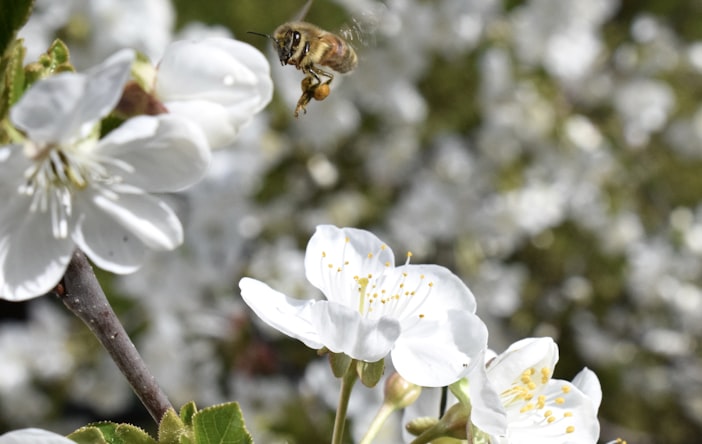
The first pollen of spring is the trigger that shifts a colony from survival mode to growth mode. In much of the eastern and midwestern United States, red maple and elm open first in February or March, producing pollen before the landscape has anything resembling spring color. Pussy willows come in March and April, offering both pollen and nectar - among the most important early sources a colony can find. Then dandelions, from March through May, depending on latitude. The dandelion is one of the most valuable bee plants in North America, which makes its fate in the average lawn particularly ironic. And then the fruit trees: apple, cherry, plum, pear, blooming through April and May - the same blossoms that commercial pollination contracts are written around.
The timing of these blooms relative to the colony's dwindle determines how fast recovery begins. A colony with access to pollen in February starts growing earlier and reaches peak population sooner than a colony where the first pollen doesn't arrive until April. That 6-week head start can be the difference between a colony that's at full strength for the main nectar flow and one that's still building when the flowers open and close.
The Apiary Project has free tools for beekeepers - calculators, schedulers, and seasonal guides.
Browse the Tools →The Exponential Math
Colony population growth during spring buildup is approximately exponential, with a doubling time of roughly three weeks.
The math: a queen laying 1,500 eggs per day produces roughly 10,500 eggs per week. Worker development takes 21 days from egg to emerging adult bee. At steady state, with 1,500 eggs per day and 21 days of development, the colony has approximately 31,500 immature bees in the brood nest at any time, with about 1,500 new adults emerging daily.
But the positive feedback loop is what drives the surge. More bees mean more foragers. More foragers bring in more pollen and nectar. More resources allow the queen to lay more eggs. More eggs produce more bees. The loop runs until the colony hits its ceiling - typically 50,000 to 60,000 bees for a strong colony in a standard Langstroth hive - or until the colony swarms, which is the biological brake on exponential growth.
In May, a strong queen lays 2,000 eggs per day. She weighs about 200 milligrams. An egg weighs about 0.1 milligrams. In the crude arithmetic of it, she's laying close to her entire body weight in eggs daily, fueled by nurse bees producing royal jelly around the clock.
The Brood Nest
The brood nest during spring buildup is a precisely organized structure. The queen works on the central frames, laying in concentric rings that expand outward and onto adjacent frames as available brood area increases.
The arrangement follows a consistent pattern: eggs at the center, surrounded by younger then older larvae, surrounded by capped pupae, surrounded by a band of pollen within easy reach of nurse bees, surrounded by honey at the margins. This concentric arrangement - sometimes called the brood nest sphere - emerges from thousands of individual bees each responding to local conditions. The queen walks to an empty cell near existing brood and lays. Nurse bees cluster on warm comb and feed larvae. Foragers deposit pollen near the brood nest edge where it can be reached. No one is managing the arrangement. It arranges itself.
During the buildup, the brood nest expands from perhaps 2 to 3 frames (the overwintered brood area) to 8 to 10 frames over 6 to 8 weeks. The expansion is limited by laying rate, pollen availability, the colony's ability to thermoregulate the growing area, and the physical space available.
A colony that runs out of space - every frame filled with brood, pollen, and honey, no empty cells for the queen to lay in - enters swarm preparation. The crowding, the reduced circulation of queen pheromone through a packed hive, and the lack of laying space trigger queen cell construction along the frame bottoms. The colony begins preparing to divide.
The Disease Window
Spring buildup is also when brood diseases gain traction. The expanding brood nest provides exactly what brood pathogens need: thousands of developing larvae in warm, humid conditions.
American foulbrood spores that lay dormant in the comb over winter can infect spring larvae. Nosema infection - particularly Nosema ceranae - often peaks in spring, debilitating adult bees during the critical buildup period. Chalkbrood, a fungal disease of larvae, is most common in the cool, damp conditions of early spring when the colony's thermoregulatory capacity is stretched thin across a growing brood area.
Varroa mites begin their own exponential growth alongside the brood expansion. Mites that overwintered on adult bees enter the first brood cells of spring and begin reproducing. A colony that entered winter with a low mite load (because the fall treatment worked) has months before mite populations reach damaging levels. A colony carrying a high mite load into spring finds the brood expansion amplifying the problem rapidly.
The colony's growth rate has to outpace its disease and parasite load. A healthy colony expanding at 2 to 3 percent per day can outgrow moderate disease pressure - new bees emerging faster than the diseases can debilitate them. A weak colony growing at 1 percent per day with a high mite load may never reach critical mass before the window closes.
The Cruelest Month
The cruelest irony of spring beekeeping: colonies that survived the entire winter can starve in March.
The mechanism is almost insulting in its simplicity. The colony emerges from winter with depleted honey stores. Spring buildup is underway - brood rearing demands calories, nurse bees need protein, the brood nest is expanding. The money is going out. But the spring blooms haven't opened yet, or a cold snap has locked the bees in for a week, and nothing is coming in. The colony runs out.
Spring starvation kills more colonies in some years than winter cold does. The colony ran the entire gauntlet - December, January, February - and then miscalculated the gap between what it had left and what it needed for one more week. It's most common during extended cold snaps in March or April, periods of 5 to 10 days when temperatures stay below flying temperature and the colony burns through reserves without the ability to forage. The brood nest is now too large to abandon (the brood would die), so the energy expenditure for heating continues at the spring rate even though no income is flowing.
In northern climates with long, unpredictable springs, this risk window can span 6 to 8 weeks - the transition zone between the colony's winter survival mode and the point where consistent foraging becomes possible.
The Reward
A colony that navigates the spring buildup - survives the dwindle, finds early pollen, outgrows its parasites, doesn't starve in March, doesn't swarm in May - arrives at the main nectar flow in peak condition. 50,000 to 60,000 bees, a queen laying at maximum rate, a brood nest packed with healthy larvae, a foraging force of 15,000 to 20,000 experienced field bees ready to work the bloom.
In a strong nectar flow - basswood, clover, alfalfa, citrus, depending on region - a full-strength colony can bring in 10 to 20 pounds of nectar per day. The house bees process it: adding enzymes, evaporating water, filling and capping cells. A colony that arrives at the main flow at peak population can produce 60 to 100 pounds of surplus honey in a 4 to 6-week flow.
That surplus represents the compound return on everything that went right during the buildup. The early pollen that fueled brood food production. The nurse bees that fed the larvae. The larvae that became foragers. The foragers that found the flow. Each step had to succeed for the surplus to exist.
Spring isn't the beginning of the season. It's the exam for the previous year's preparation - the fall feeding, the mite treatment, the winter configuration. All of it was for this. Ten thousand bees in March becoming fifty thousand by June, powered by pollen and honey and 2,000 eggs a day from a queen who spent all winter waiting for the light to change.
The light changes. The buildup begins. And the beekeeper, standing next to a hive that hums with the sound of exponential growth, watches the population curve bend upward. This is either the year that works or the year that doesn't. The bees are telling you which. They're telling you right now.