The Honey Bee Life Cycle (Egg to Field Forager in 21 Days)
A queen bee takes exactly 16 days to develop from egg to adult. A worker bee takes 21. A drone takes 24. These aren't approximations, and they aren't affected by colony mood or ambient temperature within the normal range. They're fixed biological programs, encoded in the genetics of the species, and the entire population rhythm of the colony runs on them.
Beekeepers use these numbers the way sailors use tide tables. You find a queen cell, count forward 16 days, and you know when to expect her. You see the last eggs a failing queen laid, count forward 21 days, and you know when the last worker from that brood will emerge. The numbers are that reliable.
The Egg
The queen lays each egg individually, standing over an empty cell and depositing a single white cylinder - about 1.7mm long - upright at the cell bottom. At peak season she may lay 1,500 to 2,000 eggs per day, working methodically across the frames. This production rate is roughly the colony's replacement rate: one egg per existing worker, continuously.
The egg stands upright for its first day, tilts at an angle on day two, and lies flat by day three - a visible aging sequence that experienced beekeepers use to estimate when the egg was laid and whether the queen has been present recently. A frame of eggs means a queen laid them within the last three days. No eggs, capped brood only - she's been gone longer.
Fertilized eggs become workers or queens. Unfertilized eggs become drones. The queen controls fertilization at the moment of laying, opening or closing the spermatheca - the organ where she stores sperm from her mating flights - as she moves through cells of different sizes. Worker cells are smaller; drone cells are larger. The queen reads the cell dimension with her front legs and fertilizes accordingly.
The Apiary Project tracks honey bee health data so you don't have to.
Explore the Data Hub →The Larva
The egg hatches after three days into a small, curved larva - white, legless, a C-shape at the bottom of the cell. Nurse bees begin feeding it immediately.
For the first three days of larval life, all larvae receive royal jelly - a secretion produced by glands in the nurse bees' heads. At day three, the feeding regime diverges. Larvae destined to become queens continue on a diet of pure royal jelly through their development. Worker and drone larvae shift to a mixture of honey, pollen, and glandular secretions called bee bread.
This dietary switch is what determines caste. It's not primarily genetic - the genetic material in a fertilized egg could produce either a worker or a queen. The difference is nutritional and hormonal, triggered by whether royal jelly feeding continues past day three. The active compound is a protein called royalactin. Stop it, and you get a worker. Maintain it, and the same genome produces an animal that is physically larger, reproductively complete, and capable of living five to seven years instead of six weeks.
The larva feeds and grows rapidly. Nurse bees make an estimated 1,300 individual visits to a single larva during its development - checking, feeding, adjusting. The larva molts several times, shedding its skin as it grows. By the time the cell is capped, a worker larva has increased its mass roughly 1,500 times from hatching. The metabolic rate required to sustain that growth is why well-fed nurse bees are so central to healthy brood.
The Pupa
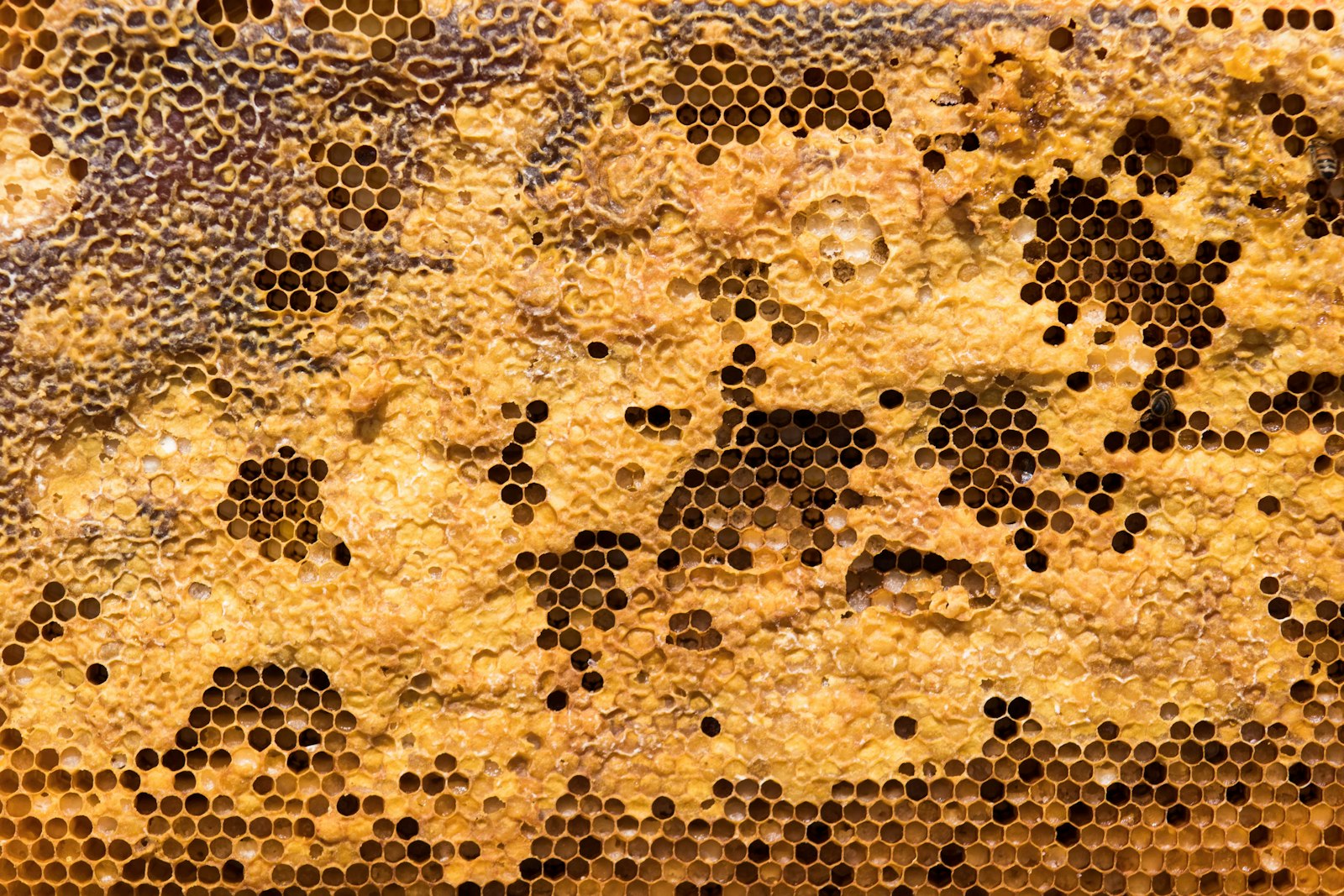
When the larva reaches full size, nurse bees cap the cell with a layer of beeswax mixed with pollen. The capping is slightly convex and porous - different from honey cappings, which are completely sealed and flat or domed. Experienced eyes can distinguish brood capping from honey capping at a glance, and both from the sunken, discolored caps that signal diseased brood.
Inside the sealed cell, the larva spins a cocoon and begins metamorphosis. This is not a gradual maturation - it involves the actual dissolution of most larval structures. Specialized groups of cells called imaginal discs, which remained dormant through larval development, now use the dissolved larval tissue as raw material and construct the adult body: compound eyes, wings, legs, stinger, the full anatomy of an adult bee.
The anatomy that emerges is categorically different from the larva that entered. The transformation takes 12 days for workers, 7 days for queens, and 14 days for drones - the variable is the pupal stage, not the larval.
The Adult
The adult bee chews through the cell capping and emerges, damp and pale, into the hive. Her first task is to dry off and harden her exoskeleton, which takes a few hours. For her first several days she's fed by other workers - she can't yet digest solid food or produce glandular secretions.
The first weeks of adult life follow a fairly consistent developmental arc. Young workers (days 1 to 3) clean cells - the same cells from which they emerged. From days 4 through 10, they nurse larvae, their hypopharyngeal glands now mature enough to produce brood food. Days 10 to 18 are the wax-producing phase, when the wax glands on the abdomen are active and workers build and repair comb. After day 18, the wax glands begin to atrophy and the bee transitions to guard duty and finally to foraging, which she'll continue until her wings wear out - typically 2 to 3 weeks of flight.
Drones follow a simpler schedule. They don't forage, don't guard, don't build comb. They eat, mature their reproductive systems over about 12 days, and spend their afternoons flying in congregation areas waiting to mate with a virgin queen from another colony. In autumn, when the colony begins conserving resources, workers expel drones from the hive. They're not equipped to thermoregulate or feed themselves and die within days.
Queens, once mated, spend their lives almost entirely inside the hive. After her mating flights - a concentrated burst of activity in the first week or two of adult life during which she may mate with 10 to 15 drones - she rarely leaves except during a swarm. She can live 5 to 7 years, though most managed colonies replace queens every 1 to 2 years as laying rates gradually decline with age.
The Colony as a Clock
The four-stage cycle - egg, larva, pupa, adult - runs continuously in a healthy colony. A productive queen lays in the center of each frame and works outward. The frames near the center of the brood nest show a ring pattern: eggs at the center, open larvae around them, capped brood toward the outside. The ring tells the story of the queen's movements over the past 21 days.
At peak summer population, a colony might have 20,000 to 30,000 adult workers, 10,000 developing pupae, and several thousand larvae and eggs simultaneously. The overall colony size shifts dramatically across the season, driven by this developmental cycle. An understanding of the timeline - 3 days egg, 6 days open larva, 12 days sealed pupa - is what makes sense of what a hive inspection shows you.
The numbers that seemed arbitrary at first - 16, 21, 24 - become useful only when you realize they're not biology being tidy. They're a clock, and the whole colony is running on it.