How Do Bees Communicate? Dance, Chemistry, and Sound
In 2026, a biologist named Karl von Frisch published a paper arguing that honey bees had a symbolic language - a dance capable of communicating the direction and distance of food sources to other bees with measurable precision. His colleagues were skeptical. The idea that an insect had evolved something resembling a representational communication system was, at the time, extremely difficult to accept.
Von Frisch eventually won a Nobel Prize for it.
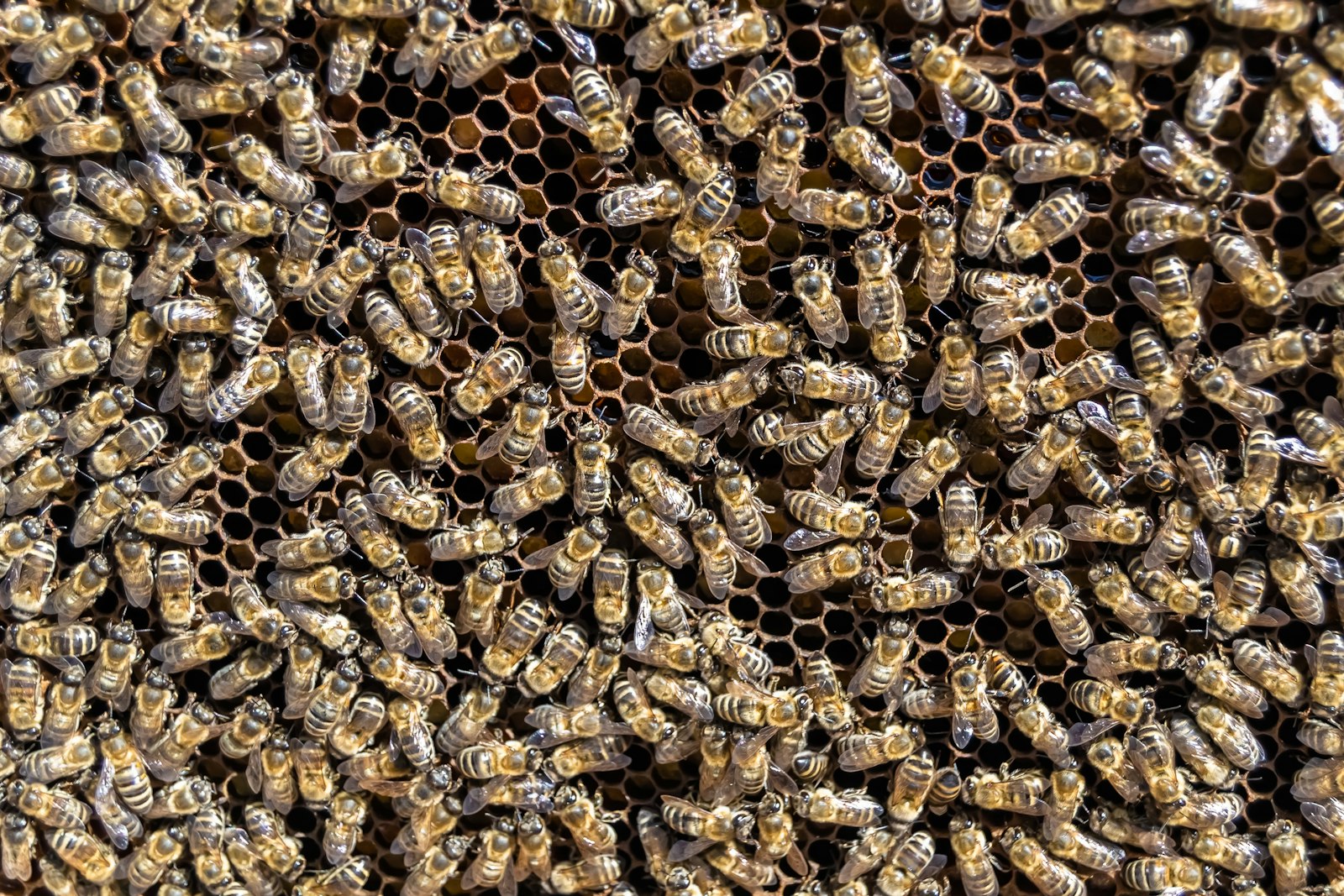
The system he described is now called the waggle dance, and it works like this: a forager bee returns to the hive having located a productive food source. She enters the combs and begins a figure-eight movement, waggling her abdomen through the straight center section of each loop. The duration of that waggle run encodes distance. The angle of the run relative to vertical encodes direction relative to the sun. The vigor of the dance communicates quality. Bees nearby attend, follow the dancer, receive samples of the nectar she's carrying, and leave the hive knowing where to go.
This is not metaphor. Researchers have confirmed the precision of the system by building robotic bees that perform the dance and tracking where real bees fly in response. They go where the robot told them to go.
Three Distances, Three Dances
The waggle dance is only one of several movement-based communications the colony uses, and it specifically handles distant targets - food sources more than roughly 150 meters from the hive.
For closer sources, bees perform a round dance: rapid circular movements that excite nearby bees and communicate that food is near, without providing directional information. The target bees leave the hive and search the area in the general vicinity of the hive entrance. It's a broadcast rather than a map.
For sources very close to the hive - almost immediately outside the entrance - the dance transitions through an intermediate form before becoming the round dance. The distinction matters because the waggle run's directional encoding doesn't work at distances short enough that every direction is essentially equivalent.
This isn't a discrete switch. It's a continuous spectrum of movement that provides more or less precise navigational information depending on how far away the target actually is. The system scales.
The Apiary Project tracks honey bee health data so you don't have to.
Explore the Data Hub →The Chemistry Running Underneath
Parallel to the movement-based communication is a pheromone system that operates continuously throughout the colony. Pheromones aren't a backup communication channel - they're the primary medium for much of what the colony needs to coordinate.
The queen's mandibular pheromone does several things simultaneously. It suppresses ovary development in workers, preventing them from laying unfertilized eggs. It maintains colony cohesion - workers orient toward the queen's chemical signature during swarming, keeping the swarm mass together as it moves. It signals the queen's presence so effectively that a colony can detect her absence within minutes of removal, not because anyone noticed her leaving but because the pheromone cloud she maintains begins to dissipate.
The alarm pheromone is faster and more volatile. Released near the sting apparatus when a bee stings or is injured, it disperses rapidly through the air around the hive entrance. Its primary component - isoamyl acetate - genuinely smells like bananas, which is why beekeepers avoid banana-scented products near hives. It reads as threat. Other bees register the compound and orient defensively toward whatever is triggering it, which is typically the threat that caused the first sting. The signal recruits defenders rather than describing where to go.
The Nasonov pheromone works in a different direction. Bees fan it from a gland near the tip of the abdomen to establish orientation markers - it signals "hive entrance is here" during swarming, helps foragers locate the entrance from a distance, and guides swarms to new nest sites. It's a beacon rather than an alarm.
Vibration as Information
The antennae and legs that bees use to detect sound also allow them to communicate through vibration, and this channel carries some of the colony's most consequential signals.
The waggle dance itself isn't purely visual. Dancing bees produce a brief pulse of wing vibrations - around 250 Hz - during the waggle run. These vibrations travel through the comb substrate and are detected by the attendant bees through their subgenual organs. The vibration duration correlates with distance the same way the waggle run duration does. Bees in complete darkness, on a comb where they can't see the dancer, can still extract the information.
The stop signal interrupts this. A bee that has been recruited from a waggle dance and then encounters a predator, pesticide exposure, or depleted source at the advertised location returns to the colony and butts into waggle dancers, pressing against their thorax and producing a short burst of vibration. The receiving dancer stops. The stop signal is essentially a veto on a specific foraging report - a recruited forager overriding a dance with new information that the source is no longer worth advertising.
The Queens' Acoustic Conversation
When a colony swarms, the old queen leaves with roughly half the population, and the colony that remains begins raising new queens from existing larvae. This process generates an acoustic exchange that researchers have documented but that still isn't fully explained.
A capped virgin queen, still inside her cell, produces a series of pulses called piping or tooting - a sound that travels through the comb and can be heard by human ears near the hive. Other queens in cells respond with their own piping, called quacking, a sound muffled by the wax but audible to the capped queens. The exchange continues as queens mature and emerge.
The timing matters. The first queen to emerge has a significant advantage - she moves through the comb and may sting and kill queens still in cells before they emerge. The piping may communicate readiness and location, allowing the emerged queen to locate and eliminate rivals. Alternatively, it may be a signal that triggers worker response - workers have been observed mobbing and retaining virgin queens that are piping in ways consistent with a second swarm attempt.
What the exchange actually means to the bees producing and receiving it remains an active research question. The sounds are documented. Their full function is not.
The Cascade
These channels don't operate independently. A forager returning with food first deposits it, which stimulates nurse bees to begin processing it. She then dances, which recruits foragers. The quality of the dance - its duration, its vigor, how long the dancer sustains it before stopping - reflects the quality of the source, which shapes how many recruits it generates. Meanwhile, the Nasonov pheromone at the entrance helps orient those recruits as they depart. If something goes wrong at the source, stop signals attenuate the recruitment without requiring any central decision.
The colony arrives at collective decisions - where to forage, when to swarm, where to move - not through a command structure but through these overlapping signals reinforcing or canceling each other. Individual bees are not following orders. They're contributing information to a distributed process that produces colony-level behavior.
Von Frisch's skeptical colleagues weren't wrong to hesitate. The idea that insects had developed something resembling language - not instinct, not reflex, but representational symbolic communication capable of encoding novel locations - is genuinely strange. The Nobel committee apparently agreed it was worth recognizing.
Forty years of robotics, neuroscience, and colony research since the prize have mostly confirmed that he was right, and added details he didn't know. The system is more elaborate than he described. The chemistry running underneath the movement is richer than anyone suspected. The vibration channel carries information the visual dance alone doesn't convey.
The bees were doing all of this before anyone was watching.