What Actually Separates Bees and Wasps
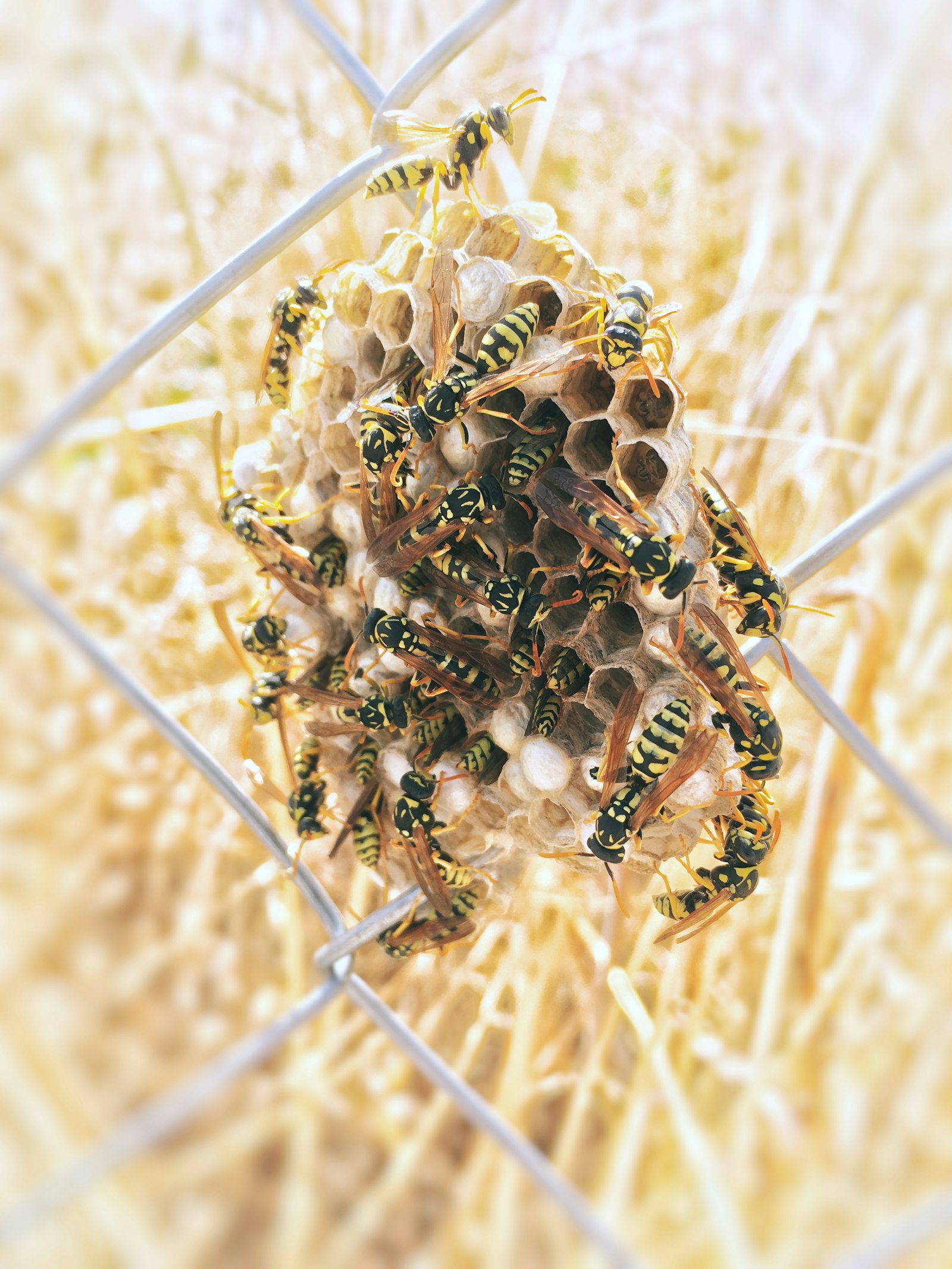
The wasp landing on your lunch is not a bee having a bad day. It's a different animal operating on completely different priorities, with different biology, different social structure, and a different relationship to the food you're trying to eat.
People confuse them constantly. The confusion makes some intuitive sense - they're both stinging insects with yellow markings, they both show up uninvited, and they both produce that specific ambient anxiety. But the similarities are mostly superficial. Bees and wasps diverged from a common ancestor somewhere around 130 million years ago, and they've spent that time solving very different ecological problems in very different ways.
The Body Tells You Immediately
Start with the body, because the visual differences are actually quite clear once you know what to look for.
Bees are fuzzy. Not metaphorically - they have branched, feather-like hairs covering significant portions of their bodies, especially on the thorax and abdomen. These hairs aren't just texture. They're specialized pollen-collection structures. The branches catch and hold pollen grains electrostatically, allowing a bee to carry substantial pollen loads back to the hive. Bees are, in their fundamental physical form, mobile pollen transport systems.
Wasps are smooth. Their bodies have a hard, almost waxy look - sleek and largely hairless except for some bristles. This isn't a minor cosmetic difference. It reflects a completely different relationship to plants. Wasps don't collect pollen. They don't need pollen transport structures. They're predators and scavengers who occasionally visit flowers for nectar, but their bodies were never shaped by the evolutionary pressures of plant pollination.
The waist tells the story most bluntly. Bees have a relatively gradual transition between the thorax and abdomen. Wasps have an extreme constriction - the "waist" of a yellow jacket is almost wire-thin, making the abdomen look like it was attached as an afterthought. This morphology shows up in cartoons because it's real and visually distinctive.
The Apiary Project makes the case for evidence-based pollinator conservation.
See How to Take Action →What They Actually Eat
Bees are vegetarians. Obligate ones. Adult bees consume nectar (carbohydrates) and pollen (protein), and feed pollen-derived provisions to their larvae. The entire life cycle is built around plant resources. This is not dietary preference - it's deep evolutionary constraint. Bee larvae require specific amino acid profiles that only pollen provides.
Wasps are not vegetarians. Most species are predatory or parasitic in their larval stage, meaning wasp larvae are fed other insects or spiders. Adult wasps often feed on nectar and sugary materials - which is why yellow jackets swarm your soda can in late summer - but they're feeding themselves, not their young. The larvae get protein from other animals.
This difference explains late-summer wasp behavior precisely. As the season progresses and wasp colonies decline, the workers lose their primary function (feeding larvae) and their queen's chemical control over their behavior begins to wane. They become foragers without a purpose, increasingly focused on finding carbohydrates. Your open soda, your fruit, your barbecue - these become resources in a way they weren't earlier in the season when the colony was functioning normally. The wasp isn't being aggressive. It's just increasingly desperate and increasingly confused.
Social Structure - Which Is More Complicated Than You'd Think
Most bee species are actually solitary. This surprises people who picture honeybees as the default bee, but roughly 90 percent of the approximately 20,000 described bee species worldwide are solitary - single females build and provision their own nests, lay eggs, and die without any cooperative social structure whatsoever.
Among the social species, the honeybee represents an extreme end of sociality - colonies of 40,000 to 80,000 individuals with a highly organized caste system, sophisticated communication, and a perennial structure that survives winter without disbanding. Most social bees, including bumblebees, have much smaller colonies and annual cycles where only mated queens overwinter. Bumblebee population declines are tracked separately from honeybee declines precisely because the species operate so differently.
Wasps show similar diversity. Paper wasps (Polistes species) have relatively small colonies and social structures considerably less rigid than honeybees. Yellow jackets (Vespula and Dolichovespula species) have larger colonies and more complex organization. Most wasp species are also solitary - the solitary hunting wasps, mud daubers, cicada killers, and spider wasps are among the most ecologically important predators of other arthropods in many landscapes.
Stinging: Why They're Different Situations
Honeybee workers have barbed stings that catch in mammalian skin. When a honeybee stings a person, the stinger - attached to the venom sac and some of the bee's abdomen - tears free. The bee dies. The venom sac continues pumping venom for up to a minute after separation, which is why removing a honeybee stinger by scraping rather than squeezing matters.
The barbed sting is an evolutionary adaptation for defending against large mammals. The barb catches in tough skin and the mechanism ensures venom delivery even after the bee is removed. Against other insects, the sting works fine without the barb - it's specifically shaped for large-mammal defense. A honeybee stinging you is, from the bee's perspective, a suicide mission. The colony calculates that your departure is worth the sacrifice.
Wasps don't have this problem. Their stings are smooth. They can sting repeatedly without any self-harm. A disturbed yellow jacket colony can deliver multiple stings from multiple individuals, and each individual can sting multiple times. This is why disturbed wasp nests produce a qualitatively different defensive response than disturbed bee colonies.
Most solitary bee and wasp species can sting but rarely do. A solitary bee has no colony to defend - she has only her nest, and her defensive behavior reflects that much lower collective stake.
Ecological Role
Bees are the primary pollinators for the majority of flowering plants on Earth. The relationship between bees and flowering plants is roughly 130 million years old and has driven the evolution of both groups - flower morphology has co-evolved with bee sensory systems, and bee foraging behavior has shaped plant reproductive strategies. The economic value of honeybee pollination to US agriculture alone is estimated in the billions of dollars annually, and that figure doesn't capture wild bee contributions.
Wasps are important predators and, in some plant communities, significant pollinators. The fig tree is entirely dependent on fig wasps (Agaonidae family) for pollination - a relationship so old and co-evolved that each fig species has its own specific wasp species. Without that wasp, the fig doesn't reproduce. Some orchid species are pollinated almost exclusively by specific wasp species. But wasps' primary ecological role in most temperate environments is predation - controlling populations of caterpillars, aphids, flies, and countless other insects.
Both groups are declining in many regions, though for different reasons and at different rates. The factors affecting honeybees - Varroa mites, colony collapse, pesticide exposure - don't apply to wasps in the same ways. Habitat fragmentation affects solitary bees differently than social ones. But the broad pattern of insect decline is affecting both groups across the board.
Why the Confusion Persists
"Bee" and "wasp" aren't precise biological categories with clear boundaries - they're informal groupings within the order Hymenoptera. Some groups blur the lines in ways that make the labels feel arbitrary. Paper wasps are technically wasps but will occasionally be seen at flowers and show some superficially bee-like behaviors.
In recent years, the yellow-legged hornet's spread into the southeastern United States has added another stinging insect to the public's awareness - one that looks like neither a typical bee nor a typical wasp to most people, which hasn't helped the general level of identification confidence.
What actually matters for practical purposes: if the insect has dense, feathery body hair and is visibly carrying pollen, it's a bee. If it's smooth, slender-waisted, and interested in your lunch meat, it's almost certainly a wasp. The implications for why it's near you are rather different.