Can Bees Smell? The Most Sensitive Nose in Nature
In 2026, researchers at the Los Alamos National Laboratory published a paper describing bees trained to detect landmines. The protocol was simple: associate the smell of explosives with sugar water, and the bees' proboscises extend automatically toward anything that smells like a meal. Within ten minutes of training, bees were reliably indicating buried TNT with their tongues.
This is not a trick. It is a demonstration of what a bee's sense of smell actually is.
A honey bee has 170 different odorant receptor types located primarily on its antennae. A dog, the animal we reflexively compare to anything smell-related, has around 800. By that number, the bee looks unimpressive. But the comparison is misleading. Dogs evolved to smell a broad world of mammals, meat, territory, and threat. Bees evolved to smell a world made almost entirely of chemistry - flowers signaling nectar availability through volatile compounds, nestmates communicating through pheromones, brood sending chemical signals about their developmental needs. The bee doesn't need more receptor types. It needs extraordinary sensitivity within the channels it has.
That sensitivity clocks in at roughly 100 times greater than a human's for the compounds bees specifically care about.
What the Antennae Are Actually Doing
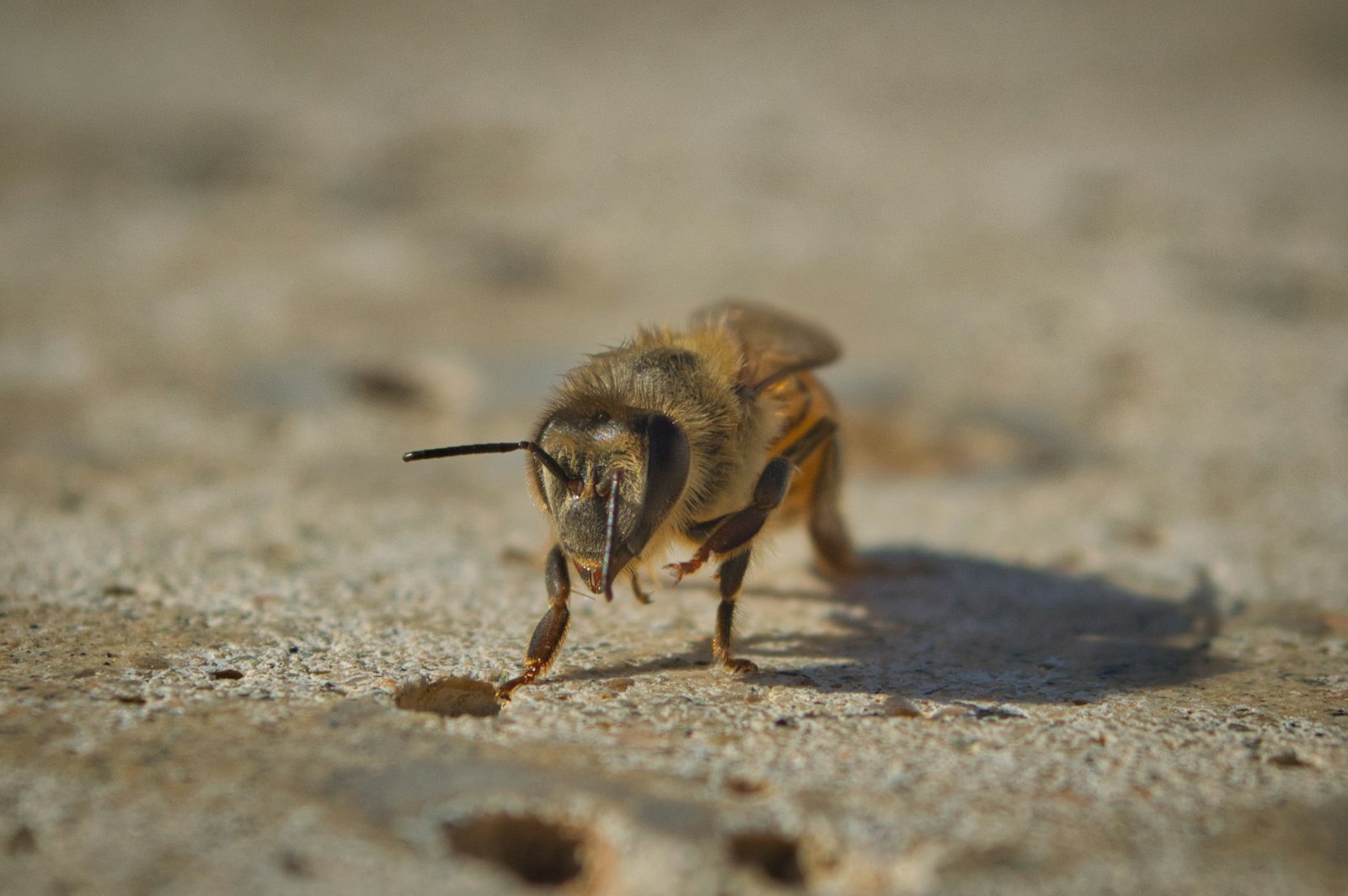
The antennae are not just smell organs. They're combined smell-touch-taste-humidity sensors with a flexibility that lets the bee continuously sample the air around it as it flies. Each antenna contains thousands of sensilla - tiny hair-like structures that come in multiple types, each tuned to different molecular signals.
Some sensilla detect floral volatiles: the specific cocktail of aromatic compounds each flower species releases to attract pollinators. These signals change throughout the day as nectar availability changes, and bees track those fluctuations in real time. A flower that was worth visiting at 10 AM may have depleted its nectar by noon, and its chemical signal shifts accordingly.
Other sensilla detect pheromones - the chemical language the colony uses to run itself. The alarm pheromone released near the stinger (which genuinely smells like bananas - isoamyl acetate is a key component) travels from bee to bee within seconds, recruiting defenders to the threat location. The queen's mandibular pheromone suppresses ovary development in workers, maintains colony cohesion, and signals her presence so efficiently that a colony can detect a missing queen within minutes of her removal. Nurse bees use brood pheromones to assess larval age and nutritional needs, adjusting feeding accordingly.
The colony is, at its core, a chemical conversation. The antennae are how everyone listens.
The Apiary Project tracks honey bee health data so you don't have to.
Explore the Data Hub →Learning and Remembering Smells
A bee's olfactory memory is not a fixed library. It learns.
When a forager first discovers a productive flower patch, she returns to the hive carrying not just nectar but the volatile compounds from those flowers on her body. Other workers learn the target scent through close contact during the waggle dance and nearby interactions. They leave the hive pre-primed to recognize the scent that proved worth finding.
This is the mechanism behind the Los Alamos landmine research. Bees learn to associate any smell with a food reward within minutes of training, and that association is stable. Researchers have also trained bees to detect tuberculosis, certain cancers, and specific agricultural pathogens by the same method - present the target compound, reward with sugar water, repeat a handful of times.
The bee isn't understanding what it's detecting. It's doing what it evolved to do: find the smell that signals food. But the precision of that finding, applied to molecules humans can barely register, is what makes it useful.
The Hive's Collective Nose
The hive entrance has a scent profile that's unique to each colony - a blend of the queen's pheromones, the brood's chemical signals, the forage the colony has been visiting, and a colony-specific mix that workers use to identify nestmates. Guards at the entrance assess incoming bees by this olfactory fingerprint. Bees from other colonies, or bees that have been away long enough that their scent profile has drifted, may be challenged or rejected.
This system isn't foolproof. Beekeepers exploit it routinely - moving frames between colonies works partly because larvae and capped brood carry their own chemical signals that suppress aggression. But the baseline sensitivity of the guard bees' assessment is high enough that a foreign bee presenting the wrong chemical signature will often be recognized and rejected before it crosses the threshold.
What Bees Can't Smell
The olfactory system is calibrated for the bee's world, which means it has gaps. Bees are relatively poor at detecting odors that have no relevance to their biology. Many pesticides have no smell that bees can detect, which is part of what makes certain agricultural chemicals particularly dangerous - the bees can't register the threat before it's too late.
Human body odor is something bees detect but don't respond to strongly under normal circumstances. The alarm pheromone's resemblance to banana smell is why beekeepers avoid banana-scented products near hives - it reads as threat, not food. But most of what humans smell like is irrelevant noise to a bee's sensory system.
Dark colors, on the other hand - those bees do respond to. Not through smell, but through vision. The olfactory system and the visual system work together. A dark shape combined with alarm pheromone creates a target. The smell tells the bee that something is wrong. The visual system points it at what to defend against.
So yes: bees smell. They smell with extraordinary precision in the chemical channels that matter to them, they learn new scent associations within minutes, and they run their entire social structure on chemical signals that their antennae continuously read and process.
The landmine research didn't make bees into something they weren't. It just borrowed an instrument that evolution had already built to a specification that turns out to be more versatile than anyone expected.