How Long Queen Bees Live - And What Cuts That Short
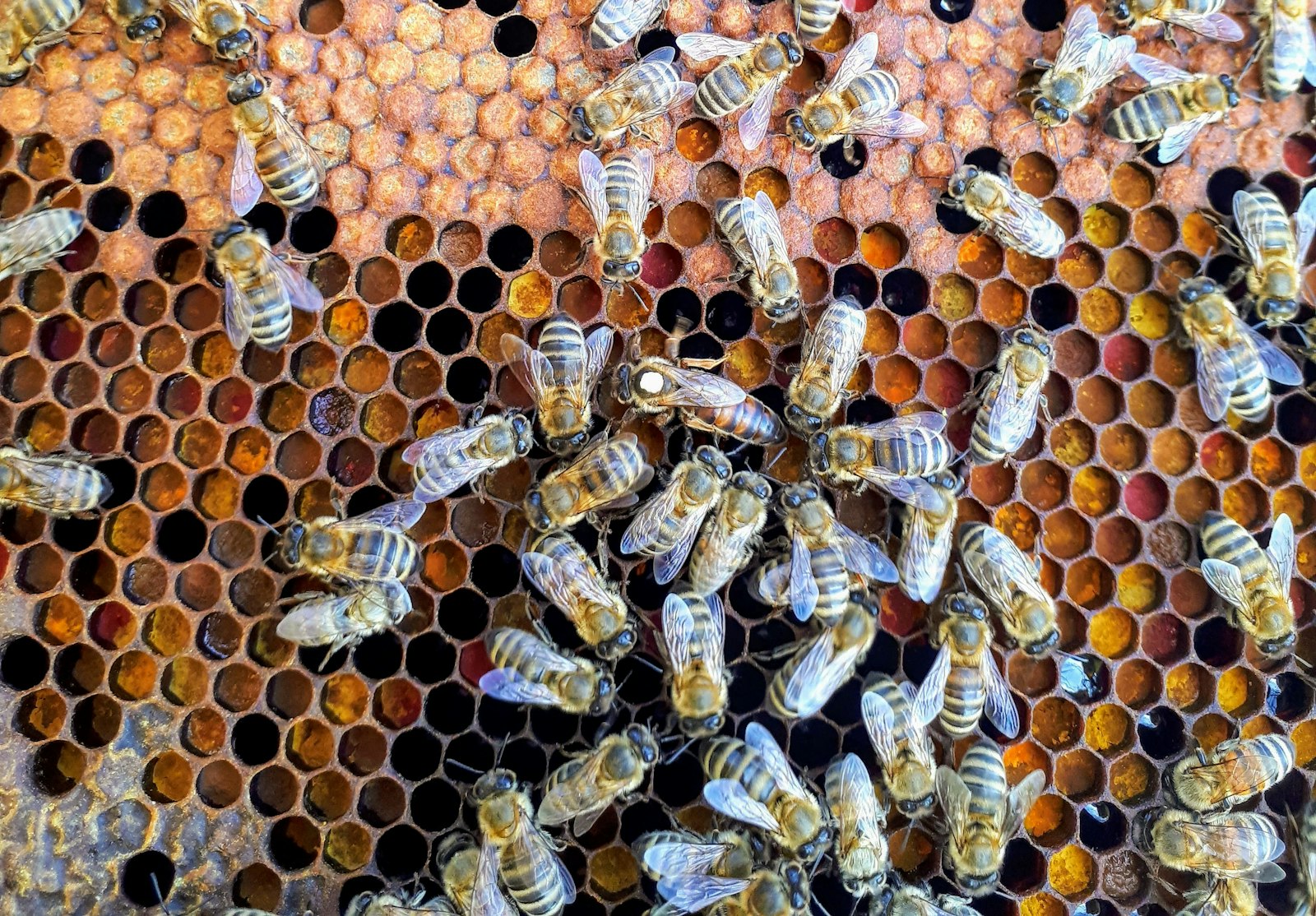
A worker bee born at the height of summer lives for approximately six weeks. She will spend roughly three of those weeks doing in-hive work - caring for brood, building comb, processing nectar - and the remaining three foraging, flying two to five miles per day until her wings wear out. Then she dies.
Her mother, the queen, will live two to five years. Potentially longer.
The difference isn't random variation. It's the most dramatic example of developmental plasticity in the insect world: two genetically identical bees, raised on different diets in different larval environments, developing into adults with lifespans that differ by a factor of twenty or more.
The Same Egg, Different Outcomes
Queens and workers develop from identical fertilized eggs. The egg laid in a queen cell is not genetically different from the egg laid in a worker cell. What changes is what happens to the larva after hatching.
Worker larvae are fed a diet that transitions: royal jelly (a protein-rich secretion from nurse bees' hypopharyngeal glands) for the first three days, then a mix of royal jelly, pollen, and honey through the remainder of larval development. Queen larvae are fed royal jelly exclusively and in much greater quantities throughout their entire larval development. This dietary difference triggers a cascade of developmental changes that produce a fundamentally different organism from the same genetic starting material.
The queen's reproductive system develops fully - she can lay up to 1,500 to 2,000 eggs per day at peak. Her worker counterparts have vestigial reproductive systems that remain dormant under normal conditions. Her body grows larger. Her life expectancy extends dramatically. The dietary switch doesn't just change her role; it changes almost everything about her biology.
The mechanism involves insulin signaling pathways and the activity of genes related to aging. Researchers have shown that blocking certain insulin-signaling pathways in workers can extend worker lifespan, suggesting that the queen's longevity isn't purely about royal jelly consumption but about the downstream effects of that consumption on gene expression and metabolic pathways. Compared to the six-week summer lifespan of a worker, the queen's biology operates on an entirely different clock.
The Apiary Project tracks every major threat to US honey bee colonies.
Explore the Issues Hub →The Productive Lifespan
Two to five years is the biologically possible range for queen longevity. In practice, the question that matters for colony performance is the productive lifespan - how long she maintains peak egg-laying capacity.
A newly mated queen typically reaches peak egg-laying by her first spring. The first two years of a queen's life are generally her most productive - laying rates are high, the spermatheca (where she stores sperm from her mating flights) still contains sufficient sperm for fertilizing eggs reliably, and her pheromone production is strong enough to maintain colony cohesion.
After two to three years, productivity tends to decline. The spermatheca depletes. She begins producing more unfertilized eggs, which develop into drones rather than workers. Her pheromone profile changes in ways the colony detects well before any beekeeper would notice. The workers respond - they may begin raising supersedure queens, replacement queens built while the old queen is still present and functioning.
Supersedure vs. Emergency Replacement
Colonies replace their queens in two main ways, and the distinction matters considerably.
Emergency replacement happens when a queen dies or disappears suddenly. The colony has no viable replacement at hand. Workers select young worker larvae - within the first three days of hatching, while the dietary switch can still trigger queen development - and build emergency queen cells around them, transitioning those larvae to a royal jelly-exclusive diet. Emergency queens are functional but are generally considered slightly lower quality than planned replacements, having been selected from whatever larvae happened to be the right age at the wrong moment.
Supersedure is the planned replacement of a failing queen. The colony raises replacement queens while the old queen is still present. The old queen sometimes continues laying even after a new queen has hatched and mated. Eventually the old queen disappears, usually without any dramatic event observable to the beekeeper. The colony transitions seamlessly. This is the colony managing its own succession - and it does it with considerably more sophistication than most beekeepers give it credit for.
What Beekeepers Do
Commercial beekeeping operations typically don't let queens live their full natural lifespan. The standard practice is annual or biennial requeening - replacing the queen every one to two years, before productivity declines significantly.
The economics drive this directly. A colony with a two-year-old queen producing at 80 percent of her peak rate will produce less honey and may show higher susceptibility to colony health problems than a colony with a new queen. The cost of purchasing a replacement queen (typically $25 to $45 for a commercially produced mated queen) is low relative to the production differential over a full season.
Replacement queens in the commercial market are primarily produced in California, Hawaii, and the Pacific Northwest, where climate allows year-round or extended-season queen production. The specific genetics of commercially available queens have shifted substantially over the past two decades, with increasing selection pressure for Varroa-sensitive hygiene (VSH) traits - behavioral characteristics that help colonies manage Varroa mite infestations more effectively. Whether this genetic selection has affected queen longevity in ways not yet fully documented remains an active area of research.
The Extremes
Queen longevity varies considerably more than the standard two to five year figure suggests.
In favorable conditions with good genetics and low disease pressure, queens have been documented laying productively for six or more years. These are outliers but they exist and beekeepers encounter them occasionally - a colony that just never seems to need requeening, still going strong in year four.
At the other extreme, queens can fail within months of installation. Failing queens - a category that encompasses queens that lay poorly, lay too many drones, have poor pheromone profiles, or simply stop laying - are one of the leading causes of colony loss in managed beekeeping. A colony with a failed queen that doesn't successfully requeen itself will dwindle and die regardless of how strong it was at peak population.
The colony loss statistics documented by the Bee Informed Partnership and USDA consistently identify queen failure as a primary contributing factor to overwinter losses - not the only factor, but a central one that often interacts with Varroa mite pressure and nutritional stress to accelerate a colony's decline. A queen that's struggling to lay may also be less able to produce the pheromones that suppress Varroa reproductive success, compounding the problem in ways that can be hard to untangle after the fact.
The queen's lifespan is, in this sense, less a fixed biological parameter and more an outcome - the result of genetics, nutrition, disease load, and the colony's own ongoing assessment of whether she's doing her job well enough to keep.