Why Honey Crystallizes (And Why Throwing It Away Is a Mistake)
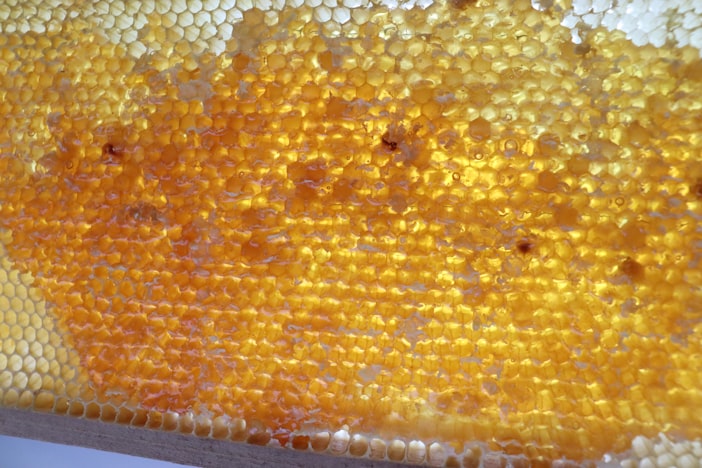
Every jar of honey on every shelf in every store is in the process of turning solid. Some are doing it fast. Some are doing it slowly. A few have been engineered - through heat, filtration, or chemistry - to delay the process for months or years. But the thermodynamics are universal: honey is a supersaturated sugar solution, and supersaturated solutions do not want to stay that way.
The process is called crystallization, and it's the single most misunderstood thing about honey. Consumers return crystallized jars to stores. Grocery chains demand liquid consistency. An entire industrial filtration apparatus exists to prevent it. And the whole time, the honey is just doing what physics says it should have done from the moment it left the comb.
The Supersaturation Problem
Honey is roughly 70 percent sugars - primarily glucose and fructose - dissolved in about 17 to 20 percent water. At room temperature, that's more sugar than the water can stably hold in solution. The mixture is supersaturated: temporarily liquid, but thermodynamically unstable. Given time, the excess glucose precipitates out as glucose monohydrate crystals - the stable crystalline form of glucose under ambient conditions, incorporating one water molecule per glucose molecule.
That incorporated water molecule is a detail that changes things. Crystallized honey is technically drier than liquid honey from the same jar. The crystallization process itself removes free water from the solution, locking it into the crystal lattice. The honey hasn't gone bad. It's gotten drier and more concentrated.
Two ratios predict how fast any given honey will crystallize. The glucose-to-water ratio - G/W - is the primary predictor. Below 1.7, crystallization is slow. Between 1.7 and 2.0, moderate. Above 2.0, fast and thorough. The fructose-to-glucose ratio - F/G - is the secondary predictor. Below 1.11, the honey crystallizes quickly. Above 1.33, it stays liquid for extended periods. Both ratios are determined entirely by the floral source the bees visited, which means crystallization behavior is programmed into the honey before the beekeeper ever opens the hive.
Canola honey has an F/G ratio of approximately 1.00 and a G/W ratio exceeding 2.2. It crystallizes so fast - weeks, sometimes - that it can solidify inside the comb before the beekeeper extracts it. The bees sealed it as liquid. By the time someone gets to it, it's solid. There is no intervention window.
At the other extreme sits tupelo honey, with an F/G ratio of approximately 1.50. The fructose dominance is so extreme that there isn't enough free glucose to form crystal lattices. Tupelo honey essentially never crystallizes. It sits on a shelf for years and stays liquid. Not because it's been processed. Because of the sugar ratios in the flower nectar the bees collected from a specific tree that grows in a specific swamp in a specific part of the Florida panhandle.
The Apiary Project tracks honey bee health data so you don't have to.
Explore the Data Hub →The Pollen Paradox
Crystallization doesn't happen in a vacuum. Glucose molecules need something to organize around - a nucleation site, a microscopic surface where the first crystals can form. Once the initial crystal exists, more glucose molecules attach to it, and the process cascades.
The nucleation sites in honey are the very particles that make it interesting: pollen grains, beeswax fragments, air bubbles trapped during extraction, and pre-existing glucose microcrystals. These particles - each one 10 to 100 micrometers in diameter, invisible to the naked eye - lower the surface energy barrier for crystal formation. They're the trigger. Without them, crystallization still happens, but much more slowly.
This is where the science of honey meets the economics of honey.
If you remove the pollen, you remove the primary nucleation sites. Honey with zero pollen stays liquid longer. It looks clear and golden on a shelf. It doesn't develop the cloudy, granular appearance that makes consumers think something is wrong. From a retail perspective, pollen-free honey is a better product.
From every other perspective, it's a problem. Pollen is the botanical fingerprint of honey - the only reliable way to determine where it came from, what flowers the bees visited, and which country it was produced in. Remove the pollen and you remove the forensic evidence. The World Health Organization, the European Commission, and dozens of other bodies have ruled that without pollen, there's no way to verify geographic origin.
In 2011, reporter Andrew Schneider and melissopalynologist Vaughn Bryant of Texas A&M tested more than 60 jars of honey from stores across 10 states and Washington, DC. The results: 76 percent of grocery store honey - Safeway, Kroger, Harris Teeter, A&P, Stop & Shop - contained zero pollen. Seventy-seven percent of big-box store honey: zero pollen. One hundred percent of drugstore honey - Walgreens, Rite-Aid, CVS - zero pollen. One hundred percent of individual-serving packets - Smucker, McDonald's, KFC - zero pollen.
The process that achieves this is ultrafiltration: honey is heated, sometimes diluted with water, forced at high pressure through filters operating at the molecular level, then dehydrated back. The FDA stated that ultrafiltered product no longer containing pollen "isn't honey." But no federal standard of identity for honey exists - the FDA denied a petition to establish one in October 2011 - and the FDA isn't testing honey on shelves to enforce its own statement.
Ultrafiltration serves no purpose that standard filtration can't achieve - except erasing geographic origin. And the reason geographic origin matters involves $180 million and a federal investigation.
Operation Honeygate
In 2001, the United States imposed anti-dumping duties on Chinese honey: up to 221 percent of declared value, later converted to $2.63 per net kilogram. The duties existed because Chinese honey was being sold in the US below production cost, undercutting American beekeepers who couldn't compete with subsidized imports.
The response was not compliance. The response was the largest food fraud case in US history.
Chinese honey was rerouted through India, Vietnam, Malaysia, Thailand, Indonesia, Taiwan, the Philippines, Mongolia, and Russia. Pollen was ultrafiltered out to prevent origin tracing. The import data showed honey flowing from countries that didn't produce anything close to the volumes they were exporting. The numbers didn't add up. Eventually, someone noticed.
Operation Honeygate, launched in 2008 by US Immigration and Customs Enforcement, took five years to unravel. Twenty-seven people were charged. Groeb Farms in Michigan and Honey Solutions in Texas entered deferred prosecution agreements. Jun Yang received a three-year sentence for 778 container loads and $37.9 million in evaded duties. The estimated total: $180 million in evaded tariffs. HSI Chicago seized roughly 60 tons of illegal honey.
The penalties: Groeb Farms paid $2 million. Honey Solutions paid $1 million. On $180 million in fraud. The contaminated product tested positive for harmful antibiotics, lead, and agricultural chemicals banned in US food production.
And the pollen had been filtered out. That's the connection. The same process that keeps grocery store honey looking liquid and golden - removing the nucleation sites that would trigger crystallization - is the same process that removes the evidence that would identify laundered Chinese honey. The crystallization solution and the fraud mechanism are the same technology.
Honey is the third most faked food in the world. In 2022, the US imposed new anti-dumping duties on Argentina, Brazil, India, and Vietnam - four countries representing 80 percent of US honey imports. In 2023, European Commission testing found 46 percent of sampled honey suspected of dilution with sugar syrups. In 2025, the World Beekeeping Awards in Copenhagen canceled their honey competition because organizers couldn't guarantee that submitted samples would be actual honey.
The world's most prestigious honey contest couldn't trust its own entries.
The Dyce Method: Using Crystallization to Solve Crystallization
While one part of the honey industry was trying to prevent crystallization, a professor at Cornell University in the 1930s decided to embrace it.
Elton James Dyce had a problem. Honey left to its own devices crystallized into large, gritty crystals that felt unpleasant on the tongue. Heated honey stayed liquid but lost its body and became too runny to spread. There was no middle ground between grit and syrup.
Dyce's solution, patented on January 15, 1935 - US Patent 1,987,893, "Honey Process and Product," assigned to Cornell University - was elegant in the way that the best engineering solutions are: he used the enemy as the tool.
The process: heat honey to 150 degrees Fahrenheit for 15 minutes to destroy wild yeast and dissolve existing crystals. Strain twice. Cool rapidly to 60 to 75 degrees. Then add seed crystals - finely ground, already-crystallized honey - at 5 to 10 percent of volume.
The seed crystals provide millions of microscopic nucleation sites, all with the same fine crystal structure. New glucose molecules attach to these tiny existing crystals rather than forming their own random large ones. The result is uniform, microscopic crystals that feel smooth and creamy on the tongue - not the gritty boulders that uncontrolled crystallization produces.
The creaming completes in two to three days at 55 to 70 degrees Fahrenheit. The product - creamed honey, also called spun honey, whipped honey, churned honey - has the consistency of soft butter, spreads on bread without dripping, and doesn't crystallize further because the glucose is already crystallized. Completely. Uniformly. By design.
The Dyce method is 90 years old. It is still the standard production technique for creamed honey worldwide. The Cornell Research Foundation administered the patent until it expired in 1952. The proceeds went to Cornell. The process is in the public domain and has been for over seven decades, and nobody has improved on it because there's nothing to improve. Dyce solved crystallization by controlling it, and the solution works as well in 2026 as it did in 1935.
The Temperature Paradox
The relationship between honey and temperature is not intuitive.
The optimal crystallization zone is 10 to 15.5 degrees Celsius - 50 to 59 degrees Fahrenheit - with 14 degrees Celsius (57 Fahrenheit) as the most frequently cited sweet spot. This is pantry temperature in a cool basement. It's also the temperature at which glucose molecules are mobile enough to find nucleation sites but the solution is cool enough that supersaturation drives them to crystallize once they get there.
Here's where it gets counterintuitive: refrigeration accelerates crystallization. The colder temperature reduces glucose solubility, pushing the solution further past saturation. The honey wants to crystallize even more badly in a refrigerator than at room temperature.
But below 10 degrees Celsius, crystallization slows dramatically - not because the thermodynamics have changed but because viscosity has. Honey at near-freezing temperatures becomes so thick that glucose molecules can't migrate to crystal sites efficiently. The crystals want to form. The molecules can't get there. Diffusion is retarded by the honey's own physical resistance to flow.
Above 25 degrees Celsius, crystallization slows significantly. Above 40 degrees - 104 Fahrenheit - existing crystals begin dissolving and new crystallization is suppressed. Above 71 degrees Celsius - 160 Fahrenheit - crystal structure is destroyed permanently, along with many of the enzymes that give raw honey its distinctive properties.
This is why honey in a warm pantry stays liquid for months while honey in a cool garage crystallizes in weeks. It's why a water bath at 40 degrees reliquefies crystallized honey without destroying enzymes. And it's why beekeepers who store equipment in unheated buildings find their extracted honey solid by spring.
Tupelo: The Honey That Breaks the Rules
White tupelo gum trees - Nyssa ogeche, also called Ogeechee lime - grow in the Apalachicola River Basin of the Florida panhandle and Southern Georgia. The region contains the world's largest concentration of these trees. The honey they produce has an F/G ratio of approximately 1.50 - compared to typical honey at 1.09 - which means the fructose dominance is so extreme that crystallization essentially doesn't happen.
The harvest window is two to three weeks in late April to early May. Beekeepers transport hives by boat to platforms built in swampy areas along the river. If the weather doesn't cooperate - too much rain washes the nectar from the blossoms, too little means poor flow - the window shrinks or disappears. Some years produce almost nothing.
The flavor is described as buttery, with vanilla-cinnamon notes. Light golden to amber color. A 16-ounce jar retails for approximately $23.50 - significantly above standard honey at $8 to $12 per jar but well below manuka's stratospheric pricing.
Van Morrison wrote an album about it in 1971. The title track, composed in Woodstock, New York, cemented tupelo honey in popular culture. The honey itself has been produced in the same swamps, by the same method - hives on platforms, accessible only by boat - for over a century.
Because tupelo commands premium prices and supply is severely limited, adulteration with cheaper honeys is a persistent problem. True tupelo contains predominantly Nyssa ogeche pollen on palynological analysis. Without pollen testing, there's no way to verify that a $23.50 jar of "tupelo honey" actually came from a tupelo tree. Which brings us, again, to the ultrafiltration question - and to manuka.
The Manuka Problem
Manuka honey comes from Leptospermum scoparium - the manuka bush native to New Zealand and parts of Australia. Its distinguishing compound is methylglyoxal - MGO - responsible for antibacterial properties not found at significant levels in other honeys. The grading systems - UMF (Unique Manuka Factor, measuring four compounds) and MGO rating (measuring methylglyoxal concentration in mg/kg) - create a price ladder that climbs steeply: UMF 5+ at $20 to $30 per jar, UMF 15+ at $50 to $65, UMF 20+ at $65 to $120.
New Zealand's manuka honey exports were valued at NZ$446 million in 2020. The global manuka honey market is projected to reach $816 million by 2033.
And here is the single most damning statistic in the global honey industry: New Zealand produces roughly 1,700 tonnes of genuine manuka honey per year. Global sales of products labeled "manuka honey" total approximately 50,000 tonnes annually. For every jar of real manuka produced, approximately four to five jars of fake manuka are sold somewhere in the world.
The UMF Honey Association tested 73 samples from Britain, China, and Singapore: 43 tested negative for authentic manuka markers. All 46 non-New Zealand manuka brands tested in the UK and US failed to meet New Zealand regulatory criteria. The FDA has issued warning letters to manufacturers making unauthorized health claims for manuka products - classifying them as unapproved drugs.
Manuka doesn't crystallize as readily as most honeys - its glucose content is relatively low and its moisture content relatively high. But its crystallization behavior is largely irrelevant to the fraud problem. Manuka fraud isn't about filtering out pollen. It's about labeling any honey "manuka" and charging 10 times the price. The premium creates the incentive. The lack of international enforcement creates the opportunity. And consumers paying $120 for a jar of UMF 20+ have, statistically speaking, roughly a one-in-five chance that what they bought actually is what the label says.
The Jar on Your Shelf
The honey on your shelf is doing one of three things. It's crystallizing naturally - glucose monohydrate forming around pollen grains and wax particles at a rate determined by the flowers the bees visited and the temperature of the room. It's been creamed using a 90-year-old Cornell method that harnesses crystallization rather than fighting it. Or it's staying liquid because someone removed the particles that would have triggered crystallization in the first place - and the question of why those particles were removed leads, depending on the jar, either to a reasonable commercial decision about shelf appeal or to a federal investigation.
The bees' contribution to this situation is entirely neutral. They produce honey in comb cells at roughly 80 percent sugar concentration and cap it with wax when the moisture content drops below 18.6 percent. What happens to it after that - whether it crystallizes on a shelf, gets creamed in a factory, gets ultrafiltered in a processing plant, or gets laundered through three countries before arriving at a grocery store - is a human problem.
The crystallization itself was never a defect. It was physics, doing what physics does, to a supersaturated solution that was never stable to begin with. The honey was always going to turn solid. The only questions were when, how, and whether anyone would try to stop it.