Wax Moths (What They Do to Stored Equipment and How Fast)
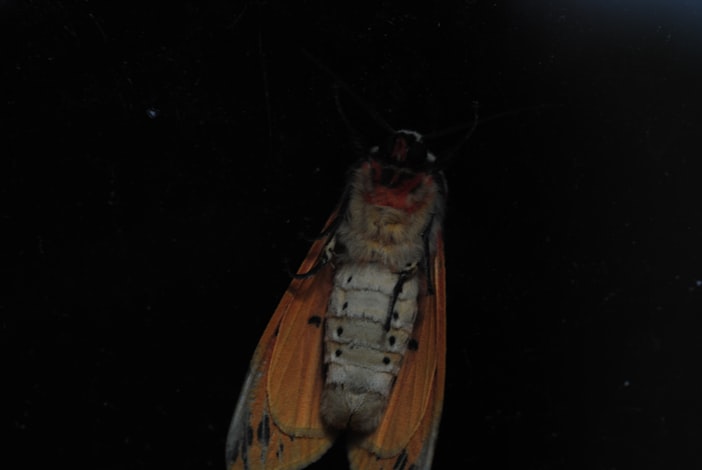
Let's start with the hearing thing, because it's too strange not to.
The greater wax moth - Galleria mellonella, beekeeping's most despised pest - possesses the highest frequency hearing sensitivity of any known animal on Earth. Not among insects. Among all animals. The moth can detect ultrasonic frequencies up to 300 kHz, using an ear that contains exactly four auditory receptor cells. Four.
For context, the highest known frequency of bat echolocation calls is 212 kHz. The wax moth hears nearly 50% beyond that range. Researchers studying this phenomenon described it as an evolutionary arms race: bats keep pushing their echolocation to higher frequencies to catch moths, and the wax moth keeps evolving ears that hear even higher. The moth is currently winning by a comfortable margin. It evolved the most sophisticated hearing in the animal kingdom using an organ roughly the size of a pinhead.
This is the creature that just ate through $300 worth of your stored honey supers.
What Actually Happens
Here's the sequence. You pull your honey supers off the hives in late summer. You extract the honey, put the equipment back in the shed, and figure you'll deal with it later. The shed is warm, dark, and still - perfect conditions for the drama about to unfold.
A female greater wax moth finds her way to your equipment. She doesn't eat - adult wax moths have vestigial mouthparts and literally cannot feed. Her entire adult life, which lasts one to three weeks, is dedicated to a single biological imperative: lay eggs and die.
She lays between 300 and 1,800 eggs, deposited in batches of 50-150 in cracks, crevices, and any gap she can find in your stacked equipment. If the temperature is around 28°C (82°F), she'll produce closer to 875 eggs. At 38°C (100°F), production drops to around 30. Temperature controls everything in the wax moth lifecycle.
Then the eggs hatch. In warm conditions, this takes five to eight days. And the larvae that emerge are what beekeepers actually dread.
A wax moth larva is a small, pale, soft-bodied caterpillar that spends the next one to five months - depending on temperature and food availability - doing one thing with extraordinary efficiency: destroying comb. The larva tunnels through beeswax, consuming not just the wax itself but the pollen, honey residue, bee cocoon silk, and dried larval feces embedded in the comb. Those protein sources are what the larvae actually need to grow. The wax is almost incidental - it's the protein-rich debris within dark brood comb that fuels their development.
This is why dark, old comb is devastated while new, light comb is often left relatively alone. Frames that have reared multiple generations of brood contain layers of cocoon silk, protein residue, and accumulated nutrients. To a wax moth larva, dark brood comb is a buffet. Clean foundation is a napkin.
The Apiary Project tracks every major threat to US honey bee colonies.
Explore the Issues Hub →The Silk Highway
As they tunnel, the larvae leave behind silk webbing. This is the visual signature that makes beekeepers' stomachs drop - opening a stack of stored supers to find frames connected by masses of silk, tunneled-through comb, and the characteristic frass (a polite word for insect excrement) that looks like sawdust mixed with small dark pellets.
The webbing serves a protective function for the larvae, creating tunnels that shield them from predators and from each other. In extreme infestations with inadequate food, wax moth larvae turn cannibal. The silk tunnels establish territories that reduce that risk. Evolution's answer to the problem of too many hungry caterpillars in one box: build walls.
The damage compounds because the larvae don't just destroy comb - they damage the wooden frames and boxes too. When larvae are ready to pupate, they excavate boat-shaped indentations into the wood of frames and hive bodies, chewing cavities where they'll spin their cocoons. These gouges are permanent. The wood never recovers. A frame with wax moth pupation damage has small canoe-shaped divots carved into the top bars and side bars that will harbor pests and moisture for as long as the frame exists.
A serious infestation can reduce a stack of ten supers to silk-covered rubble in a matter of weeks during warm weather. The frames become unusable. The comb is gone. The wooden components are gouged. What was $300-500 worth of drawn comb and equipment becomes firewood.
Why Strong Colonies Don't Care
Here's the thing about wax moths that makes their reputation slightly unfair: they're not really a problem for healthy hives.
A strong colony with a good population polices its comb constantly. Worker bees find and destroy wax moth eggs. They attack small larvae. They chase adult moths that sneak past the entrance guards - which, it turns out, is surprisingly easy to do. Female wax moths fly in the early evening when guard bees have relaxed their vigilance, and they're quick enough to lay eggs in crevices before anyone notices.
But a colony maintaining adequate population simply overwhelms the invasion with sheer numbers. Workers patrol, clean, and remove intruders faster than the moths can establish. Wax moths in a strong colony are a nuisance, not a catastrophe.
The problems start when colonies weaken. A colony that's lost its queen, been ravaged by varroa mites, suffered starvation, or dwindled for any reason loses the population density needed to patrol all its comb. Frames at the periphery - the ones farthest from the remaining cluster - go unpatrolled. Wax moths move in. The larvae establish in those undefended outer frames and work inward.
By the time a beekeeper opens a weak colony and finds wax moth damage, the moths didn't cause the collapse - they followed it. They're decomposers, not predators. In nature, wax moths serve a genuine ecological function: they break down abandoned wild bee nests, recycling the nutrients in old comb back into the ecosystem. The problem is that beekeepers don't want their equipment recycled.
The distinction matters because treating wax moth damage as the cause of colony failure leads to the wrong interventions. The moths are a symptom. The question isn't "how do I kill the moths?" It's "why was this colony too weak to defend itself?"
The Temperature Game
Wax moth biology is almost entirely temperature-dependent, and this creates a natural geographic divide in how much beekeepers worry about them.
Below 40°F (4.4°C), wax moth eggs stop developing. Below freezing, they die. Larvae in cold temperatures stop feeding and enter a kind of suspended animation. Below about 15°F (-9.4°C), larvae die within a few hours.
Northern beekeepers who store equipment in unheated barns through genuinely cold winters often have minimal wax moth problems. The cold does the work. A Michigan beekeeper leaving supers in an uninsulated shed through January doesn't need moth prevention - physics provides it.
Southern and temperate beekeepers face a completely different situation. Equipment stored in a Georgia shed during summer sits at temperatures perfectly optimized for wax moth reproduction. The lifecycle from egg to adult can complete in as little as six weeks under ideal warm conditions. Multiple generations per season are normal. A single founding female in April can produce descendants that destroy everything by August.
The lifecycle slows dramatically as temperatures drop. At cooler temperatures, the egg-to-adult cycle stretches to six months or more. Larvae overwinter in a semi-dormant state, resuming feeding when warmth returns. This creates a seasonal pulse of damage - slow through winter, explosive through summer - that tracks almost perfectly with ambient temperature curves.
The Other Wax Moth
The greater wax moth gets all the press, but it has a smaller, less destructive cousin: the lesser wax moth (Achroia grisella). The lesser wax moth is about half the size, silvery-gray rather than mottled brown, and causes less dramatic damage. Its larvae are smaller and don't tunnel as aggressively.
The lesser wax moth still destroys comb, still produces silk webbing, still gouges wood for pupation sites. It's just less efficient at it. In the hierarchy of beekeeping pests, the lesser wax moth occupies the middle ground between "genuinely threatening" and "mostly annoying" - kind of the medium-salsa of beekeeping problems.
Both species are found throughout the continental United States wherever bees are kept. Both thrive in the same conditions. Both are controlled by the same methods. The greater wax moth simply does more damage faster.
The Strange Second Life
Now here's where the story takes a turn that nobody in beekeeping saw coming.
In 2017, a paper published in Current Biology documented that greater wax moth larvae can eat and metabolize polyethylene - the plastic used in grocery bags. Researchers placed wax moth larvae on polyethylene film and observed holes appearing within 40 minutes. Chemical analysis confirmed the larvae were actually breaking down the plastic's polymer chains, not just chewing through it mechanically.
The finding made immediate sense from an evolutionary perspective. Beeswax is a complex hydrocarbon polymer. Polyethylene is a simpler hydrocarbon polymer. The enzymes that wax moth larvae evolved to digest beeswax apparently work on plastic too. The same biology that makes them devastating to stored beekeeping equipment might offer a pathway to biodegrading one of the planet's most persistent pollutants.
Subsequent research confirmed the finding and identified specific enzymes - particularly those produced by gut bacteria in the larvae - responsible for the degradation. The research is still far from producing a scalable plastic-degradation technology, but the irony is rich: the most hated pest in the bee shed might contribute to solving a different environmental crisis entirely.
And that's before we get to the medical research. Galleria mellonella larvae have become a standard model organism in infection research, immunology, and wound healing studies. Their innate immune response shows remarkable similarities to vertebrate immune systems. Researchers use wax moth larvae to test new antibiotics, study burn wound infections, and evaluate antimicrobial materials - because the larvae are inexpensive, reproduce quickly, and don't require the ethical review process that mammalian test subjects demand.
The creature that eats your frames, hears better than any animal alive, potentially digests plastic pollution, and serves as a stand-in for human immune systems in medical labs. Beekeeping's greatest pest is also one of biology's most improbable overachievers.
Cold, Light, and Air
The three factors that prevent wax moth damage in stored equipment are cold, light, and air circulation. Moths prefer dark, warm, still environments. Remove any of those conditions and the equation changes.
Cold storage is the simplest approach in climates that cooperate. Equipment stored where temperatures regularly drop below freezing experiences natural moth mortality. Even a 24-48 hour hard freeze kills eggs and larvae - some beekeepers cycle stored equipment through a chest freezer specifically for this purpose before storing it for the season.
Light and ventilation work because wax moths actively avoid exposed, well-lit conditions. Equipment stored with gaps that allow airflow and some light penetration experiences less moth pressure than equipment sealed in dark, stacked towers. This runs counter to many beekeepers' instinct to wrap their stored equipment tightly - which creates exactly the dark, still conditions moths prefer.
The biological control option is Bacillus thuringiensis, marketed as B401 or B402 (Certan). This bacteria produces spores containing a toxin lethal to wax moth larvae, achieving 100% effectiveness against larvae that consume the treated comb. A single application protects drawn comb until the next season. The product is safe for bees and leaves no residues in wax or honey. One 120ml package treats 100-120 frames.
The older chemical option - paradichlorobenzene (PDB) moth crystals - works but comes with significant baggage. PDB residues accumulate in beeswax, and the crystals are classified as a possible human carcinogen. Many beekeepers and most organic operations have moved away from PDB entirely.
The Actual Math
How much does wax moth damage cost? The question is harder to answer than it sounds, because the damage is measured in drawn comb, which has a value that's difficult to quantify precisely.
Drawn comb - frames of built-out wax comb that bees have already constructed - represents one of a beekeeper's most valuable assets. Building comb requires approximately 6-7 pounds of consumed honey for every pound of wax produced. A colony building comb diverts energy from honey production, brood rearing, and every other productive activity. Drawn comb handed back to a colony in spring gives them a head start worth weeks of development time.
When wax moths destroy drawn comb, the beekeeper loses not just the wax and foundation (a few dollars per frame) but the biological investment the colony made in building it. Replacing destroyed comb means the colony spends its early season building wax instead of building population or storing honey. That delayed productivity might cost 10-20 pounds of honey production per hive - worth $27-54 at current wholesale prices, or $120-240 at farmer's market retail.
Multiply that across the number of frames lost, and a single wax moth infestation in stored equipment can cost hundreds of dollars per hive in lost productivity the following season. For operations storing hundreds of supers, the potential loss scales into thousands.
All because a moth with four-cell ears and 1,800 eggs found a crack in a dark shed.
The moth doesn't know it's a pest. From her perspective, she found an abandoned food source and did what evolution designed her to do. The fact that the abandoned food source cost someone $300 in woodenware and represents weeks of colony development time is, to her, entirely irrelevant.
She's already laid the eggs. She's already dying. And somewhere in the silk-threaded wreckage of what used to be a perfect frame of drawn brood comb, 800 larvae are doing the only thing they know how to do.
In six weeks, they'll be moths themselves. With the best ears on the planet and absolutely no concern for your equipment budget.