Bee Navigation (How They Find Home From Five Miles Away)
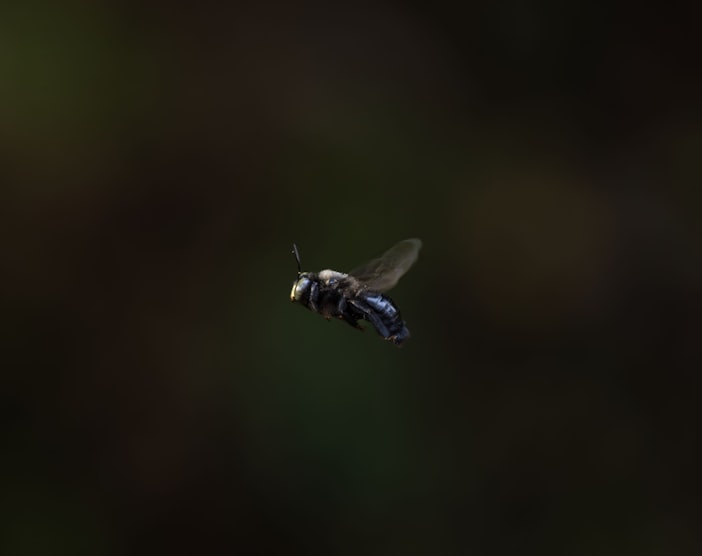
Randolf Menzel glued a 12-milligram antenna to a bee's thorax and let her fly. The antenna weighed less than a raindrop. The bee didn't appear to notice. There was food to find and a hive to return to, and she got on with it while the radar tracked her flight from above.
After the bee had established a foraging route to a feeding station, Menzel's team captured her there, put her in a dark container, drove to a location she had never visited, and released her. The release point was within her known foraging range but far from any route she'd previously flown.
She circled for about two minutes at the release point. Then she flew home - not by backtracking the route she'd been on, not by flying in a random direction, but on a direct course through airspace she had never used. She took a shortcut. Through territory she had never crossed. To a location she hadn't been displaced from.
Whether this constitutes a "cognitive map" in the theoretical sense is a debate that researchers at the Free University of Berlin and everyone else in insect neuroscience have been having for years. What's not debated: the bee got home.
The Primary Tool: A Sun Compass That Moves
The main directional reference for a foraging bee is the sun's azimuth - its compass bearing on the horizon. The bee's compound eyes detect the sun's position, and when the sun is obscured by clouds, they detect the pattern of polarized light in the sky, which encodes the sun's position even when it isn't directly visible. The waggle dance translates this sun reference into communication: the angle of the waggle run relative to vertical on the comb represents the angle of the food source relative to the sun's azimuth.
The complication: the sun moves about 15 degrees per hour in mid-latitudes. A food source that was "30 degrees left of the sun" at 10 AM is "75 degrees left of the sun" at 1 PM. The bee compensates for this. She has an internal model of the sun's movement rate that allows her to update her directional reference in real time. A bee trained to a food source in the morning finds it in the afternoon despite the sun's changed position, because she's adjusting the angle continuously.
Karl von Frisch - the same researcher who proved bees see color and decoded the waggle dance - demonstrated this time-compensated navigation in the 1960s. Bees kept in dark hives between dances still adjusted their dance angles over the course of the day, tracking the sun's movement without seeing it. The mechanism requires an internal clock - the same circadian oscillator that drives sleep-wake rhythms in foragers also serves as the temporal reference for sun compass navigation. The clock and the compass turn out to be the same system.
The Apiary Project tracks honey bee health data so you don't have to.
Explore the Data Hub →Dead Reckoning Across the Landscape
Path integration - also called dead reckoning - is the continuous tracking of position relative to a starting point, based on direction traveled and distance covered. A bee that flies 500 meters northeast and then 300 meters east has, if she's tracking her path, a continuously updated vector pointing back to the hive.
Direction comes from the sun compass. Distance comes from optic flow - the apparent motion of the visual environment across the retina as the bee moves through space, which functions as a speedometer. The integration of direction and distance over time produces a home vector: a constantly updated pointer toward the hive, regardless of how indirect the outbound path has been.
Path integration is the backup system. It works when landmarks aren't visible and when the bee needs a direct route home rather than retracing her outbound path. The limitation is error accumulation - small inaccuracies in direction or distance compound over time, so a bee navigating purely by path integration over a long flight arrives approximately right but not precisely right. In practice, bees use path integration as a rough guide and switch to landmark memory as they approach familiar terrain.
The Landmark Library
A forager bee's landmark memory is specific, detailed, and long-lasting. She memorizes the visual appearance of the hive entrance, the arrangement of nearby structures, the shape of tree lines, distinctive features along foraging routes, and the visual scene surrounding food sources - all encoded during the orientation flights she makes in the first days of her foraging life, expanding arcs that systematically photograph the local landscape from multiple angles.
This memory lives in the mushroom bodies - paired structures in the bee brain that process associative learning and spatial information. The mushroom bodies of a forager are physically larger than those of a nurse bee: the neuropil measurably expands during the first week of foraging as the bee begins encoding spatial information. The growth isn't metaphorical. It's been measured under microscopes.
The memories are view-based rather than abstract. The bee remembers what the world looks like from specific vantage points and matches current visual scenes to stored ones. This is why moving a hive more than a few feet confuses returning foragers - the stored visual scene no longer matches the current one, and the hive entrance that should be right there isn't. Experienced beekeepers move hives either incrementally (less than three feet per day, giving the bees time to update their memory) or radically (more than two miles, forcing a complete re-orientation) but not in between.
What the Radar Showed
The Menzel displacement experiments did more than demonstrate that bees take shortcuts. They revealed that bees navigate between known locations in ways that can't be explained by memorized routes or path integration alone.
The orthodox view before Menzel's work held that insects navigate using route-based memory: they memorize sequences of landmarks along specific paths but don't build a flexible representation of spatial relationships between landmarks. An insect displaced to an unfamiliar location should be lost, or should use path integration to head roughly in the direction of home, but shouldn't be able to compute a novel direct route.
What the radar tracked was different. After a brief period of orientation at the release point, most displaced bees flew directly toward the hive or a known landmark - on routes they had never previously flown. Not approximately toward home, and not in random directions, but on courses that indicated knowledge of spatial relationships between places they knew.
Some researchers interpret this as a very efficient path integration system combined with large-scale landmark recognition: the bee sees a distant familiar feature and heads for it, which looks like a shortcut but doesn't require a true cognitive map. Others accept the map interpretation. The debate is about what neural computation is happening under the behavior, and that's harder to settle than the behavior itself.
What's settled: bees displaced to novel locations within their foraging range find efficient routes home. The navigation system is flexible enough to compute solutions to situations it has never encountered.
960,000 Neurons
A honey bee brain contains approximately 960,000 neurons. The full navigation toolkit - sun compass, polarized light analyzer, optic flow odometer, path integration, landmark memory, time-compensated directional reference, possible magnetic compass - runs on this. For comparison, a human brain contains roughly 86 billion neurons. The bee accomplishes spatial navigation, associative learning, symbolic communication, face recognition, collective decision-making, and circadian rhythm regulation with a brain smaller than a sesame seed.
The efficiency comes partly from specialization: the bee brain doesn't allocate neurons to functions it doesn't need. Forty percent of it is optic lobes because vision is the primary sensory modality. Large antennal lobes handle olfactory communication. Large mushroom bodies handle spatial learning. There is no cortex, no language center, no circuitry for abstract reasoning. Every neuron is doing something the bee actually does.
It also comes from what might be called outsourcing to the environment. A bee doesn't need to store a mental model of the wind if she can adjust her flight in real time. She doesn't need to remember the hive temperature if her antennae can measure it directly. The environment carries information she reads continuously, reducing what needs to be stored in neural tissue.
The Magnetic Question
Bees contain magnetite - biogenic iron oxide nanoparticles - in their abdomens. Magnetite is the same mineral used by migratory birds and sea turtles for magnetic field detection. Its presence in bees suggests the capacity to detect Earth's magnetic field.
The behavioral evidence for magnetic navigation is suggestive: bees building comb orient their sheets in consistent directions relative to Earth's magnetic field, matching the orientation of the parent colony's comb - suggesting that swarms carry a magnetic memory of their mother hive. Magnetic anomalies disrupt orientation in controlled experiments. Whether bees routinely use magnetic information during field navigation remains less clear - the sun compass and polarized light compass appear to be primary, with the magnetic sense possibly serving as a backup or calibration reference.
The drone congregation area mystery - how drones find the same invisible mating zone year after year with no surviving individuals to follow - may involve magnetic navigation. The areas could be defined by local magnetic anomalies. This is speculative, and the bees aren't providing additional information.
Flying Home
Every element of the system feeds into a single output: the bee flies home.
She flies home from a flower patch she found for the first time an hour ago. She flies home through a crosswind that displaces her trajectory. She flies home on an overcast day when the sun isn't visible. She flies home from a release point where a researcher with a radar transponder and a van let her go. She carries a load of nectar weighing 40 percent of her body weight. She spent 45 minutes at the food source, during which the sun moved 11 degrees. She compensated. She arrives at the hive entrance - not approximately, but within centimeters.
Then she dances. The dance translates her navigational computation into a symbolic message that recruits nestmates to the same food source. The recruits use the same navigation system to find it. The colony locates food because individual bees can navigate and communicate where they've been.
The GPS in your phone has 3 billion transistors. The bee has fewer than a million neurons. The bee gets home more reliably. The phone runs out of battery. The bee runs out of wings.