Drone Congregation Areas (Why Queens Fly to the Same Invisible Spots)
A virgin queen honey bee will leave her hive exactly once for reproductive purposes. She may take one mating flight or two, rarely three, over the course of a few days between 5 and 14 days after emergence. Each flight lasts roughly 12 to 25 minutes. During that window, she will mate with 12 to 20 drones from colonies she has no connection to. She will store their combined semen - roughly 5 to 7 million sperm cells - in her spermatheca, a spherical storage organ about 1 millimeter in diameter. She will use this stored sperm for every fertilized egg she lays for the rest of her life - potentially 3 to 5 years, potentially a million eggs.
Every managed honey bee colony in the Western Hemisphere descends from matings that happened in the open air, in about 12 minutes, in a zone that no beekeeper planned, controlled, or even necessarily knew existed.
Those zones are called drone congregation areas - DCAs - and they are one of the strangest phenomena in insect biology.
The Arena
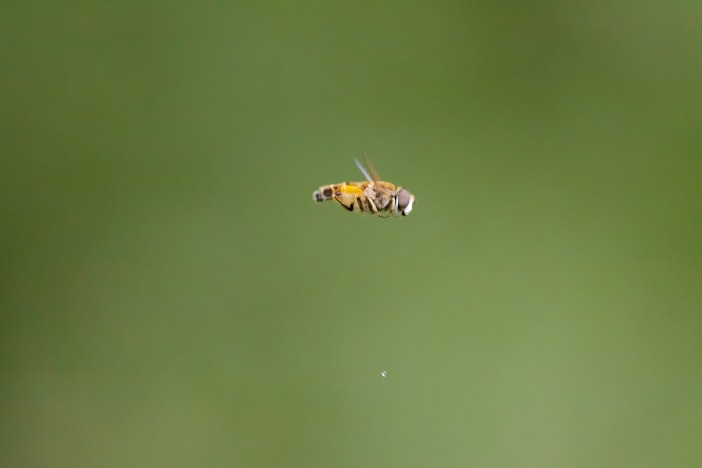
A drone congregation area is a volume of airspace - roughly 30 to 200 meters in diameter and 10 to 40 meters above the ground - where drones from multiple colonies gather and wait for queens. The drones arrive beginning in early afternoon, typically between 1:00 and 5:00 PM, when temperatures are warm enough for sustained flight (above about 20 degrees Celsius) and skies are clear or partly cloudy. They fly in a characteristic looping pattern - circling, hovering, darting - within the boundaries of the DCA.
The number of drones in a single DCA can be enormous. Estimates range from several hundred to over 10,000 drones, drawn from colonies within a 5-kilometer radius. Jean-Pierre Van Praagh's research in Germany documented DCAs with acoustic detection equipment and estimated populations in the thousands. The sound is sometimes audible from the ground - a distant hum that beekeepers have described as a low-frequency drone (the linguistic coincidence is not lost on anyone).
The drones aren't there all day. They return to their home colonies in the evening, eat honey to refuel (drones can't forage; they're fed by workers), and return to the DCA the following afternoon. A drone's adult life lasts roughly 3 to 5 weeks in spring and summer. He'll visit the DCA every suitable afternoon during that period, spending 30 to 60 minutes per visit.
The Apiary Project tracks honey bee health data so you don't have to.
Explore the Data Hub →The Persistence Problem
In 2005, researchers Gudrun Koeniger and Nikolaus Koeniger published work confirming what beekeepers had anecdotally reported for decades: DCAs persist in the same locations year after year, despite the fact that every drone that uses them dies before the next season.
Drones in temperate climates are produced from spring through midsummer. By late summer, the workers evict the drones from the hive - pushing them out, refusing to feed them, letting them starve. By autumn, every drone is dead. In spring, new drones are raised from new eggs. These new drones have never visited a DCA. They have no surviving elders to follow. And yet they fly to the same airspace - the same invisible volume above the same landscape feature - that drones used the previous year.
GPS-tagged studies have confirmed this persistence over periods of up to 12 years. The same clearing, the same ridgeline, the same valley entrance. The coordinates don't shift. The area doesn't drift. Something about the landscape itself defines the DCA, and new drones find it independently, every year, from scratch.
How?
The Hypotheses
Nobody has definitively answered the question. Several hypotheses exist, and none of them is fully satisfying.
Landscape features. DCAs tend to form over distinctive landscape elements: hilltops, valley edges, gaps in tree lines, clearings, ridges. The consistent feature across documented DCAs is that they occur at or near topographic transitions - places where the visual or thermal landscape changes abruptly. One hypothesis is that drones use visual landmarks to navigate to these features, the same way they use landmarks during orientation flights, and that certain types of landscape transitions are inherently attractive.
Magnetic fields. Honey bees contain magnetite - iron oxide crystals that function as biological magnets. Magnetoreception has been demonstrated in honey bee navigation: bees can detect and orient to magnetic fields. Some researchers have proposed that DCAs form over locations with distinctive magnetic field properties - anomalies in the local geomagnetic field that drones can detect and converge on. The evidence for this is indirect: DCAs have been found to correlate with certain geomagnetic features in some studies, but the sample sizes are small and the correlation isn't universal.
Wind patterns. Drones are large, relatively heavy, and energetically expensive to keep airborne. They may preferentially converge at locations where thermal updrafts or consistent wind patterns reduce the energetic cost of hovering. Hilltops and ridge edges generate orographic lift. Clearings flanked by forest generate thermal differentials. The same physics that determines where hawks soar might determine where drones congregate.
Optical flow. The same optic flow mechanisms that bees use for navigation during foraging may drive drone aggregation. A distinctive visual transition - a dark forest edge against a bright clearing, a ridgeline against the sky - generates a specific optic flow pattern during flight that drones may find attractive or may use as a rendezvous reference.
Pheromones. The most obvious hypothesis - that drones or queens leave chemical markers - is probably the least supported. DCAs form in the absence of queens. Drones arrive before queens do. And the DCA location persists through winter, when no living bee is present to maintain a scent mark. If pheromones play a role, they're a real-time aggregation signal (drones following each other's scent to the DCA once a critical mass arrives), not a year-to-year persistence mechanism.
The most likely answer is some combination - landscape features define the general area, wind and thermal patterns make it energetically favorable, and real-time aggregation pheromones (Nasonov-like signals from the drones themselves, or queen pheromones during the actual mating) concentrate the swarm once it begins to form.
But nobody knows for certain. This is one of the genuinely unsolved problems in bee biology.
The Queen's Flight
A virgin queen departing on her mating flight takes a series of orientation flights first - short loops around the hive, expanding in radius, learning the visual landmarks that will guide her home. When she's ready, she flies to a DCA - possibly one within a few kilometers, possibly one several kilometers away. There's evidence that queens preferentially fly to DCAs that are relatively far from their own colony, which reduces the chance of inbreeding.
Her flight to the DCA takes her high - 10 to 30 meters above the ground, well above the normal foraging altitude. She enters the DCA and releases queen mandibular pheromone (QMP), the same blend of chemicals - primarily 9-ODA, 9-HDA, and related compounds - that controls worker behavior inside the hive. In the open air, the pheromone plume is detectable by drones for several hundred meters downwind.
The drones respond immediately. A "comet" forms - a cluster of drones pursuing the queen, visible from the ground as a tight, fast-moving group. The pursuit is intense. Drones that catch the queen grasp her in flight. Mating occurs in midair - the drone everts his endophallus, delivers semen, and his reproductive organs are torn from his body. He falls to the ground and dies within minutes.
The queen mates with the next drone. And the next. Each mating takes seconds. The entire mating flight - from departure to return - lasts 12 to 25 minutes. In that time, she mates with 12 to 20 drones, accumulating semen from each.
The mating sign - the remnant of the previous drone's endophallus still attached to the queen - is removed by the next drone before he mates. The queen returns to the hive with the last mating sign, which workers remove. She may take one or two additional mating flights over the following days if her spermatheca isn't fully charged.
Then she's done. She never leaves the hive again (except during a swarm). Every egg she lays for the next several years uses sperm stored from those 12 to 25 minutes in the sky.
Polyandry
Why 12 to 20 drones? Why not one?
The answer is genetic diversity. A queen mated to a single drone produces a colony where every worker shares 75 percent of its genes (because drones are haploid - they carry only one set of chromosomes, so all their daughters get identical paternal genes). A colony with 75 percent genetic relatedness among workers is vulnerable: if one pathogen can kill one worker, it can likely kill them all.
A queen mated to 20 drones produces a colony with multiple patrilines - 20 subfamilies of workers, each fathered by a different drone, each with different genetic strengths and vulnerabilities. The colony's overall disease resistance is the composite of all patrilines. If one patriline is susceptible to Nosema, the others may not be. If one patriline is poor at thermoregulation, another compensates. The genetic diversity within the colony buffers it against environmental and pathogenic challenges.
Heather Mattila at Wellesley College demonstrated this directly in 2007: colonies headed by multiply mated queens had significantly higher survival and productivity than colonies headed by singly inseminated queens. The benefit of polyandry is measurable and significant.
This is also why the DCA matters. The drones in a DCA come from many different colonies - dozens of colonies within a 5-kilometer radius. A queen mating at a DCA is unlikely to mate with drones from her own colony (because most of the drones are from other colonies), and the 12 to 20 drones she mates with likely come from 12 to 20 different colonies. The DCA is a genetic mixing station - a mechanism that prevents inbreeding and maximizes the genetic diversity within each new colony.
The Drone's Perspective
From the drone's perspective, the DCA is a competitive arena. He has one purpose: mate with a queen. He will spend 3 to 5 weeks of his adult life flying to the DCA every afternoon, burning through honey reserves provided by workers, expending enormous amounts of energy hovering and pursuing, and almost certainly failing. The odds are terrible. A DCA may contain 10,000 drones. A queen mates with 20. On any given afternoon, the chance that a specific drone mates is roughly 0.2 percent - and that's assuming a queen even shows up.
Drone vision is optimized for this one task. Their compound eyes are enormous - roughly twice the size of worker eyes, with about 8,600 ommatidia compared to a worker's 6,900. The enlarged eyes provide better spatial resolution in the dorsal visual field - the area of the sky where a queen's silhouette would appear. The drones' ocelli (simple eyes) are also larger, providing better light sensitivity for detecting movement against a bright sky.
Their flight muscles are proportionally larger than worker flight muscles. Their flight speed is faster. Their acceleration is higher. Everything about the drone's anatomy is optimized for one airborne pursuit that lasts a few seconds, that he's been training for with daily DCA visits, and that ends either in death (if he mates) or in an evening flight home to eat honey and try again tomorrow.
About 99.8 percent of drones die without ever mating. They're evicted in autumn, starving, having spent their entire adult lives flying to a spot in the air, circling for an hour, and going home. The colony produced them, fed them, housed them, and tolerated their freeloading for one purpose, and most of them never fulfill it.
This is not a design flaw. It's a genetic strategy. The colony doesn't need every drone to mate. It needs the drones to be there - in sufficient numbers, from sufficient diversity of colonies - so that every queen who arrives at the DCA can mate with enough drones to produce a genetically diverse colony. The individual drone is expendable. The population of drones at the DCA is essential.
Finding Them
Beekeepers and researchers find DCAs through several methods. The traditional approach is the "drone trap" - a queen pheromone lure attached to a weather balloon or kite, raised to various altitudes. When the lure enters a DCA, drones converge on it visibly, and the observer notes the location, altitude, and approximate number.
More recently, acoustic detection has been used. The combined wing-beat frequency of thousands of hovering drones produces a characteristic sound that directional microphones can detect and triangulate. The frequency is lower than the worker bee's flight tone - approximately 130 Hz for drones versus 230 Hz for workers - because drones are larger and their wings beat more slowly.
Radar tracking has been used in German and Swiss studies to follow individual drones from their colonies to DCAs, mapping the flight paths and confirming that drones from widely separated apiaries converge on common areas.
The most common method for hobbyist discovery is accidental: a beekeeper happens to walk under a DCA on a warm afternoon and notices the distinctive hum overhead. Looking up, they see drones flying in circular patterns 20 to 30 meters above them. They've found a spot that's probably been used since before the beekeeper was born.
The 12-Minute Window
The entire reproductive future of a honey bee colony - the genetic constitution of every worker, every drone, every queen daughter - is determined in roughly 12 minutes of airborne activity above a landscape feature that no bee chose, no bee maintains, and no bee can explain.
The queen carries the semen home. The workers accept her. The colony builds up. In a managed hive, the beekeeper observes a good laying pattern and assumes all is well. The genetics were set weeks ago, in an invisible arena, by a process that the beekeeper can influence only by controlling which colonies provide the drones within flight range - and most beekeepers don't control that at all.
Instrumental insemination bypasses the DCA entirely. The queen never flies. The drones are selected by a human. The mating happens under a microscope. The resulting genetics are fully controlled. But instrumentally inseminated queens represent a tiny fraction of all queens produced. The vast majority - the million-plus queens produced annually in the US - mate in the open air, at a DCA, with whichever drones happen to be there.
The DCA is the uncontrolled variable in beekeeping. The arena nobody built. The mating ground that persists for decades without maintenance. The meeting place that thousands of drones navigate to independently, using mechanisms that the best researchers in the field haven't fully identified.
Somewhere above a hilltop, a clearing, a valley edge - above the same spot where drones circled 12 years ago, where different drones will circle next year - the genetic future of every colony within 10 kilometers is being decided in 12-minute increments, 30 meters off the ground, by bees that have approximately 960,000 neurons and no appointment to keep.
They show up every afternoon anyway. They've been showing up for millions of years. The queens know where to find them. The drones know where to go. Nobody knows how.