Dead Bees at the Hive Entrance (What Each Pattern Tells You)
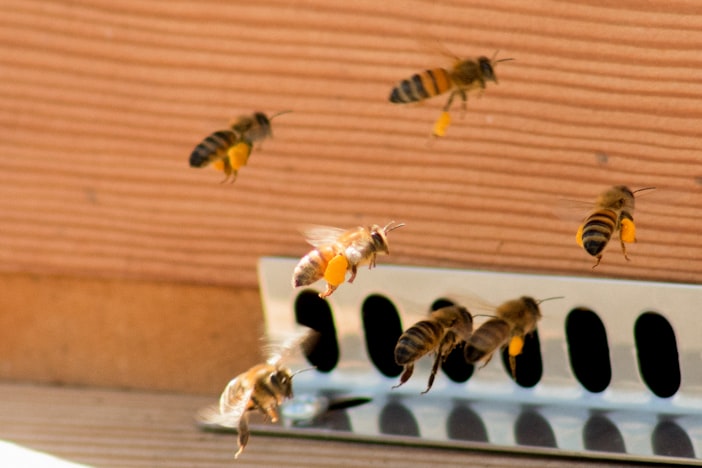
A healthy honey bee colony in midsummer contains roughly 60,000 workers. The queen lays 1,500 to 2,000 eggs per day. Each worker lives about 6 weeks. The math is simple: the colony is producing and losing approximately 1,000 to 1,500 workers per day. Every day. As a normal function of being alive.
Most of those deaths happen away from the hive. Foragers die in the field - their wings give out, their energy depletes, they land on a flower and don't take off again. These deaths are invisible to the beekeeper. The bee left. She didn't come back. Nobody counts the missing.
The deaths that happen inside the hive are different. When a worker dies inside the box - from age, disease, injury, or cold - the undertaker bees find the corpse within an hour or two. They grip it, drag it to the entrance, and fly it 50 meters or more from the hive before dropping it. The removal behavior is instinctive and hygienic - corpses harbor bacteria and attract small hive beetles and wax moths.
The bees that get dropped near the entrance - the ones the undertakers didn't carry far enough, or the ones that were pushed out the entrance and fell rather than being flown away - accumulate on the landing board and in the grass in front of the hive. This accumulation is, for a beekeeper who pays attention, a diagnostic tool. The pattern of dead bees tells a story before the hive is ever opened.
Normal Attrition
A scattering of dead bees in front of the hive - 10 to 50 per day visible on the landing board and ground - is completely normal for a full-strength summer colony. The bodies are full-sized adults with intact wings, normal coloring, and no visible deformities. Some are curled in the fetal position common to bees that die of old age. Some are stretched out, legs extended. A few drones may be mixed in.
In early spring, the accumulation may be higher as winter bees die off and are replaced by the first generation of spring brood. These winter bee corpses are often darker, more worn, and lighter in weight than summer bees - depleted after months of honey consumption and cluster maintenance.
After a cold snap in spring or fall, the dead count spikes. Bees that were caught outside when temperatures dropped, or bees on the cluster periphery that lost their grip and fell to the bottom board during a cold night, get carried out when temperatures rise. Finding 100 to 200 dead bees after a cold night isn't alarming. It's cleanup.
The key diagnostic: normal attrition produces dead bees that look like healthy bees that happened to die. No deformities. No discoloration beyond normal aging. No unusual postures. No smell.
The Apiary Project has free tools for beekeepers - calculators, schedulers, and seasonal guides.
Browse the Tools →The Deformed Wing Signal
Dead bees with crumpled, shortened, or completely absent wings are the calling card of Varroa destructor. The wings aren't mechanically damaged. They never developed properly. The cause is deformed wing virus (DWV), which is transmitted by Varroa mites feeding on pupae during development. The virus disrupts wing formation. The bee emerges unable to fly.
A bee with deformed wings can't forage. She can't contribute to the colony. She gets pushed around by nestmates, often ejected from the hive. She crawls on the landing board, on the front of the hive, on the ground. She dies within a day or two.
Finding one or two bees with deformed wings in midsummer is not necessarily an emergency - some level of DWV is present in virtually every colony. Finding 5 to 10 per day, or finding them consistently over several days, is a signal that Varroa levels are high enough to produce significant viral loads. By the time deformed wing bees are visible at the entrance, the mite population inside is almost certainly above the treatment threshold.
The related observation: crawling bees. Bees that can fly don't crawl in front of the hive. A bee crawling on the ground in front of the entrance - moving slowly, unable or unwilling to take flight - may have deformed wings, may be suffering from viral infection without visible wing damage, or may be weakened by mite-induced fat body depletion. Crawlers are a Varroa indicator.
The Tongue-Out Kill
A sudden mass of dead bees - hundreds to thousands in a single day - with their tongues (proboscises) extended is the classic sign of acute pesticide poisoning. The extended tongue is a reflexive response to neurotoxic exposure. The bee's nervous system fires uncontrollably as the pesticide disrupts acetylcholine signaling, and the proboscis extends and locks in place.
Neonicotinoid poisoning typically produces a more gradual kill - bees that fail to return from foraging, a slow decline in population, disorientation rather than acute toxicity. The tongue-out mass kill is more characteristic of organophosphate or pyrethroid spray applications - older-generation contact insecticides applied to blooming crops or sprayed in neighborhoods for mosquito control.
The geography of the kill is diagnostic too. If only one hive in an apiary is affected, the poisoning likely happened at a specific location where that colony's foragers were working. If every hive in the apiary shows the same mass kill, the source was probably aerial or area-wide - a crop spraying event or a municipal mosquito spray that drifted into the apiary.
Dead bees from pesticide kills often show a specific spatial pattern: a carpet of bodies extending from the entrance outward, densest directly in front of the hive, as if the bees made it home but died on the landing board or just inside the entrance. They returned from the contaminated source, entered the hive, and collapsed.
Ejected Brood
Dead pupae on the landing board - white or grey, partially developed, sometimes with visible eyes or legs - are being removed by hygienic workers from cells inside the hive. This is hygienic behavior - the colony's disease defense system at work. Workers that detect dead, diseased, or mite-infested brood uncap the cell, remove the contents, and carry them out of the hive.
A few ejected pupae per week is normal and healthy - it indicates the colony's hygienic behavior is functioning. The bees are detecting and removing chalkbrood mummies, sacbrood-killed pupae, or Varroa-infested cells before the problem spreads.
When the ejected brood count rises to dozens per day, the colony has a brood disease problem significant enough that the hygienic behavior can't keep up. Chalkbrood mummies - hard, white, chalky - are particularly visible because they don't decompose quickly. They accumulate in front of the hive like tiny white pebbles. A carpet of chalkbrood mummies indicates the colony is cold-stressed, nutritionally stressed, or genetically susceptible, and the disease chapter of the colony's story is being written on the landing board.
The August Drone Eviction
In late summer - typically August in temperate climates - the workers stop tolerating drones. The drones, who have been eating honey and contributing nothing except genetic material to the mating flights of other colonies' queens, are suddenly persona non grata. Workers block them from honey cells. Refuse to feed them. Physically drag them to the entrance and push them out.
The ground in front of the hive during drone eviction is littered with drones - larger than workers, wide-eyed, stumbling, unable to feed themselves. They die within 24 to 48 hours of eviction. The colony has decided that winter is coming and that feeding 2,000 freeloaders through it is not in the budget.
Drone eviction in August is normal and healthy. It means the colony is preparing for winter appropriately. The absence of drone eviction in August can be a concern - it may indicate the colony is queenless (queenless colonies sometimes retain drones longer, possibly because the absence of queen pheromone disrupts the behavioral trigger for eviction).
The Wax Cappings on the Bottom Board
Not all bottom board debris is dead bees. Wax cappings - small, crescent-shaped flakes of beeswax - accumulate on the bottom board when bees uncap honey cells to eat the contents. In winter, the pattern of wax cappings on a bottom board insert (a removable tray placed beneath a screened bottom board) shows exactly where the cluster is sitting - because the bees eat the honey directly above them and the cappings fall straight down.
A beekeeper who slides out the bottom board insert in January can see the cluster's position without opening the hive. If the cappings are centered, the cluster is centered. If the cappings are at the top of the frame area, the cluster has moved up - which means it's running low on honey in the lower boxes and may need supplemental feeding. If the cappings are only on one side, the cluster is off-center, possibly because one side of the hive is warmer (south-facing) or because the honey stores are unevenly distributed.
Varroa mites also fall onto the bottom board insert. A "mite drop" count - the number of mites found on a sticky board placed on the bottom board tray over 24 to 72 hours - is a commonly used monitoring method. More than 10 mites per day in fall suggests a mite load above the treatment threshold. The bottom board is a sampling device for the colony's mite population.
The Entrance Traffic Report
Beyond the dead, the entrance tells other stories.
Orientation flights. Young bees on their first flights hover in front of the hive entrance, facing the hive, memorizing its location. The cloud of hovering bees - all facing the same direction, all within a few meters of the entrance - looks like congestion but is actually navigation training. It happens most visibly in early afternoon on warm days. A hive with orientation flights has recently produced a batch of new bees, which means the queen is laying and brood is emerging - both healthy signs.
Washboarding. Workers sometimes stand in rows on the landing board and front of the hive, rocking back and forth in a rhythmic, synchronized motion. The behavior looks like they're scrubbing the surface. The function is debated - theories include propolis distribution, scent marking, surface cleaning - but the most consistent observation is that it happens on warm afternoons when foraging activity is moderate. It's not a distress behavior.
Robbing. When a colony is being robbed by bees from another hive - attracted by the smell of exposed honey, typically during a dearth - the entrance becomes chaotic. Fighting bees tumble on the landing board. Dead bees with bitten legs or wings accumulate. The defending colony's guards engage the invaders in grappling matches that both parties often lose. If the robbing is intense, the smell of alarm pheromone - which smells like bananas to humans - is detectable from several feet away.
Reading Without Opening
Experienced beekeepers can assess a colony's status without lifting the cover. The entrance provides a running diagnostic readout: activity level (low activity on a warm day suggests queenlessness or disease), the presence or absence of pollen loads on returning foragers (no pollen means no brood, or no available pollen), the sound coming from the entrance (a healthy hive hums; a queenless hive roars; a sick hive is quiet), and the dead on the ground.
The dead are the most revealing. They're the colony's waste stream - the output of its quality control system, its disease management, its seasonal adjustments. The undertaker bees don't sort the dead by cause of death before ejecting them. They just carry them out. But the pattern - the number, the condition, the timing, the posture - encodes information about what's happening inside the box.
A beekeeper who checks the entrance daily, who counts the dead, who notices the first deformed wing bee or the first chalkbrood mummy or the sudden absence of forager traffic, knows something is happening before it becomes a crisis. The entrance is the cheapest diagnostic tool in beekeeping. It costs nothing. It requires no equipment. It requires only attention.
The dead bees in front of the hive are data. The landing board is a dashboard. And the colony, in its methodical way, is reporting its status to anyone who cares to look down.