How Bees Fly (The Physics That Took 70 Years to Figure Out)
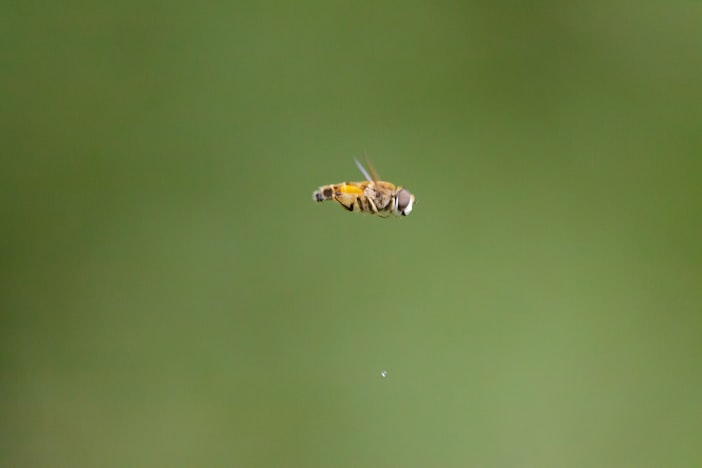
There's a famous claim that, according to the laws of aerodynamics, bees can't fly. It's been printed on coffee mugs, embroidered on throw pillows, attributed to Einstein (who never said it), and used as an inspirational metaphor in at least three commencement speeches that should have known better. The claim is wrong. But the reason it's wrong is more interesting than the claim itself.
The story traces to the 1930s - most likely to a dinner conversation involving the French entomologist Antoine Magnan and his assistant André Sainte-Laguë, who reportedly applied the equations of fixed-wing aerodynamics to a bumblebee's wings and found that the wings couldn't generate enough lift to support the bee's body weight. Magnan included a version of this calculation in his 1934 book Le Vol des Insectes. The conclusion wasn't that bees can't fly - Magnan was looking out the window; he could see them flying. The conclusion was that the mathematical models available in the 1930s couldn't explain how they did it.
The distinction matters. Bees weren't defying physics. Physics was failing to describe what bees were doing. The math was correct for the assumptions it was based on. The assumptions were wrong.
The Wrong Model
Fixed-wing aerodynamics - the physics of airplane wings - is built on the concept of steady-state airflow. An airplane wing moves through the air at a constant speed and angle, generating lift through the Bernoulli effect (lower pressure above the wing due to faster airflow over the curved upper surface) and Newton's third law (the wing deflects air downward, generating an equal and opposite upward force). The equations work beautifully for objects that move forward continuously through the air.
A bee's wing doesn't do this. It flaps. And it doesn't just flap up and down - it rotates, twists, sweeps forward, sweeps backward, and traces a figure-eight pattern (or, more precisely, an elongated oval) through each stroke cycle. The airflow over a bee's wing is never steady-state. It's chaotic, turbulent, and constantly changing direction. Applying steady-state aerodynamic equations to this motion is like trying to calculate the fuel economy of a car by measuring how far it slides on ice. The tool doesn't match the problem.
The aerodynamic forces that keep a bee in the air are generated by mechanisms that don't appear in conventional airplane aerodynamics because airplanes don't use them. These mechanisms were identified through a combination of high-speed photography, computational fluid dynamics, and a remarkable piece of engineering: a giant robotic bee wing flapping in mineral oil.
The Apiary Project tracks honey bee health data so you don't have to.
Explore the Data Hub →Robofly
Michael Dickinson, then at the University of California, Berkeley (later at Caltech and the University of Washington), built Robofly in the late 1990s - a dynamically scaled model of an insect wing. "Dynamically scaled" means the robot wing was much larger than a real insect wing (about 25 centimeters long) but operated in mineral oil rather than air, and flapped at a proportionally slower rate, so that the fluid dynamics were mathematically equivalent to a real wing in air at real speed. The physics scaled correctly. The robot wing experienced the same aerodynamic forces, in the same proportions, as a real bee's wing.
By instrumenting the Robofly wing with force sensors and surrounding it with particle image velocimetry equipment (which tracks fluid flow by illuminating tiny particles suspended in the oil with laser sheets), Dickinson's team could measure the forces generated at every point in the wing stroke and visualize the airflow patterns around the wing.
The results, published in a landmark 1999 paper in Science, identified three mechanisms that, together, explain how insect wings generate enough lift to fly. Each mechanism exploits the unsteady, dynamic nature of the flapping motion - the very property that made fixed-wing equations fail.
Three Tricks
Delayed stall and the leading-edge vortex. When an airplane wing tilts too steeply into the airflow (exceeds its "critical angle of attack"), the smooth airflow over the upper surface separates, creating turbulence and a catastrophic loss of lift. This is a stall. Airplanes avoid stalls by maintaining a moderate angle of attack.
A bee's wing operates at angles of attack that would stall an airplane wing instantly - sometimes exceeding 40 to 50 degrees. But the wing doesn't stall, because the flapping motion creates a stable vortex along the leading edge (the front edge) of the wing. This leading-edge vortex (LEV) is a spinning tube of air that sits on top of the wing like a tornado lying on its side. The low pressure inside the vortex sucks the wing upward, generating lift that far exceeds what the wing's size and speed would produce under steady-state conditions.
The LEV would normally detach from the wing and dissipate - this is what happens in a conventional stall. But the flapping motion continuously regenerates it. The wing sweeps forward, building the vortex; the wing reverses at the end of the stroke before the vortex can detach; the next stroke builds a new vortex. The bee maintains a permanently "stalled" wing that never actually stalls, because the flapping motion keeps regenerating the vortex before it can escape.
This mechanism alone accounts for roughly two-thirds of the lift that keeps a bee airborne. Without it, bees couldn't fly. With it, bees generate approximately 1.5 to 2 times the lift predicted by steady-state aerodynamics.
Rotational circulation. At the end of each forward stroke, the bee's wing doesn't just stop and reverse. It rotates rapidly around its long axis - flipping its orientation so the leading edge on the forward stroke becomes the leading edge on the backward stroke. This rapid rotation, completed in a few milliseconds, adds circulation to the airflow around the wing - the same principle that makes a spinning baseball curve, but applied in reverse. The rotation generates a brief spike of additional lift at the stroke transition.
The timing of this rotation is critical. Dickinson's team showed that the wing rotates just before the stroke reversal - an "advanced rotation" that captures the maximum rotational lift. Shifting the rotation timing by even a few milliseconds reduced the lift significantly. The bee's neural control of wing rotation timing operates with a precision of roughly 0.1 milliseconds at 230 beats per second. The flight control system in a 960,000-neuron brain is timing wing rotations to sub-millisecond accuracy.
Wake capture. After the wing reverses direction at the end of a stroke, it moves back through the wake - the disturbed air - left by the previous stroke. This disturbed air contains kinetic energy from the previous stroke's motion. The wing captures some of this energy on the return stroke, generating additional lift "for free" - without additional muscular effort. It's the aerodynamic equivalent of surfing the wave you just created.
Wake capture contributes a smaller fraction of total lift than the leading-edge vortex, but it's significant during hovering, when the wing is repeatedly sweeping through the same volume of air and the wake effects accumulate.
230 Beats Per Second
A honey bee's wings beat approximately 230 times per second - a frequency that's higher than that of most similar-sized insects. Bumblebees beat their wings at roughly 130 times per second. A housefly manages about 200. A mosquito hits 600. A honey bee's 230 Hz beat frequency is in the middle range for insects, but it's remarkable for the bee's body mass: a honey bee weighs roughly 100 milligrams, making it one of the heavier insects to maintain such a high wing-beat frequency.
The wings themselves are proportionally small. A honey bee's wing area relative to its body mass (the "wing loading") is higher than that of most flying insects - meaning the bee has less wing per gram of body than, say, a butterfly or a dragonfly. This high wing loading is compensated by the high beat frequency and the large stroke amplitude (the arc the wing sweeps through each stroke, roughly 90 degrees for a honey bee, which is close to the maximum physically possible).
The power source: indirect flight muscles. Unlike dragonflies and butterflies, which have muscles that attach directly to the wing base and contract once per wing beat, bees (and flies, and beetles) use indirect flight muscles that attach to the thorax walls rather than the wings. The muscles deform the thorax, and the thorax deformation is transmitted to the wings through a lever system at the wing hinge. This arrangement allows the wings to beat faster than the neural firing rate - the muscles exhibit "stretch activation," where a stretch triggers a contraction, creating an oscillation that runs faster than the nerve impulses driving it.
The thorax of a bee in flight is essentially a resonating box. The muscles deform it in one direction, the elastic properties of the cuticle snap it back, the muscles fire again. The wing-beat frequency is determined partly by the neural drive and partly by the mechanical resonance properties of the thorax. This is why the distinctive buzz of a bee is so consistent - the frequency is set by the physical properties of the thorax, not just by neural control.
The Loaded Flight
Everything about bee flight becomes more impressive when you consider the cargo. A forager bee returning from a productive trip carries a honey crop loaded with nectar (up to 40 milligrams, roughly 40 percent of her body weight) and/or pollen loads on her hind legs (up to 15 milligrams per leg, 30 milligrams total). A fully loaded forager may weigh 140 to 170 milligrams - 40 to 70 percent more than her unladen weight.
The flight dynamics change with the load. The wing-beat frequency increases slightly (the bee "revs" harder). The stroke amplitude increases. The body angle tilts more nose-up, shifting the net aerodynamic force vector forward to maintain speed despite the increased drag. The leading-edge vortex has to work harder.
The optic flow system that measures ground speed provides feedback for load compensation - a loaded bee that's flying slower than expected increases wing effort to maintain the airspeed her brain expects. The entire flight system - neural, muscular, aerodynamic - adjusts dynamically to the load.
A loaded forager also burns fuel faster. The metabolic rate during flight is roughly 500 watts per kilogram of muscle - one of the highest metabolic rates in the animal kingdom. A bee flying at full speed burns through her honey crop at a rate that gives her a maximum range of about 8 to 10 kilometers on a full tank. She typically forages within 2 to 5 kilometers of the hive - a practical limit set not by navigation but by fuel economics. Beyond 5 kilometers, the energy cost of the round trip exceeds the energy value of the nectar she can carry back.
The Hovering Problem
Hovering is the hardest thing a flying animal can do. Forward flight generates lift partly through the forward motion itself - air flowing over the wings creates lift continuously. In a hover, there's no forward motion. All lift must come from the wing's own flapping motion.
Bees hover routinely - during orientation flights, during inspection of potential nest sites, during the approach to a flower, and during the waggle dance (which is performed on a vertical comb surface with the bee clinging to the comb rather than hovering, but the dance followers hover briefly as they track the dancer).
During hovering, the bee's body hangs nearly vertical and the wings stroke almost horizontally - back and forth in a nearly flat plane. Each forward stroke and each backward stroke generates lift through the leading-edge vortex mechanism. The wing rotates at each stroke reversal to maintain the correct angle of attack for lift generation in both directions.
The metabolic cost of hovering is roughly 30 percent higher than forward flight at optimal speed. This is why bees don't hover unnecessarily - at a flower, a bee lands as quickly as possible rather than hovering in front of it. Every second of hovering costs energy that could have been used to fly to the next flower or carry nectar home.
Hummingbirds are the only vertebrates that can sustain a true hover (other birds can hover briefly). Bees, flies, and some other insects hover routinely. The physical challenge is the same for all of them: generate enough lift from flapping alone, with no help from forward motion, to support body weight against gravity. The solutions are convergent: high wing-beat frequency, large stroke amplitude, figure-eight stroke patterns, and leading-edge vortices. Evolution arrived at the same physics independently in insects and birds.
The Sound
The buzz of a bee is the sound of the wing-beat frequency transmitted through the air as a pressure wave. A honey bee's 230 Hz beat produces a tone close to A#3 below middle C on a piano. A bumblebee's lower frequency (130 Hz) produces a deeper buzz, roughly C3.
The buzz changes with the bee's activity. A bee flying normally produces the baseline buzz. A bee flying loaded produces a slightly higher-pitched buzz (higher wing-beat frequency to compensate for the load). A bee fanning at the hive entrance - using her wings as ventilation fans to evaporate moisture from ripening honey - produces a different tone because fanning uses a different stroke pattern than flight.
The "piping" sound made by queens before emergence, and the "tooting" and "quacking" between a newly emerged queen and her unhatched rivals, are produced by thoracic vibrations transmitted through the comb, not by wing beats. But the sound of a colony being robbed - louder, more agitated, higher-pitched than normal - reflects the increased wing-beat frequency of stressed, fighting bees. Experienced beekeepers diagnose colony conditions partly by sound: the pitch, volume, and quality of the hive's buzz encode information about population size, queen status, and stress level.
The Aging Wing
A bee's wings don't regenerate. They wear out.
Over the course of a forager's 2 to 3-week flying career, the wing membranes accumulate damage: nicks from vegetation, tears from collisions, wear from the constant flexing of 230 beats per second for hours per day. The wing margin frays. Pieces break off. The wing area decreases.
As wing area decreases, the bee compensates by increasing wing-beat frequency and stroke amplitude - working harder to generate the same lift with less wing. But there's a limit. A forager with severely damaged wings can't generate enough lift to fly loaded. She may still be able to fly unladen - returning to the hive empty - but she can't forage productively. At some point, the wing damage is fatal: the bee can't fly at all, and a bee that can't fly can't feed itself (foraging is the only source of nectar and pollen).
The wings are the limiting factor in a forager bee's lifespan. A forager doesn't die of old age in the mammalian sense. She flies until her wings can't carry her, and then she doesn't come home. The approximately 500 miles of total flight distance that a forager accumulates in her 2 to 3-week career represents the working life of a pair of wings, not the biological age of the insect.
Winter bees - bees raised in autumn that live through the winter - survive 4 to 6 months partly because they don't fly. Their wings are preserved. When spring arrives and they begin foraging, their wings are fresh, and their flying career is as long as any summer bee's. The difference in lifespan between a summer bee (6 weeks) and a winter bee (6 months) is largely a difference in wing wear.
The Corrected Calculation
If you redo Antoine Magnan's 1934 calculation using unsteady aerodynamics - accounting for the leading-edge vortex, rotational circulation, and wake capture that Dickinson identified - the math works. The wings generate more than enough lift. The bee flies. Physics is satisfied. The coffee mugs are wrong.
But here's the part that doesn't make it onto the mugs: the unsteady aerodynamic mechanisms that bees use are, in some ways, more sophisticated than the steady-state aerodynamics that airplanes use. An airplane wing generates lift through a single, well-understood mechanism. A bee's wing generates lift through three mechanisms operating simultaneously, at 230 cycles per second, with sub-millisecond timing precision, dynamically adjusted for load, wind, and maneuver requirements, controlled by a brain with fewer neurons than a fruit fly has.
The myth said bees fly despite physics. The reality is that bees fly with physics that took 70 years to identify, and that engineers are still working to replicate. Micro air vehicle researchers at Harvard, Caltech, and elsewhere are building bee-sized drones that attempt to use flapping-wing aerodynamics for flight. The engineering challenge is immense. Matching the power-to-weight ratio, the control precision, and the aerodynamic efficiency of a honey bee's flight system remains beyond the current state of the art.
A bee weighs 100 milligrams. Her flight muscles generate roughly 80 milliwatts of mechanical power. Her wings sweep through 90 degrees of arc, 230 times per second, generating vortices that produce twice the lift that conventional aerodynamics would predict. She carries 40 percent of her body weight in cargo. She flies 10 miles a day. She navigates home from 5 miles away with sub-degree accuracy. She does all of this until her wings literally fall apart, and then she doesn't come home, and the colony raises another bee to take her place.
The French entomologist was right that his equations couldn't explain it. He was wrong that this was the bee's problem. It was the equations' problem. The bees were flying fine.