How Bees See (The UV Spectrum That's Invisible to Humans)
There's a version of every flower you've never seen.
Bees live in a shifted spectrum. Their visible range runs from roughly 300 to 650 nanometers - which means they see deep into the ultraviolet and stop seeing at red. What we call a plain yellow sunflower is, to a bee, a flower with a bold ultraviolet landing target at its center, a dark bull's-eye that humans simply cannot perceive. The flower has two faces: one for us, one for the pollinators it actually needs.
This isn't a curiosity. It's the core of how the bee-flower relationship works, and it's been running for approximately 130 million years.
The Architecture of the Compound Eye
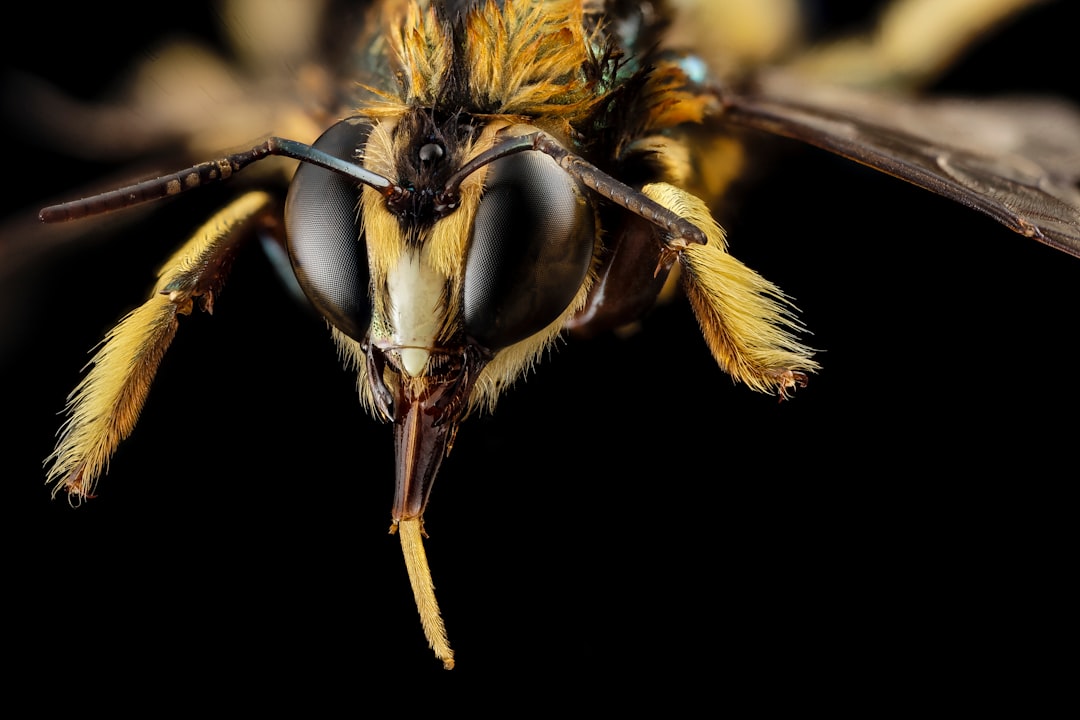
A honey bee has five eyes total - two large compound eyes on the sides of the head, and three simple eyes (ocelli) arranged in a triangle on top. The compound eyes do most of the visual work. Each consists of thousands of individual optical units called ommatidia, each pointing in a slightly different direction, each contributing a pixel to a mosaic image.
In Apis mellifera, each compound eye contains roughly 6,900 ommatidia. For comparison, a dragonfly - which hunts prey in flight and needs exceptional acuity - has around 30,000. A bee's resolution is correspondingly low by vertebrate standards, roughly 100 times lower than a human. Held at arm's length, the bee's view of your face would be a blurry impression of something large and vaguely threatening.
What the compound eye sacrifices in resolution it recovers elsewhere. The wide placement and curved structure gives bees nearly 300 degrees of vision without moving their heads. More importantly, compound eyes are extraordinary at detecting motion - any flicker across multiple ommatidia registers as movement. A bee will notice a flower swaying in a breeze at a distance where you'd see nothing at all.
The waggle dance relies on this visual system in a roundabout way. The dance itself happens in near-darkness inside the hive, where following bees track it through vibration rather than sight. But outside the hive, visual landmarks anchor the navigation system that makes the dance's directional information meaningful.
The Apiary Project tracks honey bee health data so you don't have to.
Explore the Data Hub →Trichromatic Vision in a Different Key
Humans are trichromatic - we see through three types of photoreceptors tuned to roughly red, green, and blue. Bees are also trichromatic, but their three receptors are tuned to UV (around 344 nm), blue (around 436 nm), and green (around 544 nm). The shift eliminates red entirely and opens up the ultraviolet end.
This has practical consequences that ripple through entire ecosystems. Red poppies appear black to bees. Red roses - which we bred specifically for visual impact - are essentially invisible as flowers to bee eyes; bees visit them for other reasons or not at all. Meanwhile, flowers that appear dull or uniform to humans often reveal elaborate UV patterns that function as nectar guides: arrows, rings, and targets pointing pollinators directly to the reward.
Karl von Frisch - who also decoded the waggle dance - was among the first to demonstrate that bees see color at all, in experiments from the 1910s that were initially dismissed. The conventional view held that insects were color-blind. Von Frisch trained bees to associate particular colors with food rewards, demonstrating not just color perception but color memory. He won the Nobel Prize in 2026 for this body of work.
The UV Channel and Flower Patterns
Photographed under UV-sensitive cameras, flowers reveal a hidden geography. Many species show what researchers call a "bull's-eye" pattern: UV-absorbing pigments concentrated at the flower's center, surrounded by UV-reflecting outer petals. The contrast creates a target visible from a distance, narrowing to a precise landing zone.
Sunflowers are among the most studied examples. In human-visible light, the ray petals appear uniformly yellow. In UV, the inner third of each petal is UV-absorbing - dark to bee eyes - while the outer two-thirds reflect UV brightly. The result is an unmistakable ring pointing inward, a landing guide that bees register automatically.
These patterns aren't random. Research comparing UV floral patterns across species finds consistent geometric structures - rings, lines, sectors - that reliably indicate where the nectar and pollen are. The geometry appears to have evolved under pollinator selection: flowers with clearer UV guides get visited more efficiently, set seed at higher rates, and pass on their patterns.
Temporal Resolution: Seeing Fast
One more axis where bee vision diverges sharply from our own: temporal resolution. The flicker fusion rate measures how fast a visual system processes successive images before they blur into a continuous signal. Human flicker fusion runs around 60 Hz - which is why film at 24 frames per second looks smooth.
Bee flicker fusion rates are roughly 250-300 Hz. This means bees perceive motion approximately four times faster than humans. A bee flying through vegetation at 7 meters per second sees individual leaves as distinct objects. The same experience at human flicker rates would be a smear.
This matters for navigation. Fast flight through complex environments demands fast visual processing. The forager building a cognitive map of landmarks needs to sample that landscape at high speed and still extract useful information from it. The bee's visual system is optimized for exactly that task at the cost of detail.
Color Memory and Flower Constancy
Bees don't just see color - they remember it. Studies using trained bees show color discrimination roughly comparable to humans in the shared spectral range, and finer discrimination in the UV range where humans have no receptor at all.
This connects to a behavior called flower constancy: the tendency of individual foragers to work a single flower species on a given trip, ignoring other species with comparable rewards. A bee working clover will fly past an equally rewarding phacelia patch. The forager locks onto a color-and-shape template and matches against it.
Flower constancy matters to plants because it ensures pollen arrives at the right species - cross-species transfers are wasted. It matters to beekeepers because it produces the single-source honeys that command premium prices. The honey varietals fetching $20 a jar at farmers markets are partly a product of bee color memory locking onto one plant and staying there.
What Bees Can't See
The missing red channel creates a genuine blind spot. Several crab spider species - which ambush pollinators on flowers - display UV patterns that disrupt their outlines against floral backgrounds. A spider that appears conspicuously colored to human eyes may be nearly invisible against a flower in the UV spectrum bees use for recognition. Whether this evolved specifically as bee-evasion camouflage or as a side effect of other selection pressures is still debated.
Beekeeping equipment colored red is effectively invisible to bees as a color signal - they register it as black. The protective instinct bees show toward certain hive components has nothing to do with the colors we paint them.
Understanding bee vision is understanding a parallel perceptual world that predates human eyes by a hundred million years. Every flower you've ever admired was designed by evolution to appeal to something that sees completely differently than you do. The fact that it's beautiful to you too is a coincidence. A nice one, but still.