Bee Water Foraging and the Swimming Pool Problem
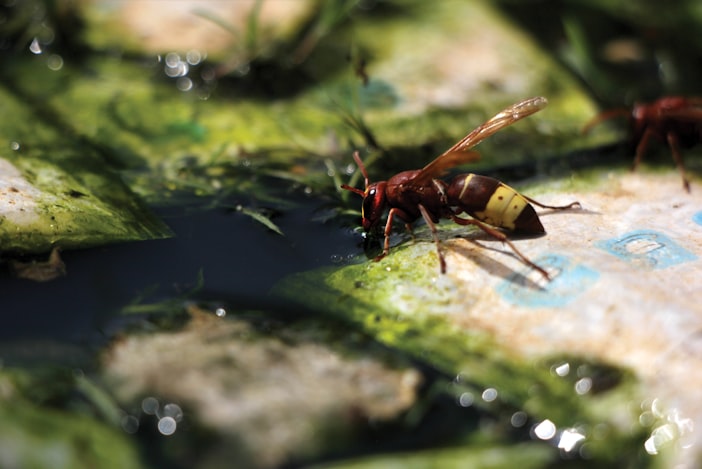
Bees don't drink water. That sounds wrong, and it requires clarification: individual bees drink tiny amounts of water as part of their normal hydration, but the vast majority of water a colony collects isn't consumed as a beverage. It's industrial coolant. The colony collects water, spreads it across comb surfaces and on the tops of cells, and fans air over the wet surfaces to drive evaporative cooling. The water absorbs heat as it transitions from liquid to vapor. The comb cools. The brood nest stays at 35 degrees Celsius. The water evaporates and is gone.
A colony on a hot day - 95 degrees Fahrenheit, full sun, mid-July - can consume up to 1 liter of water. One liter. That's roughly 50,000 individual forager loads (each forager carries about 20 to 25 microliters of water in her crop per trip). At 10 trips per day per water forager, the colony needs 5,000 forager-trips dedicated exclusively to water collection to meet peak demand.
The water has to come from somewhere. That somewhere is, with remarkable consistency, your neighbor's swimming pool.
The Water Forager
Water foraging is a specialized task performed by a minority of the foraging force. On a cool day with moderate colony demand, water foragers may constitute 1 percent of foragers. On a hot day with high demand, the proportion can climb to 5 percent or more - with some nectar foragers temporarily switching to water collection as the colony's need increases.
The switch is driven by demand-side signaling within the hive. When house bees need water for evaporative cooling, they cluster near the entrance and solicit incoming bees with tongue-to-tongue contact. A returning water forager is unloaded quickly and enthusiastically - the house bees take the water from her crop within seconds. The speed of unloading is the signal: if the water forager is unloaded quickly, demand is high, and she immediately departs for another trip. If she has to wait to find a house bee willing to take her water, demand has dropped, and she may switch back to nectar foraging.
This feedback mechanism - speed of unloading as a demand signal - was described by Thomas Seeley in his analysis of colony-level regulation of foraging. The same mechanism operates for nectar foraging: a forager bringing in nectar from a rich source is unloaded quickly, signaling that the colony values her cargo. A forager bringing in nectar from a poor source waits longer. The colony allocates its foraging force through this simple market mechanism - no central controller, no planning, just individual bees responding to how fast their cargo gets taken.
The Apiary Project has free tools for beekeepers - calculators, schedulers, and seasonal guides.
Browse the Tools →Source Fidelity
Here is where the neighbor problem begins. Bees are site-faithful foragers. A water forager that discovers a reliable water source - a swimming pool, a pond edge, a dripping outdoor faucet, a bird bath - memorizes its location, flies to it repeatedly, and recruits other foragers to it through waggle dances.
The recruitment means that a water source discovered by one bee becomes the colony's primary water source within days. Once 50 foragers are visiting the pool every morning, the behavior is self-reinforcing: the source is reliable (the pool doesn't dry up), the location is memorized, the recruitment continues, and the colony treats it as a permanent fixture of its foraging landscape.
The challenge: you can't redirect bees from an established water source. Moving the hive doesn't help (the foragers will fly back to the old location). Providing an alternative water source at the hive helps only if it's established before the bees find the pool. Once the pool is in the colony's spatial memory, the alternative source must be more attractive than the pool - and pools are very attractive to bees.
Why Pools
Bees prefer water sources that have three qualities: proximity to the hive, reliability (doesn't dry up), and a scent or mineral content they find attractive.
Swimming pools hit all three. They're within the typical foraging radius. They never dry up. And they smell: chlorine, dissolved minerals, algae on pool edges, and the organic compounds that accumulate in any standing water. Bees are attracted to water with dissolved minerals and organic compounds - they prefer "dirty" water to clean water. A mud puddle is more attractive than a freshwater stream. A chlorinated pool with some algae on the coping stones is more attractive than a clean bowl of fresh water.
This preference for mineralized, slightly organic-smelling water makes biological sense. Water with dissolved minerals provides micronutrients. Water with organic compounds may provide pheromonal or chemical cues that indicate "other bees have been here and survived." A pristine glass of tap water, set out by a well-meaning beekeeper, is less attractive than the bird bath that hasn't been cleaned in two weeks.
Other common water sources that attract bees: pet water bowls (especially outdoor dog bowls that accumulate drool and food particles), leaky outdoor faucets, air conditioning drip lines, garden hoses left slightly on, rain gutters with standing water, compost piles (which generate moisture with rich organic chemistry), and livestock watering troughs.
The Neighbor Conflict
The most common legal and social conflict in backyard beekeeping isn't stinging. It's water.
A beekeeper installs two hives in the backyard. The bees need water. The nearest reliable source is the neighbor's pool, 100 feet away. Within a week, the neighbor's pool has 50 bees circling the surface, landing on the water, drinking from the pool edge. The neighbor is unhappy. The neighbor's children are afraid. The neighbor calls the beekeeper. The beekeeper promises to provide an alternative water source. The bees ignore it because they already know where the pool is.
This scenario plays out thousands of times per summer across the United States. It has destroyed neighborly relationships. It has resulted in legal complaints, code enforcement actions, and, in some cases, the forced removal of bee colonies. The water problem is a significant factor in municipal ordinances that restrict urban beekeeping - not because the bees are dangerous at the pool (water foragers are docile; they're focused on water, not defense), but because the presence of dozens of bees at a swimming pool is unacceptable to most homeowners regardless of the actual risk.
Prevention
The only reliable solution is proactive: establish a water source at or near the apiary before the bees find someone else's. The source must be reliable (filled daily or self-replenishing), accessible (bees can land and drink without drowning - a flat surface with a slight film of water works better than a deep bowl), and attractive (add a small amount of salt or place the water in a sunny location near decomposing organic material).
Specific approaches that work:
Chicken waterer with pebbles. A standard poultry waterer provides a continuous shallow tray of water. Pebbles or marbles in the tray give the bees landing platforms so they don't drown. Refill daily.
Drip system. A slow-dripping faucet or irrigation emitter onto a textured surface (concrete, burlap, moss) provides a constantly wet surface that bees can land on. The drip keeps the surface wet without creating standing water that breeds mosquitoes.
Boardman-style entrance feeder with water. A jar of water inverted over a feeder base at the hive entrance provides water directly at the hive. Simple, cheap, requires daily refilling.
Wet burlap over a bucket. A bucket of water with a piece of burlap draped over the edge, wicking water to the surface. The burlap provides a textured landing surface and stays wet through capillary action.
The critical factor: the water source must be established and operational when the hives are installed, before the first foragers take their orientation flights. A water source that's been there for a week when the bees arrive becomes "the" water source. A water source installed after the bees have already found the neighbor's pool becomes "the other water source that's not as good as the pool."
The Drowning Problem
Bees drown easily. Their wings are hydrophobic (they shed water) but their bodies are not. A bee that falls into water can usually climb out if there's a textured edge to grip. A bee that falls into a smooth-sided bowl, a bucket, or a swimming pool may not be able to climb out. The surface tension of water doesn't support a bee's weight. She sinks, her wings get wet, and she drowns.
Swimming pool owners with bee visitors regularly find dead bees in the skimmer basket - foragers that landed on the water surface, couldn't take off, and were swept into the filtration system. The number can be significant: dozens per day during peak water demand.
Some pool owners add floating objects - pool noodles, floating planters, cork boards - to give bees a landing platform from which they can drink and take off. This reduces drowning but doesn't solve the neighbor-conflict problem (the bees are still at the pool). Others find that running the pool pump more frequently or adjusting the pool chemistry to reduce algae growth makes the pool marginally less attractive - but a pool is still a pool, and the bees know where it is.
Winter Water
Water collection isn't exclusively a summer activity. During winter, bees in the cluster need moisture - primarily for diluting crystallized honey so they can consume it. Crystallized honey is solid and can't be ingested directly. Bees add moisture to the surface of crystallized honey, dissolve the crystals, and consume the liquefied result.
The moisture in winter comes primarily from metabolic water (water produced as a byproduct of burning sugar for energy) and from condensation within the hive (the bees' respiration generates water vapor, which condenses on cold surfaces inside the box). On warm winter days - above 50 degrees Fahrenheit - bees make brief cleansing flights (to defecate outside the hive) and may also collect water from nearby sources.
Inadequate moisture in winter leads to starvation - not because the colony runs out of honey, but because the honey is crystallized and the bees can't access the sugar it contains. Beekeepers who find dead colonies surrounded by full frames of crystallized honey often misidentify the cause as "starvation" when the actual cause is dehydration-limited access to crystallized stores.
Hive moisture management in winter - ventilation to prevent excess condensation while retaining enough moisture for honey dissolution - is one of the more delicate balances in cold-climate beekeeping.
1 Liter
The colony's water budget on a hot day - 1 liter, 50,000 forager loads, 5,000 trips - is a resource allocation commitment that competes directly with nectar foraging. Every bee collecting water is a bee not collecting nectar. Every trip to the pool is a trip not taken to the clover field.
The colony manages this trade-off through the same demand-signaling mechanism that manages all foraging allocation. When the hive is hot, water foragers are unloaded quickly, signaling high demand and high value. Nectar foragers returning with dilute nectar are unloaded slowly, signaling low value. Some nectar foragers switch to water. The colony's foraging force rebalances in real time - shifting resources from food collection to cooling as the temperature demands.
On cool days, the reverse happens. Water foragers are unloaded slowly or not at all. They switch back to nectar. The colony's entire foraging operation pivots between food acquisition and thermoregulation based on temperature, and the pivot mechanism is the speed at which a returning bee gets her crop emptied by a house bee at the entrance.
No manager. No schedule. No meeting about resource allocation. Just 10,000 foragers responding to how fast their delivery gets accepted, and a colony that stays cool because enough of them decided, independently, that the pool was more important than the clover field today.
One liter. Your neighbor's pool. A handshake you should have had before you installed the hives. The bees already know where the water is. They're not going to forget.