Winter Bee Management (How Cold Storage Changed Commercial Operations)
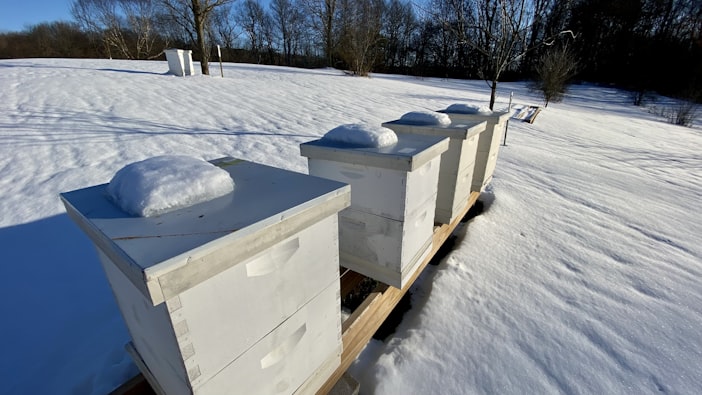
A standard wooden Langstroth hive provides R-0.84 insulation. A natural tree cavity - the kind of space honey bees evolved to occupy over millions of years - provides R-5.6. That's nearly seven times the insulation value, and it goes a long way toward explaining why managed colonies die at rates that would make wild colonies look invincible by comparison.
This number matters differently depending on where the hive sits. A colony in Duluth, Minnesota faces sustained temperatures below zero for weeks. A colony in Savannah, Georgia never sees a hard freeze. A colony in Portland, Oregon might never get truly cold - but it will get wet, and wet kills bees faster than cold does. The same species, the same hive design, the same basic biology - and completely different survival equations depending on which side of which state line the beekeeper happens to live on.
The 2024-2025 winter recorded 40.2% colony losses nationally - the highest since annual tracking began. State-level winter losses ranged from 13.6% to 76.6%, the widest range ever documented. The national number is a statistical fiction. What actually happens to bees in winter is a regional story, and the regions tell very different versions of it.
Minnesota: The Deep Freeze
In the Upper Midwest - Minnesota, Wisconsin, Michigan, the Dakotas - winter is an endurance event measured in months. Temperatures between November and March range from average highs around 35 degrees Fahrenheit to average lows of 18 degrees, with extended stretches well below zero. Colonies need 90 to 100 pounds of stored honey to fuel the cluster from November through April.
The cluster itself is a feat of collective thermoregulation that nothing in human engineering quite matches. Workers pack together, thoracic hairs interlacing for insulation, contracting the cluster to conserve warmth when temperatures drop and expanding it to dissipate excess heat when conditions moderate. The mantle - the outer shell of bees - maintains temperatures just above the lethal threshold while the core stays around 93 degrees Fahrenheit. The bees on the outside rotate inward. The ones in the center rotate out. Nobody freezes. Everybody takes a turn at the edge.
Winter bees in zones 3 through 5 can live up to seven months - compared to the 35-day lifespan of a summer worker - with the critical vulnerability window stretching from February through April. This is when stored honey runs lowest, when the queen begins laying again (adding demand for warmth and protein), and when extended cold snaps can trap the cluster on one side of the hive while capped honey sits two frames away, unreachable. Classic starvation dead-outs look exactly like this: bees found head-first in cells, rear ends sticking up, searching for the last drops of honey. Often just inches from full frames. The cluster couldn't move across the gap.
The Apiary Project has free tools for beekeepers - calculators, schedulers, and seasonal guides.
Browse the Tools →Georgia: The Paradox of Warmth
The Deep South presents the opposite problem, and it's counterintuitive enough that it catches people off guard: colonies in mild climates can starve faster than colonies in cold ones.
In Georgia, queens resume laying eggs in January. Pollen starts coming into hives in January. Heavy brooding occurs in February unless abnormally cold weather intervenes. Colonies may be preparing to swarm by the beginning of March - and in south Georgia, even earlier. The bees are active. They're building. They're burning through stores at rates that northern colonies, locked in their winter clusters and metabolizing slowly, simply don't.
The paradox: early brood rearing means stored honey and pollen get consumed fast. Colony stores can fall dangerously low in late winter even when the thermometer never drops below freezing. A Georgia beekeeper feeding sugar syrup in January and February isn't compensating for cold. They're compensating for activity. The colony is awake and working and eating through its reserves before the first major nectar flow arrives to replenish them.
Beekeepers in the Deep South successfully manage colonies in a single hive body - one brood box rather than the two-box setup standard in colder regions. The economics of winter preparation look entirely different: no insulation wrapping, no moisture quilts, no candy boards. Instead, the costs are liquid syrup feeding, pollen patties, and managing a swarming impulse that kicks in weeks before northern beekeepers have even done their first spring inspection.
The cause of death in a southern dead-out is less likely to be cold and more likely to be Nosema, varroa, or starvation from overactive brood rearing. Different climate. Different failure modes. Same empty hive in spring.
Pacific Northwest: The Moisture Problem
In Oregon and Washington, temperature is often secondary to humidity. The primary killer isn't cold - it's condensation.
Water vapor from respiring bees rises through the hive. It hits the cold, uninsulated underside of the hive cover. It condenses. It drips. Cold water at 32 degrees falls directly onto the cluster, and wet bees die at temperatures that dry bees survive without difficulty. Dry bees can tolerate below negative 20 degrees Fahrenheit. Wet bees can't tolerate 32. The difference between survival and death is often not how cold it gets but whether the hive sheds moisture or traps it.
More hives fail in the Pacific Northwest in March than in any other month - prolonged stretches of no-flying weather, pollen washed away by rain, colonies that survived December and January and February only to collapse in the last month before spring because the rain wouldn't stop long enough for a cleansing flight.
The management responses are specific to the problem: tilting hives forward so condensation runs toward the entrance and drips out. Insulating top covers to prevent condensation formation in the first place. Using both bottom and top entrances for airflow - creating a chimney effect that vents moisture upward and out. These are engineering solutions to a physics problem, not a biology problem, and they illustrate how profoundly local conditions shape what "winter management" actually means.
California: The Staging Ground
California occupies a unique position in American winter beekeeping: it's simultaneously a winter holding area and the destination that drives winter management decisions for beekeepers across the entire country.
In February, 1.62 million hives converge on the Central Valley for almond pollination. Beekeepers derive at least half their annual income from pollination rental fees, with almonds representing nearly 80% of that pollination income. Fees average over $200 per colony. The financial incentive to arrive in California with strong, healthy, eight-frame colonies by February 1st shapes every decision the migratory industry makes from September forward.
California Almond Pollination Services handles wintering management for out-of-state beekeepers from October through March - advancing all costs (feed, medication, bee yard rent, labor), which are deducted from almond pollination fees in February. The mid-November final pre-winter inspection records the condition of each hive. Last week of December, feeding begins: one pound of pollen patty per hive. The colonies that arrive strong earn their keep. The ones that don't represent a loss that no pollination fee can offset.
Adee Honey Farms - the largest beekeeping operation in the nation, running approximately 80,000 hives out of Bruce, South Dakota - sends roughly 160 semi-truck loads of bees to California for almonds. Eighty full-time employees, 22 contract workers from Nicaragua on H2A visas. Summer in South Dakota for honey production. Winter historically in Mississippi for rebuilding and requeening. Now California for the money. The annual migration requires 3,050 to 6,100 semi trucks across the industry - 200 to 400 colonies per truck - converging on a 400-mile stretch of California valley floor over the span of a few weeks.
The Potato Shed Revolution
The indoor wintering movement started, as many revolutions do, with someone looking at an existing piece of infrastructure and thinking about it differently.
In Twin Falls, Idaho, the Agri-Stor Company had spent 65 years designing and building post-harvest storage facilities - primarily potato cellars and onion sheds. Climate-controlled warehouses that maintain precise temperature and humidity conditions for months. Israel Bravo, a beekeeper, looked at a potato cellar and saw a bee warehouse.
The partnership produced the first purpose-designed "smart bee storage" facility: 27,000 square feet, capacity for 25,000 colonies. The first winter, they stored 17,000 colonies for a Texas beekeeper. Death rate: 6 to 7 percent.
The national average winter loss that year was between 20 and 40 percent, depending on operation size and region. Indoor storage cut mortality to a fraction. Not by treating diseases. Not by improving genetics. Not by changing anything about the bees themselves. By putting them in a potato shed.
The biology explains why it works. Honey bees have their lowest metabolism between 40 and 50 degrees Fahrenheit. At these temperatures, in total darkness, the queen stops laying. Brood ceases within about two weeks. The colony enters a broodless state - consuming minimal food, producing minimal waste, burning minimal energy. Varroa mites, which reproduce in capped brood, have no brood to reproduce in. The forced brood break that cold storage induces is, in effect, a non-chemical varroa treatment.
The USDA ARS Carl Hayden Bee Research Center studied the timing question and found that colonies placed in cold storage in October had 82% winter survival rates and emerged large enough for almond pollination. Colonies placed in cold storage in November: 76% survival. Six percentage points, attributable entirely to entering storage one month earlier. October entry also allows beekeepers to skip the expensive late-October varroa treatment - by the time the bees go in, the brood break is already underway, and mites are forced onto adult bees where they're fully exposed to any miticide applied at entry.
2J Honey Farms in Blackfoot, Idaho built a fully refrigerated facility storing 18,000 hives with a 500-kilowatt backup generator. Michigan State University maintains a research facility holding colonies at 40 to 45 degrees Fahrenheit with CO2 ventilation. The technology requirements are straightforward: constant temperature between 40 and 50 degrees, total darkness, ventilation to remove CO2 from bee respiration, and humidity monitoring. The engineering is borrowed from agriculture that's been storing perishable crops for decades. The application to bees is newer than most people assume.
The Climate Wrench
Climate change is making winter less predictable in ways that specifically undermine honey bee survival, and the effects differ by region in ways that aren't always intuitive.
Warmer autumns prevent colonies from transitioning properly to winter physiology. Bees keep foraging and burning energy instead of conserving. The population age shifts - warmer falls accelerate the aging of winter bees, leaving colonies with older, less productive workers by the time February arrives. The biology expects a signal - sustained cold, shortened days - that triggers physiological changes. Warmer autumns delay or weaken that signal.
Premature brood break exit is the specific mechanism that kills. A warm spell in January or February signals the colony that spring has arrived. The queen resumes laying. Foragers begin flying. They find no nectar and no pollen - because it's January, and the warm spell is temporary. Then temperatures crash back to freezing, and the colony that ramped up its metabolic demand for brood rearing now faces that demand with no incoming resources and rapidly depleting stores.
In Minnesota and Wisconsin, beekeepers report less predictable cold snaps and more freeze-thaw cycles that stress clusters. The steady, sustained cold that northern bees evolved to handle is being replaced by temperature oscillations that their physiology isn't designed for. A colony can survive sustained minus 20 degrees more easily than it can survive repeated cycling between 45 and 10 degrees, because the cycling triggers behavioral responses - foraging flights, brood rearing - that continuous cold does not.
WSU researchers modeled the future: by the end of the century, in a Pacific Northwest scenario, colonies kept outdoors through winter would emerge with only 5,000 to 8,000 bees. Colonies held in cold storage over the same period would emerge with 15,000 or more. Indoor storage isn't just a current optimization. It may be a climate adaptation strategy - forcing proper brood breaks regardless of what outdoor temperatures are doing.
The Spring Reckoning
Every spring, beekeepers open hives and find dead colonies. What they find inside tells a story that varies by region.
Classic starvation: bees head-first in cells, searching for the last traces of honey, often inches from capped frames they couldn't reach. More common in the Upper Midwest, where sustained deep cold immobilizes the cluster.
Condensation death: wet bees, sometimes frozen in a film of ice on the comb surface. The hive's moisture management failed. More prevalent in the Pacific Northwest than anywhere else.
Varroa collapse: dead bees with deformed wings and shrunken abdomens, bottom boards covered with dead mites. The mite population exceeded the colony's ability to compensate. Common everywhere, dominant in southern states where cold isn't the proximate cause.
Queenlessness: scattered, spotty brood pattern in the dead cluster. The queen died at some point during winter, the colony couldn't raise a replacement in the cold, and the dwindling workforce couldn't maintain the cluster.
Against the inner cover: the entire remaining population pressed up against the top of the hive, no honey on any comb near the remains. They moved upward following the heat, ate through everything, and hit the ceiling with nowhere left to go.
The cost of each dead-out - roughly $200 per colony for replacement, not counting lost production, lost pollination income, or the labor required to clean equipment and start over. The 2024-2025 season saw approximately 1.6 million colonies lost between June and March. At $200 per replacement, that's $320 million in direct costs alone. Add lost almond pollination income at roughly $181 per colony, and the total economic impact approaches $634 million.
A standard wooden hive box. R-0.84 insulation. The bees evolved for tree cavities at R-5.6. The gap between what the bees need and what the industry provides has existed since Langstroth patented his design in 1852. A potato storage company in Idaho may have accidentally built the bridge.