Honeycomb Hexagons (Why Bees Don't Actually Build Them)
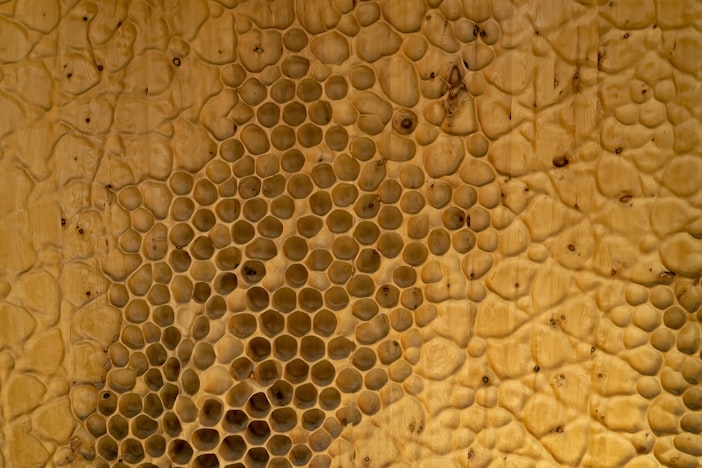
In 36 BC, Marcus Terentius Varro - a Roman scholar who wrote about everything from agriculture to linguistics - posed a question about honeycomb. Why hexagons? A plane can be tiled without gaps by three regular polygons: equilateral triangles, squares, and regular hexagons. Bees use hexagons. Varro suggested they did so because hexagons enclose the greatest area with the least perimeter - the most storage space for the least building material.
He was right. It took 2,063 years for someone to prove it mathematically.
Thomas Hales, a mathematician at the University of Michigan (later at the University of Pittsburgh), published the proof in 1999. The Honeycomb Conjecture, as it came to be known, states that a regular hexagonal grid is the most efficient way to partition a plane into equal areas with the least total perimeter. Hales proved it. The bees had been implementing it for roughly 100 million years prior to receiving formal mathematical confirmation.
The Wax
Beeswax is produced by four pairs of wax glands on the ventral (underside) surface of a worker bee's abdomen, in segments 4 through 7. The glands are most active in bees aged 12 to 18 days - the house bee stage - though older and younger bees can produce wax if colony needs demand it.
The wax is secreted as thin, oval flakes approximately 3 millimeters across. Each flake weighs about 1.1 milligrams. A bee produces 8 flakes at a time, one from each gland. The flakes are transparent when fresh and harden quickly on exposure to air.
To build comb, the bee transfers a wax flake from her abdomen to her mandibles using her hind legs. She chews the flake, mixing it with secretions from the mandibular glands. The chewing softens the wax and incorporates the secretions - which lower the wax's melting point slightly and improve its workability. The resulting putty is applied to the growing comb edge.
The metabolic cost is staggering. Bees consume approximately 6 to 7 kilograms of honey to produce 1 kilogram of wax. The conversion efficiency is roughly 15 percent - the rest is metabolic overhead, the energy burned to fuel the biochemical conversion of sugar to wax esters in the wax glands. A single frame of comb weighs about 100 grams and represents roughly 600 to 700 grams of honey consumed to build it. This is why beekeepers provide foundation - pre-pressed sheets of beeswax embossed with the hexagonal cell pattern - to give the bees a head start. Foundation reduces the amount of wax the bees need to produce by providing the midrib and cell base, so the bees only need to draw out the cell walls.
The Apiary Project tracks honey bee health data so you don't have to.
Explore the Data Hub →Not Hexagons
Here's where the standard story gets more interesting. Bees don't draw hexagons. They draw circles.
If you watch a bee building comb on fresh foundation (or on a bare top bar, if you use a top-bar hive), the cells she initially constructs are roughly circular. The walls are curved. The shapes are cylindrical, not hexagonal. The bee constructs a tube of wax, and each tube is more or less round.
The hexagonal shape emerges afterward, through a process that remained debated until relatively recently. Two mechanisms contribute.
Mechanical packing. When you pack circles as tightly as possible on a flat surface, each circle touches six neighbors. The contact pressure at those six points deforms the circles into hexagons - the same way soap bubbles pressed together form hexagonal patterns. The geometry of close-packing drives the shape change.
Thermal softening. Beeswax has a relatively low melting point - about 63 to 65 degrees Celsius - and becomes significantly softer and more pliable above 40 degrees Celsius. The brood nest is maintained at approximately 35 degrees Celsius, and bees actively heat the wax during construction by pressing their thoraxes against the comb and vibrating their flight muscles. A 2013 study by Bhushan Karihaloo and colleagues at Cardiff University showed that the heat generated by the bees' bodies is sufficient to soften freshly deposited wax to the point where surface tension forces - the same forces that shape soap bubbles - pull the cylindrical cells into hexagonal cross-sections.
The bees don't calculate hexagons. They build cylinders, heat them, pack them tightly, and physics does the rest. The hexagonal optimization that Varro admired and Hales proved isn't a design decision. It's an emergent property of circles pressed together at the right temperature.
This doesn't make it less impressive. It makes it more impressive. The bees produce a structurally optimal geometry without computing it - by engineering the conditions (temperature, packing density, wax composition) under which the optimal geometry self-assembles.
The Tilt
Each cell in a honeycomb is not horizontal. It tilts slightly upward - approximately 13 degrees from the horizontal plane. This tilt prevents liquid honey and uncured nectar from running out of the cells before they're capped. Freshly deposited nectar has a water content of 60 to 80 percent - it's essentially sugar water, and it would flow freely if the cells were level. The 13-degree tilt uses gravity to keep the liquid in place during the evaporation process that reduces the water content to 18 percent (the point at which the honey is considered ripe and the cell is capped).
The tilt is consistent across subspecies, across continents, across colony conditions. It's built into the construction behavior. When foundation is installed by a beekeeper, the bees draw out cells at the same 13-degree angle regardless of whether the foundation itself is perfectly vertical or slightly off. They compensate for the frame's orientation to maintain the tilt.
Cell Sizes
A natural brood comb contains two distinct cell sizes. Worker cells measure approximately 5.2 to 5.4 millimeters across (measured between parallel walls). Drone cells are larger - approximately 6.9 millimeters. The queen's decision on whether to lay a fertilized (worker) or unfertilized (drone) egg is influenced by the cell size she encounters: she measures each cell with her forelegs before turning and depositing an egg. A worker-sized cell gets a fertilized egg. A drone-sized cell gets an unfertilized one. The comb is, in effect, the colony's reproductive planning tool - the ratio of worker cells to drone cells determines the ratio of workers to drones in the population.
Foundation for managed hives is typically embossed with worker-cell-sized hexagons, which effectively suppresses drone production (since the bees don't have drone-sized cells to draw out). Some beekeepers use a single "drone frame" per hive with larger foundation or no foundation at all, allowing the bees to build drone comb in a controlled location. The drone frame serves a dual purpose: it satisfies the colony's drive to produce drones, and it can be removed and frozen to kill Varroa mites concentrated in the drone brood (mites preferentially infest drone cells because the longer development period gives their offspring more time to mature).
The natural cell size debate - the argument that foundation-imposed cell sizes are unnaturally large and that bees allowed to build natural comb produce smaller cells that resist Varroa - has been tested and mostly debunked. Studies comparing mite loads in colonies with small-cell foundation (4.9 mm) versus standard foundation (5.4 mm) generally find no significant difference in mite levels. The mites don't seem to care about the cell size within the range of natural variation.
Strength
A single cell wall in a honeycomb is approximately 0.05 to 0.10 millimeters thick. That's thinner than a sheet of paper. The wax itself has a tensile strength of roughly 1 MPa - not impressive compared to engineering materials. And yet a standard Langstroth deep frame of capped honey weighs about 8 to 10 pounds and is supported by a structure - the comb - that weighs about 100 grams.
The strength comes from the geometry. The hexagonal structure distributes load across a network of walls, each wall shared between two adjacent cells. The 13-degree tilt adds rigidity by preventing the cells from collapsing under shear stress. The midrib - the central sheet of wax from which cells extend on both sides - acts as a structural beam. The result is a structure that can hold roughly 22 times its own weight.
For comparison: a steel I-beam holds about 20 to 30 times its own weight depending on the loading configuration. A honeycomb made of wax by insects with brains smaller than sesame seeds achieves a strength-to-weight ratio in the same neighborhood as structural steel. This is why honeycomb geometry is used in aerospace engineering, sandwich panel construction, and packaging materials. The bees invented it. Boeing copied it.
The Building Process
Comb construction is a collective behavior - no single bee builds a cell from start to finish. Instead, a chain of bees works on the growing comb edge simultaneously. One bee deposits wax. Another shapes it. A third works on the adjacent cell. The coordination is achieved without a blueprint, a foreman, or a plan. Each bee responds to local cues: the angle of the wall she's working on, the thickness of the wax under her mandibles, the temperature, the presence of neighboring bees doing similar work.
When a colony needs comb urgently - when a swarm moves into a new cavity and needs to start storing food and raising brood immediately - the bees form "festoons": chains of bees hanging from the top of the cavity, linked leg to leg. The festoons mark the planes where comb will be built, establishing the parallel arrangement of combs with proper bee space between them. The wax-producing bees work within and along these chains, depositing and shaping wax simultaneously.
A strong colony on a heavy nectar flow can build a full frame of comb - about 8,000 cells on two sides - in roughly 3 to 5 days. The same colony during a dearth may build nothing for weeks. Comb construction is driven by the availability of honey (to fuel wax production) and the need for storage or brood space. It's demand-driven architecture.
The Communication Medium
Honeycomb isn't just storage and nursery. It's a communication channel. When a bee performs the waggle dance on the vertical surface of a comb, the vibrations travel through the wax. Nearby bees detect these vibrations through their legs. The comb acts as a transmission medium for vibratory signals that encode the location of food sources, the quality of potential nest sites, and colony-level alerts.
The mechanical properties of the comb affect signal transmission. New comb - fresh, pure beeswax - transmits vibrations differently than old comb, which has been reinforced by cocoons (each brood cycle leaves a cocoon lining inside the cell, and after 10 to 15 brood cycles the cells become noticeably darker and smaller as the cocoon layers accumulate). Old comb is stiffer and denser. It may transmit dance signals over longer distances but with different frequency characteristics.
Propolis applied to the comb surface changes its vibratory properties too. The colony is continuously modifying the medium through which it communicates, which means the communication channel co-evolves with the infrastructure.
The Third Body
The honeycomb has been described by biologists as "the third body of the colony." The first body is the queen - the reproductive center. The second body is the mass of workers - the labor force, the immune system, the thermoregulatory apparatus. The third body is the comb - the skeleton, the pantry, the nursery, the communication network, and the memory of the colony.
A colony's comb contains chemical information about its history. Pheromone residues, propolis deposits, brood cocoon accumulations, and trace amounts of pesticide residues absorbed from the environment all persist in the wax. A swarm that moves into a cavity previously occupied by a healthy colony finds chemical signals of "bees lived here successfully" embedded in the old comb. A swarm that moves into a cavity where the previous colony died of foulbrood finds spores that will infect the new colony.
This is why beekeeping equipment management matters. Old comb accumulates contaminants. Miticides, fungicides, and pesticides brought back by foragers dissolve into the wax and concentrate over time. Studies have found detectable residues of 121 different pesticides in beeswax samples from managed hives. The third body of the colony absorbs the chemical environment and presents it to every larva that develops inside its cells.
And this is why some beekeepers rotate comb on a schedule - replacing the oldest frames with new foundation every few years, so the third body is refreshed and the accumulated chemical history is reset. The bees build new comb. They spend 600 grams of honey per frame to do it. The investment is worth it because the alternative is raising brood in cells lined with 15 generations of cocoons and whatever the foragers brought home from the cornfield.
100 Million Years
Hexagonal comb has been found in the fossil record dating to approximately 100 million years ago. The geometry predates Apis mellifera. It predates the genus Apis. It appears in the nests of social wasps, in the combs of stingless bees, and in structures built by species that diverged from the honey bee lineage tens of millions of years before modern bees existed.
The hexagonal solution to the problem of efficient tiling was discovered independently by multiple lineages because the physics is universal. Circles pressed together in a plane become hexagons. Insects that build storage cells from wax or paper or mud, at temperatures where the material is workable, arrive at hexagons the same way soap bubbles do - through the geometry of close-packing and surface tension minimization.
Varro saw the hexagons in 36 BC and asked why. Hales proved the optimality in 1999. Karihaloo showed the thermal mechanism in 2013. The bees didn't read any of them. They've been building the same structure, at the same 13-degree tilt, with the same 0.05-millimeter wall thickness, using wax flakes that weigh 1.1 milligrams each, secreted from glands that are most active at 15 days old, heated by thoracic muscles that maintain 35 degrees Celsius in the brood nest - and arriving at a structural geometry that aerospace engineers describe as optimal.
The brain that does all this weighs less than a milligram. The comb it produces holds 22 times its own weight. And the first mathematician to prove why it works was born about 99,999,900 years after the first bee figured it out.