American Foulbrood (Why the Only Legal Treatment Is Fire)
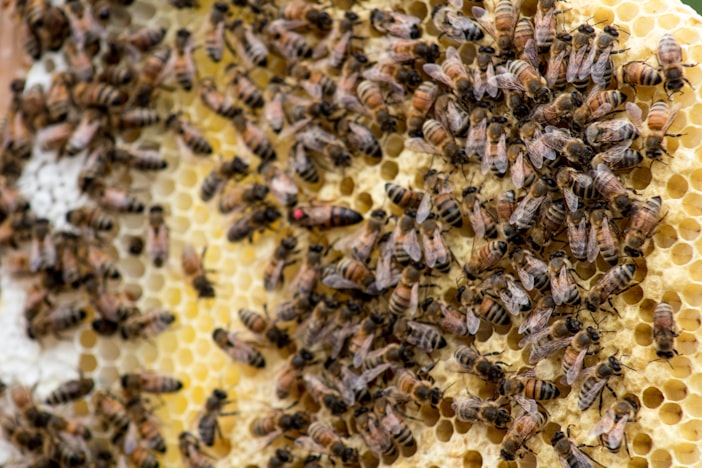
The disease smells like something died. That's the first thing every beekeeper learns about American foulbrood, and it's the thing that stuck with Adam Gottlob Schirach when he first documented it in Germany in 1769 - the foul smell rising from brood frames that should have smelled like warm wax and pollen. He called it foulbrood. The name, unlike almost everything else about the disease, turned out to be perfectly straightforward.
What Schirach didn't know - what nobody would know for another 137 years - was that the smell came from larvae being dissolved from the inside by a bacterium so resilient that its spores would outlast the hive, the beekeeper, and in some documented cases, the beekeeper's grandchildren.
8 Spores
The pathogen is Paenibacillus larvae, a Gram-positive, spore-forming bacterium first isolated in 1906 by G.F. White, a USDA entomologist who named it Bacillus larvae after fulfilling Koch's postulates - the gold standard for proving that a specific microorganism causes a specific disease. The bacterium was reclassified to Paenibacillus in 1993 and combined into a single species in 1996, which is the kind of taxonomic housekeeping that matters to microbiologists and nobody else.
What matters to beekeepers is the infectious dose: approximately 8 spores.
Not 8,000. Not 800. Eight. The LD50 - the dose at which half of exposed larvae die - is 8.49 spores, plus or minus 1.49, in larvae aged 24 to 28 hours. Hansen and Brodsgaard pinned down that number in 1999. Eight spores, ingested by a larva barely a day old, carried in contaminated food delivered by nurse bees who have no idea they're poisoning the brood they're trying to feed.
The spores germinate in the larval midgut. Vegetative bacteria proliferate massively - silently, invisibly - before attacking and breaching the midgut epithelium. The larva dies. It doesn't die quickly. It dies slowly enough to be sealed in its cell by workers who cap it on schedule, not realizing what's happening underneath. And then the dead larva decomposes into a brown, ropy mass that produces over one billion new spores.
One larva. Eight spores in. One billion spores out. The math is the kind of exponential that epidemiologists have nightmares about.
The Apiary Project tracks every major threat to US honey bee colonies.
Explore the Issues Hub →The Matchstick Test
The field detection method for American foulbrood has remained essentially unchanged since before anyone understood what caused it, and it works like this: insert a matchstick, toothpick, or twig into a cell containing suspect dead brood. Twist. Slowly withdraw.
If the brown, mucous-like mass ropes out of the cell 2.5 centimeters or more - stretching into a stringy, elastic thread between the stick and the cell wall - it's AFB. The roping is diagnostic. European foulbrood, a different disease caused by a different bacterium, ropes to about 1.5 centimeters. AFB ropes 3 to 5 centimeters. The distinction matters because the response to each disease is entirely different.
The visual signs fill in the rest: sunken cappings, darker and greasier than healthy brood, some perforated with small holes. A spotty brood pattern - live larvae scattered among dead ones in a patchwork that healthy colonies don't produce. The dead larvae progress from dull white to coffee brown to nearly black. And eventually, dried remains called "scale" - flat, dark, firmly adhered to the lower cell wall, essentially impossible to remove without destroying the comb.
And the smell. Always the smell. A sulfurous, rotting-meat odor that experienced beekeepers can detect from several feet away. The name foulbrood has lasted 255 years because the first thing about the disease that hits you is still the stench.
The Disease That Built Regulation
Here is the part that rarely makes it into the casual telling: American foulbrood is, in a meaningful legal and institutional sense, the reason state apiary inspection programs exist.
The first apiary inspection law in the United States was established in San Bernardino County, California, in 1877. California had statewide law by 1883. By 1906 - the same year White identified the pathogen - 12 states had foulbrood laws. Pennsylvania passed its first beekeeping law in 1921, in direct response to a major AFB outbreak. Florida built the largest state apiary inspection program in the country, with over 14 apiary inspectors, primarily to track and contain foulbrood.
The regulatory infrastructure that governs American beekeeping today - registration of apiaries, permits for interstate movement, certificates of inspection, inspector right of entry, requirements for movable-frame hives, quarantine powers, prohibition on sale of diseased material - all of it traces back, directly and explicitly, to foulbrood. Not varroa mites. Not colony collapse. Not pesticides. Foulbrood. A bacterial disease that was devastating colonies before the automobile existed.
In the 1870s, California experienced an outbreak that affected an estimated 90% of colonies statewide. The 1920s saw AFB described as "a huge problem killing hives and causing the loss of thousands of dollars for US beekeepers." These weren't abstract policy concerns. They were crises that forced state governments to create an entirely new category of agricultural regulation - one that gave government officials the legal authority to enter private property, inspect privately owned livestock, and in many cases, destroy it.
Fire
The mandated response to American foulbrood in most US states is burning. Not treatment. Not quarantine-and-observe. Fire.
Georgia: any apiary found infected with AFB shall be placed under quarantine; all infected hives immediately destroyed by burning under supervision of the Commissioner. California: infected hives must be burned; ashes buried at least two feet deep. Illinois: infected colonies must be destroyed by burning or burying per inspector directives. Iowa: severely infected, weak colonies must be killed and diseased combs destroyed by burning or melting at temperatures high enough to kill spores.
The burning mandate exists because of what happens when you don't burn. The spores of Paenibacillus larvae remain viable for 40 years or more on contaminated equipment. Some sources document viability exceeding 70 years. The spores resist freezing. They resist desiccation. They resist standard boiling - water at 212 degrees Fahrenheit is not hot enough. They resist most chemical disinfectants. A contaminated hive body sitting in a barn, a frame stored in a garage, a tool used once on an infected colony and never sterilized - all of these remain dangerous for decades.
The only reliable methods for sterilizing equipment without burning it: gamma irradiation using cobalt-60, ethylene oxide gas treatment, or sustained high-temperature autoclaving at 120 degrees Celsius for 20 or more minutes under pressure. None of these are available to a typical beekeeper. None of them are cheap. The practical reality for most beekeeping operations is that AFB-positive equipment gets burned, and the colony replacement cost - $200 or more per colony - gets absorbed as a loss.
Michigan softens the blow slightly: state law mandates indemnity of 75% of fair market value of destroyed colonies. In 2018, USDA reimbursed at least 75% of fair market value, equating to at least $105 per colony loss and $193 per hive loss. But most states offer no compensation. The burning is compulsory. The financial loss is yours.
The Antibiotic Era (and Why It Ended)
Since the 1950s, oxytetracycline - brand name Terramycin, often shortened to OTC - was the only approved treatment for American foulbrood in the United States. It suppressed the disease. It did not cure it. This distinction matters more than almost any other fact about AFB treatment.
Antibiotics kill vegetative bacteria - the active, growing form of P. larvae. They do not kill spores. When treatment stops, the spore reservoir remains. The disease returns. Oxytetracycline doesn't eliminate AFB. It masks it. For decades, commercial beekeepers used OTC prophylactically - as a preventive measure, applied routinely whether disease was present or not - because the economics of losing colonies to AFB were worse than the economics of continuous antibiotic use.
The predictable consequence arrived on schedule: antibiotic resistance. Approximately 16% of North American P. larvae isolates now show oxytetracycline resistance. In Argentina, the figure is roughly 40%. Resistance spread was accelerated by migratory beekeeping - colonies from wide geographic areas mixing during pollination contracts, exchanging pathogens and resistant strains across state lines.
In 2005, USDA approved tylosin (brand name Tylan) as an alternative after OTC resistance became widespread. By 2017, tylosin-resistant and lincomycin-resistant strains of P. larvae had been detected in the United States. The resistance treadmill - new antibiotic, resistance develops, newer antibiotic, resistance develops again - was running exactly as microbiologists had predicted it would.
Then the FDA changed the rules. Starting January 1, 2017, beekeepers using antibiotics for AFB or European foulbrood must obtain a prescription or Veterinary Feed Directive from a licensed veterinarian. This was part of the FDA's broader phase-out of over-the-counter antibiotics for food-producing animals, begun in December 2013. The regulation applied to all three approved antibiotics: oxytetracycline, tylosin, and lincomycin.
The practical effect: many beekeepers, particularly hobbyists with no established veterinary relationship, stopped using antibiotics entirely. The concern within the industry is straightforward - decades of prophylactic antibiotic use suppressed latent infections across millions of colonies. As that prophylactic blanket lifts, those latent infections have nowhere to hide.
The Hidden Reservoir
An estimated 25% of spore-producing colonies remain undetected by visual inspection. The brown scale, the sunken cappings, the ropy brood - these are symptoms of advanced disease. By the time a beekeeper sees them, the colony has been producing and distributing spores for weeks or months.
This is why newer detection methods are generating genuine excitement in apiary inspection circles. The Foster method, published in the Journal of Apicultural Research in 2024, uses environmental DNA sampling from colony entrance swabs combined with dual-target qPCR for P. larvae. It can detect clinically significant infections before visual symptoms appear, without opening the hive. A LAMP assay - Loop-Mediated Isothermal Amplification - targets the GyrB gene region with 97% diagnostic sensitivity and 98% specificity, producing results in under 20 minutes.
The USDA Bee Disease Diagnosis Service in Beltsville, Maryland - operating since 1891, which makes it older than every state apiary inspection program it supports - received 4,790 brood samples between 2015 and 2022. Their data shows AFB infection levels remaining relatively constant over that eight-year period. European foulbrood, meanwhile, showed a statistically significant upward trend, peaking in 2022. The diseases are moving in different directions, and nobody is entirely sure why.
A Saskatchewan study from 2019-2021 detected P. larvae spores in 753 of 1,476 honey samples - 51%. Half of all honey samples contained the pathogen's spores. Not clinical disease. Not symptomatic colonies. Just spores, sitting in honey, waiting.
The Virus That Eats the Bacteria
At Brigham Young University, researchers have been working on something that sounds like science fiction but is actually one of the oldest ideas in microbiology: using viruses to kill bacteria.
Bacteriophages - viruses that infect and destroy specific bacterial species - were discovered in the early 20th century and largely abandoned in Western medicine after antibiotics arrived. They never went away in Eastern European medicine, particularly in Georgia (the country), where phage therapy has been practiced continuously since the 1930s.
The BYU team identified phage PL.Ph-1, which does something that most bacteriophages don't: it adsorbs to both vegetative cells and endospores of P. larvae. This is critical because the spores are the entire problem. An intervention that kills only vegetative bacteria - which is what antibiotics do - leaves the spore reservoir intact. A phage that attaches to spores represents a fundamentally different approach.
The research is still in the laboratory. No phage therapy product is commercially available for beekeepers. But the work by Elke Genersch, Julia Ebeling, and Anne Fünfhaus at the Institute for Bee Research in Hohen Neuendorf, Germany - who identified two novel toxins expressed by P. larvae that drive the pathogenesis - is steadily filling in the molecular picture of how the bacterium actually kills larvae. Understanding the mechanism is the prerequisite for designing better interventions, whether pharmaceutical, biological, or genetic.
One Billion Spores
The economics of AFB are straightforward and brutal. A single outbreak in one apiary can result in losses of up to $10,000. AFB reduces honey production by 50% within an infested colony before it's detected. No standard beekeeping insurance in the United States covers AFB losses. The only equivalent - BDI (Bee Diseases Insurance Ltd) - exists only in England and Wales, covering equipment at a maximum of 150 GBP per hive.
The 2024-2025 season saw commercial beekeepers report average colony losses of 62% between June and February. AFB isn't the primary driver of those numbers - that distinction belongs to varroa - but it remains the disease that, once confirmed, triggers the most absolute response. Varroa can be treated. Nosema can be managed. Small hive beetles can be trapped. American foulbrood gets the match.
Eight spores infect a larva. The larva produces a billion spores. Those spores survive for decades on any surface they contact. The mandated response is destruction by fire. The regulatory apparatus of American beekeeping was built specifically to contain this disease. And after 255 years of knowing about it, 118 years of understanding what causes it, and 70 years of throwing antibiotics at it, the fundamental reality hasn't changed: the only thing that reliably eliminates American foulbrood from beekeeping equipment is heat sufficient to destroy the spores.
The matchstick still ropes. The states still burn. And 51% of honey samples still carry spores of a bacterium that needs only eight of them to begin the cycle again.