Bee Suits (How Protection Evolved From Animal Hides to Ventilated Mesh)
In 16th-century Europe, beekeepers wore wicker masks.
Take a moment with that. Wicker. The material your grandmother's patio furniture is made of. Someone looked at an angry colony of 50,000 stinging insects and thought: I'll protect my face with the same technology used to make baskets. The masks covered the face and neck but offered, by all reasonable assessment, essentially zero visibility and questionable protection. The bees were probably as confused as the beekeepers.
Four hundred years later, the protective equipment hasn't just improved - it's undergone a transformation driven by a lingerie manufacturer, a Quaker beekeeper who didn't own a veil, and the evolutionary reason that bears are a specific color. The story of bee suits is, in a way no one planned, the story of humans trying to negotiate a truce with an organism that doesn't negotiate.
Why Everything Is White
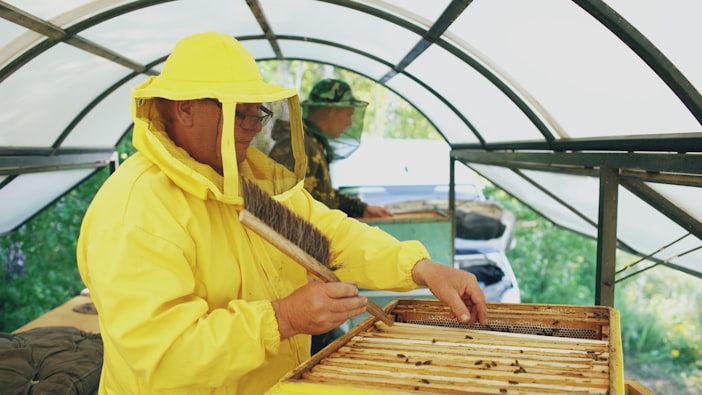
Bee suits are white. Not because white is traditional, or because beekeeping has a dress code, but because bears are brown.
The logic traces back through millions of years of evolutionary pressure. Honey bee colonies' primary natural predators - bears, raccoons, skunks, mice - are dark-colored and furry. Over evolutionary time, bees developed heightened defensive responses to dark objects approaching the hive. Research from the University of California San Diego confirmed what beekeepers have observed anecdotally for centuries: bees target dark spots on a suit with significantly more stings than white areas.
The behavioral evidence is stark. When working aggressive colonies, beekeepers wearing white suits with dark patches (dirt, stains, pen marks) consistently find the dark areas peppered with stingers while the white fabric remains mostly unstung. Bees see dark and read "predator." Bees see white and read "not interesting."
White also happens to reflect sunlight rather than absorbing it, which matters when the primary beekeeping season runs May through September and the protective equipment adds a full layer of clothing over whatever you're already wearing. A dark bee suit in a July bee yard in Georgia would be an engineering failure on two fronts: attracting more stings and cooking the beekeeper.
The result is an entire industry dressed in white, working under open sky, looking - from a distance - like a convention of hazmat technicians who wandered into a farm.
The Apiary Project has free tools for beekeepers - calculators, schedulers, and seasonal guides.
Browse the Tools →The Bra Makers
The modern self-supporting bee veil exists because of Brian and Pat Sherriff, and the story of how they got there might be the most improbable supply chain in agricultural equipment.
In the mid-1960s, Brian and Pat were running a clothing manufacturing business in South Cornwall, England. Their clients included Marks & Spencer. Their specialties included military uniforms, lingerie, corsetry, and swimwear. They also happened to take up beekeeping, eventually building their South Cornwall Honey Farm to 400 hives.
The problem was the existing protective equipment. Traditional veils required hats - wide-brimmed affairs that held the mesh away from the face. They were cumbersome, hot, and made it hard to see the bees clearly. Brian and Pat looked at this situation with the eyes of professional garment engineers who had spent years working with wire-supported fabrics and structural textiles.
In 1968, they applied their expertise in - there's no delicate way to say this - bras and corsets to create the first "No Hat Needed" lightweight, self-supporting hood with UV-resistant veiling. The structural principles that kept underwire bras in shape turned out to work remarkably well for keeping bee veils away from faces. The same engineering that made swimwear comfortable in heat made bee hoods breathable.
The BJ Sherriff Apiarist suit has been a best-seller for more than 50 years. People are still wearing Sherriff suits from the 1980s. The company went from making lingerie for British department stores to outfitting beekeepers worldwide, and the bridge between those two industries was a couple who got tired of wearing a hat while inspecting their hives.
Moses Quinby Didn't Own a Veil
Moses Quinby - the same Quaker from New York who invented the modern bee smoker - initially didn't use a veil because he didn't know they existed. He covered the back of his head and neck with a handkerchief. That was the protection. A handkerchief.
This was the mid-1800s, when beekeeping protective gear consisted of whatever you happened to find in the house that morning. The progression from handkerchiefs and wicker masks to modern three-layer ventilated suits tracks roughly alongside the professionalization of beekeeping itself. As hive management moved from "occasional interaction with wild bees" to "commercial enterprise involving thousands of colonies," the equipment evolved from "hope for the best" to actual engineering.
The Stinger Math
A honey bee's stinger is approximately 1.5 millimeters long. The tip is barbed, which is why it remains embedded in skin after stinging - the bee can't retract it and dies as her venom sac tears from her abdomen. (Drones, for the record, have no stinger at all. One of the few advantages of the drone's otherwise challenging existence.)
The protective principle behind modern bee suits is straightforward: keep fabric far enough from skin that the stinger can't reach through. A single layer of cotton or polyester - the kind used in basic bee suits - stops many stings, but if the fabric presses against the skin, a stinger can penetrate through and reach you anyway. This is why beekeepers in single-layer suits still get stung at pressure points: elbows, knees, shoulders, anywhere the fabric compresses.
The three-layer ventilated suit solved this by sandwiching a thick mesh layer between two outer fabric layers. The total thickness comes to approximately 5 millimeters - more than three times the length of a stinger. Even when compressed against the body, the mesh creates enough standoff distance that the stinger can't reach skin. The outer fabric catches the stinger, the mesh absorbs the remaining length, and the inner fabric sits undisturbed against the body.
This is also why ventilated suits breathe: air circulates through the mesh layer while the overall structure remains too thick for stinger penetration. The same design that stops stings also stops the greenhouse effect that makes traditional suits miserable in warm weather. It's that rare engineering outcome where the solution to one problem accidentally solves another.
The Price Spectrum
The range of protective equipment pricing tells its own story about who keeps bees and what they're willing to spend.
At the entry level: a basic veil - the minimum protection that covers only the head and face - runs $15-30. A cotton or poly-cotton jacket with attached veil costs $30-60. A full-body suit with veil in the same materials runs $50-100. These are the suits that work fine on gentle colonies during warm nectar flows and become noticeably insufficient on cloudy days, during nectar dearths, or with any colony expressing the genetic anger of Africanized stock.
The mid-range: Dadant's economy ventilated suit runs $152.95. Their standard full suit is $128.95. Mann Lake offers a range from basic to their ProVent professional-grade suit. These represent the mainstream commercial beekeeper's equipment - functional, durable, replaceable without significant financial distress.
At the premium end: the Ultra Breeze jacket (with hood) retails at $179. The Ultra Breeze full jumpsuit with hood costs $289. BJ Sherriff's Apiarist suit - the one descended from corsetry engineering - commands similar pricing in the premium tier. These are the suits that commercial beekeepers running aggressive colonies or hot-climate operations gravitate toward after calculating that $289 once is cheaper than hating your job every day from May through September.
Gloves add another $15-50. The irony of beekeeping gloves is that they protect hands at the cost of dexterity - thick leather gloves make it harder to handle frames gently, which agitates bees, which makes gloves more necessary. Many experienced beekeepers work barehanded for this reason, accepting occasional stings as the price of being able to feel what they're doing. It's a calculated trade-off, and the calculation changes colony by colony, day by day.
72 Deaths Per Year
The CDC documented 788 deaths from hornet, wasp, and bee stings in the United States between 2011 and 2021 - an average of 72 deaths per year. During the earlier period of 2000-2017, 1,109 deaths occurred, averaging 62 per year. The annual count ranged from 59 (2012) to 89 (2017). Eighty-four percent of those deaths were among males.
Most fatalities result from anaphylaxis - a systemic allergic reaction that can cause fatal drops in blood pressure and airway closure within minutes. Anaphylaxis from Hymenoptera stings affects approximately 3% of the general population, with life-threatening reactions in 0.4-0.8% of children and 3% of adults.
These numbers put bee suits in a different context. For the 95% of hobbyist beekeepers who manage the vast majority of American beekeeping operations, protective equipment isn't just comfort gear - it's medical equipment. The $50 suit that keeps a beekeeper from taking multiple stings during an inspection isn't preventing inconvenience. For anyone with an undiagnosed Hymenoptera allergy, it's preventing a medical emergency in a field that's typically 20 minutes from the nearest hospital.
The math of protective equipment value is impossible to calculate precisely and extremely easy to calculate emotionally: the suit is worth whatever it costs the first time it stops the sting that would have sent you to the ER.
The Arc From Wicker to Mesh
The progression tells a story about the relationship between humans and honey bees.
For most of beekeeping's 9,000-year history, the protective equipment was "deal with it." Smoke helped. Careful movement helped. But fundamentally, keeping bees meant accepting stings as part of the transaction. The earliest beekeeping was effectively honey hunting - raiding wild colonies for their stores. Protection meant being fast.
The shift to managed hives changed the calculus. You couldn't be fast with a colony you were planning to keep alive. You needed to be careful, methodical, thorough. You needed to spend 30-45 minutes per hive, twice a month, during the entire active season. The longer you spend near bees, the more stings you accumulate. The equipment had to evolve because the task changed.
And so it went: from handkerchiefs to veils, from veils to jackets, from jackets to full suits, from single-layer cotton to three-layer ventilated mesh - each step driven by beekeepers who got stung enough to spend money preventing the next sting. The Sherriffs got tired of their hats. Moses Quinby didn't know veils existed until someone showed him one. Some beekeeper in 16th-century Europe thought wicker sounded like a good idea and learned otherwise.
The bees, for their part, haven't changed their approach at all. Dark objects near the hive still trigger defensive behavior. Stingers are still 1.5 millimeters long. The alarm pheromone that smoke temporarily suppresses still cascades through the colony when a single guard bee decides you're a bear.
The bees keep stinging. The suits keep improving. The handkerchief era is over. The wicker era is definitely over. But the negotiation continues, one inspection at a time, in a white suit, under open sky, with 50,000 opinions about whether you should be there.