The Langstroth Hive (How One Measurement Changed Beekeeping Forever)
Lorenzo Lorraine Langstroth was born on Christmas Day, 1810, in Philadelphia. He graduated from Yale in 1831, married Anne Tucker in 1836, and became a Congregational minister. He was, by all accounts, a gifted preacher - empathetic, intellectually rigorous, genuinely concerned with the spiritual welfare of his parishioners. He was also, by all accounts, periodically incapable of getting out of bed.
He called it "head trouble." It would arrive without warning - sometimes triggered by stress, sometimes by nothing at all - and when it came, it shut everything down. Sermons canceled. Classes abandoned. Weeks lost. The young minister felt he wasn't effective because of his recurring dark days, so he quit preaching and became principal of a women's school instead. The head trouble followed him there too. He was, in modern terms, severely manic-depressive, cycling between periods of intense productivity and periods of complete collapse, and he lived in a century that had no language for what was happening to him and no treatment beyond willpower and prayer.
Bees were the only thing that helped. Not fixed. Helped. In 1838, the sight of a honeycomb built inside a glass globe on a friend's table revived a childhood fascination, and from that point forward, bees became the one constant in a life defined by disruption. He set up an apiary in West Philadelphia after moving there in 1848. He kept bees not as a hobby or a business but as a form of survival - the only occupation that could absorb his full attention during good periods and wait patiently during bad ones.
And in the summer of 1851, working with his hives, he noticed something that would change everything about how humans keep bees. Something so obvious that thousands of beekeepers before him had seen it without understanding what they were looking at.
The 3-Millimeter Window
The observation was this: bees are construction obsessives with extremely specific tolerances.
Leave a gap of less than 6 millimeters - about a quarter inch - inside a hive, and bees seal it with propolis, the resinous substance they manufacture from tree sap. They treat anything smaller than 6 millimeters as a crack, a vulnerability, something that needs filling. Leave a gap of more than 9 millimeters - about three-eighths of an inch - and bees build comb in it. They treat anything larger than 9 millimeters as construction space, an invitation to extend the wax architecture. But between 6 and 9 millimeters - in that narrow 3-millimeter window - bees do neither. They leave it alone. They use it as a passageway, a corridor, a space for two bees to pass back-to-back while working on adjacent combs.
This is bee space. The gap that bees choose, instinctively, to maintain as functional architecture. Not sealed. Not filled. Just left open, at a width that corresponds almost exactly to the space needed for bee traffic.
Every beekeeper before Langstroth had encountered this behavior. Every beekeeper had pried apart frames glued together with propolis or scraped off burr comb built in spaces that were too wide. The information was universal. The insight - that a hive designed to maintain bee space everywhere, on all sides of every frame, would produce combs that never stuck to anything - was Langstroth's.
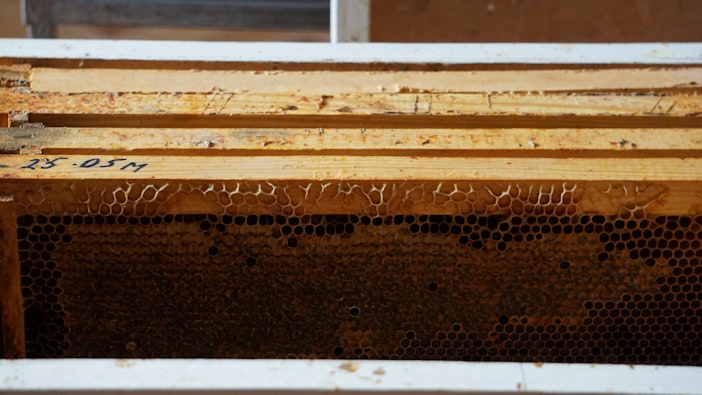
On October 30, 1851, he drew the design in his journal: a frame that hung inside a box with bee space above, below, and on both sides. The frame could be lifted out without cutting, without destroying comb, without killing bees. The honey could be extracted. The frame could be put back. The colony continued as if nothing had happened.
The Apiary Project has free tools for beekeepers - calculators, schedulers, and seasonal guides.
Browse the Tools →What Came Before
To understand what Langstroth's design replaced, picture a skep - the domed straw basket that appears on honey jar labels and has been the visual symbol of beekeeping for centuries. Skeps were the standard beehive from roughly the Bronze Age through the 1800s. The bees built their comb directly attached to the interior walls and ceiling. There was no way to inspect the colony without destroying the structure. There was no way to harvest honey without cutting out the comb. And there was no way to do either of those things without killing a significant portion of the colony - often deliberately, often with sulfur fumes.
Beekeeping with skeps was, functionally, an annual cycle of colonize-harvest-destroy. You let the bees build up over spring and summer, killed or weakened the colony in autumn to take the honey, and hoped a new swarm would move in the following spring. It worked in the sense that it produced honey. It didn't work in the sense that you had to start over every year.
Various attempts at improvement preceded Langstroth. Francois Huber - a Swiss naturalist who, in one of natural history's better ironies, was nearly blind - invented the "leaf hive" in 1789: frames that opened like the pages of a book, allowing observation without destroying the colony. Huber's hive was brilliant for research and impractical for production. Charles Darwin owned a copy of Huber's published observations and referenced them in On the Origin of Species.
Jan Dzierzon, a Polish-Silesian priest and apiarist, came closer. In 1838 he devised movable-comb hives, and by 1848 he had introduced grooves into hive sidewalls measuring 8 by 8 millimeters - squarely within bee space range. Dzierzon understood the measurement. He published it. What he didn't do was build a fully enclosed, standardized hive system that applied the measurement consistently to every surface.
That was Langstroth's contribution. Not the discovery that bees maintain specific gaps - Dzierzon had that. Not the concept of movable frames - Huber had that. The contribution was the engineering: a practical, producible, standardized box where every dimension respected bee space, creating frames that could be removed, inspected, rearranged, and replaced without any of the destruction that had defined beekeeping for two thousand years.
Patent 9,300
On October 5, 1852, the United States Patent Office issued Patent 9,300 to L.L. Langstroth for "Beehive." The patent described a hive with removable frames suspended in a box, maintaining bee space on all sides. Langstroth also published Langstroth on the Hive and the Honey-Bee: A Bee Keeper's Manual in 1853 - the first comprehensive, scientifically grounded beekeeping text in the United States.
Then he tried to make money from it.
He sought one dollar per hive as a licensing fee. In the 1850s, that was significant money. It was also unenforceable. The design was so simple, so obviously correct once you saw it, that anyone with a saw and some lumber could build one. Minor modifications were touted as significant improvements to circumvent the patent. People who traveled with Langstroth, posed as friends, learned his methods, and then went home and built competing hives based on what he'd shown them.
Langstroth began lawsuits against the more flagrant violators. And then, as lawsuits do, they generated stress. And stress, for Langstroth, triggered the head trouble. The litigation collapsed when his illness prevented a spirited defense. He dropped the cases when he realized he could not win - not because the patent was invalid, but because he could not sustain the fight.
He was, as one biographer noted, "deceived and literally robbed." Legal contests left him destitute. He earned nothing from his invention. Not one dollar of the licensing fee he'd requested. By the 1880s, with failing health and no income from the design that was rapidly becoming the global standard, he sold his book to Charles Dadant - a French-American beekeeper in Hamilton, Illinois who had already translated it into French. The book has been in continuous print for over 170 years. It went through more than 40 editions. Langstroth's name is on every one. His estate benefited from none of them.
The Cast of Characters
The history of American beekeeping in the second half of the nineteenth century reads like a small-town novel where everyone knows everyone and the technology advances through personal relationships and grudges.
Charles Dadant, who bought Langstroth's book, founded Dadant & Sons in 1863. The company is still operating. Dadant developed his own frame size - 12 by 13 inches, larger than Langstroth's - which became the standard in France and parts of Europe. He imported 250 Italian queen bees to the US in 1874, fundamentally altering the genetic stock of American apiaries.
Amos Ives Root, born in Ohio in 1839, started beekeeping as a hobby and turned it into an industry. He founded Gleanings in Bee Culture journal in 1873, published The ABC of Bee Culture - which became a worldwide reference - and built the A.I. Root Company into a manufacturing empire producing hives, foundation, and equipment. Root did more than anyone to popularize Langstroth's design, making it available to hobbyists and commercial operators alike.
Samuel Wagner introduced Langstroth to Dzierzon's work after visiting Dzierzon's apiaries in Silesia. August Adolph von Berlepsch, working independently in Thuringia, incorporated bee space into his own frame arrangement by May 1852 - months before Langstroth's patent was granted. The intellectual history is messier than any single-inventor narrative suggests. Langstroth is rightly called the father of American beekeeping, but the baby had several midwives.
The Hive in 2026
Langstroth equipment accounts for approximately 75 percent of beekeeping equipment worldwide. In North and South America and Australasia, the percentage is higher. Over 90 sub-species and variations of the "Langstroth standard" exist, some totally incompatible with each other, but they all share the same fundamental principle: bee space maintained on all surfaces.
The standard 10-frame deep box has internal dimensions of 18 3/8 by 14 3/4 inches. The deep frame is 9 1/8 inches deep. A full deep box of honey weighs approximately 80 pounds - a number that becomes relevant when you're a commercial beekeeper lifting dozens of them per day, or an aging hobbyist whose back has opinions about the weight.
The 8-frame variant addresses the weight problem: roughly 64 pounds per deep box, a 20 percent reduction. The 8-frame format has been gaining ground among hobbyists and smaller operations, though 10-frame remains the commercial standard because of accessory availability and the fact that existing infrastructure is built around it.
Medium boxes - 6 5/8 inches deep - have spawned the "all-medium" approach, where beekeepers use one box size for both brood and honey, simplifying inventory and making every frame interchangeable. Shallow boxes at 5 11/16 inches are primarily honey supers - lighter to lift, quicker to fill.
The alternatives exist and have their advocates. The Warre hive, designed by French monk Abbe Emile Warre, uses smaller square boxes with top bars instead of full frames, attempting to replicate hollow-tree conditions. Top-bar hives go horizontal instead of vertical, eliminating heavy lifting entirely but requiring more skill and producing less honey. Neither has made serious inroads against the Langstroth design, because the Langstroth design does the one thing that matters most for both commercial pollination and honey production: it standardizes everything. Frames from one manufacturer fit boxes from another. Equipment from one beekeeper can be transferred to another. The whole supply chain - from foundation to extractors to shipping pallets - assumes Langstroth dimensions.
The Pulpit
Langstroth spent his final years in Dayton, Ohio, where he had moved to be near his daughter. He continued to keep bees. He continued to experience the head trouble that had defined his adult life. He continued to preach, intermittently, when the darkness lifted long enough.
On October 6, 1895, he stood at the pulpit of the Wayne Avenue Presbyterian Church in Dayton. He was 84 years old. He was about to begin a sermon on the love of God when he collapsed and died.
He is buried at Woodland Cemetery and Arboretum in Dayton. A monument was erected "to the memory of Rev. L.L. Langstroth, 'Father of American Beekeeping,' by his affectionate beneficiaries who, in the remembrance of the service rendered by his persistent and painstaking observations and experiments with the honey bee, his improvements in the hive, and the literary ability shown in the first scientific and popular book on the subject of beekeeping in the United States, gratefully erect this monument."
The man who couldn't enforce a patent on the most important invention in beekeeping history - who was robbed by friends, bankrupted by litigation, and abandoned by a legal system that couldn't protect an idea too simple to defend - got a monument instead of royalties. The journal he kept, with that October 30, 1851 drawing of a frame hanging in a box, is now digitized and freely available through Cornell's Biodiversity Heritage Library. The hive design he created is used by millions of beekeepers on every continent except Antarctica.
And the bee space - 6 to 9 millimeters, a 3-millimeter tolerance window that bees enforce with the precision of a manufacturing spec - is still exactly what it was in 1851. The bees haven't changed the measurement. They haven't needed to. It was right the first time. The only thing that changed was that, after several thousand years of beekeeping, a depressed minister in Philadelphia finally noticed.