Asian Giant Hornet (What Actually Happened After the Murder Hornet Hype)
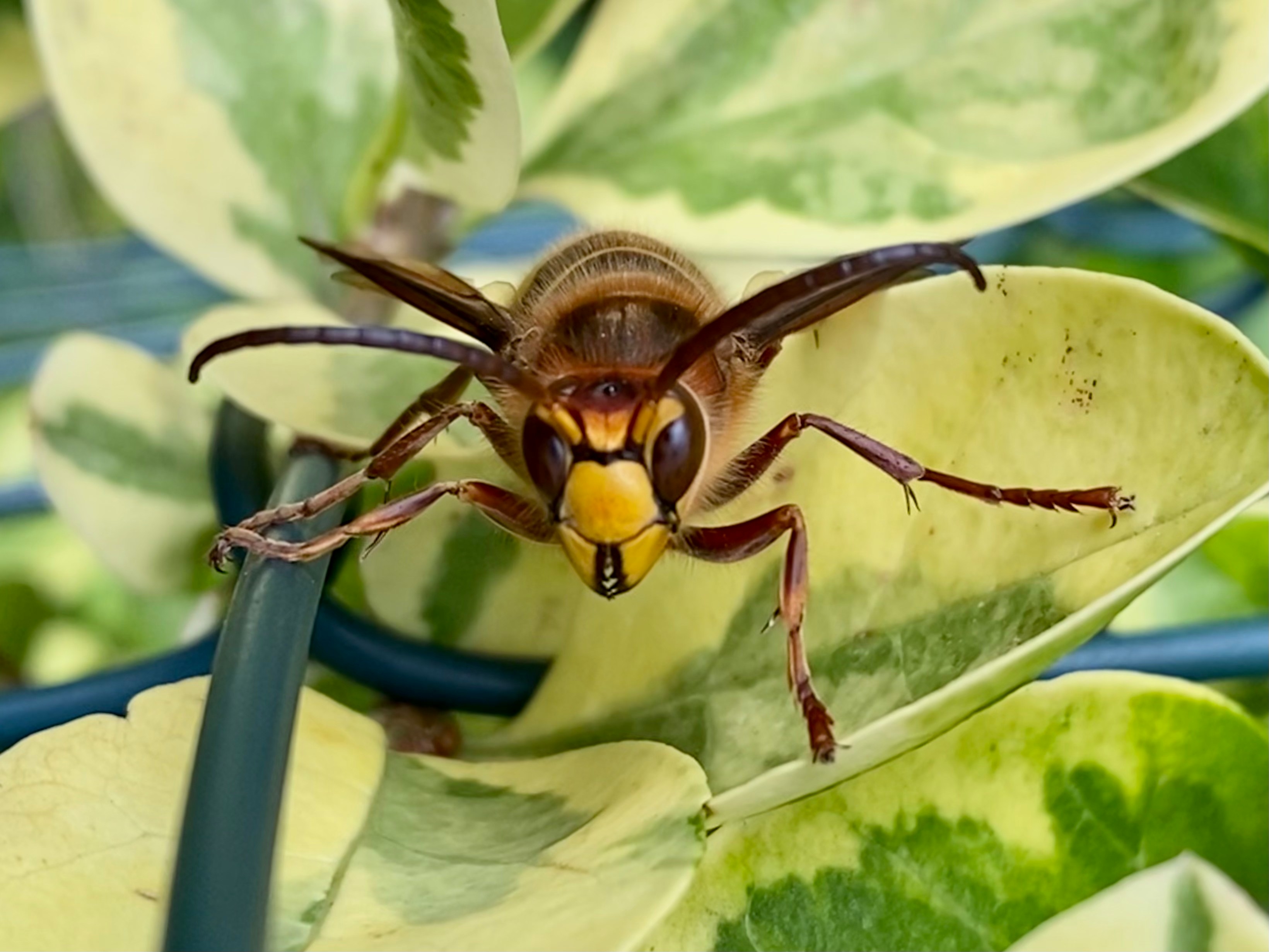
The text message arrived in September 2019. A beekeeper in Nanaimo, on Vancouver Island, British Columbia, had found something dead on his property that he couldn't identify. Two inches long. Orange head. Black and orange striped abdomen. Wings like a fighter jet. He sent a photo to the provincial entomologist.
The entomologist identified it immediately. Vespa mandarinia - the Asian giant hornet. The world's largest hornet species. Native to the temperate and tropical regions of East Asia - Japan, Korea, China, parts of Southeast Asia. Not native to North America. Not supposed to be anywhere near British Columbia. Not supposed to be anywhere in the Western Hemisphere.
The entomologist's response, paraphrased: this is very bad.
The Species
Vespa mandarinia is genuinely enormous by wasp standards. Queens measure 45 to 50 millimeters (roughly 2 inches) in body length. Workers measure 35 to 40 millimeters. The wingspan reaches 75 millimeters (3 inches). The stinger is 6 millimeters long - roughly a quarter of an inch - and injects a potent venom containing cytotoxins and neurotoxins that, in sufficient quantity, can cause tissue necrosis and organ failure.
In its native range in Japan, the species kills an estimated 30 to 50 people per year - more than any other venomous animal in Japan. The fatalities are primarily from anaphylaxis (allergic reaction) and, in cases of multiple stings, from the cumulative toxicity of the venom itself. A single sting from V. mandarinia is extremely painful but rarely lethal to a non-allergic person. Multiple stings - 50 or more - can be fatal even without allergy, due to the volume of venom injected.
But the human sting risk is secondary to the beekeeping concern. What makes the Asian giant hornet a threat to North American beekeeping is its predatory behavior toward honey bee colonies.
The Apiary Project tracks every major threat to US honey bee colonies.
Explore the Issues Hub →The Slaughter Phase
Asian giant hornets are predators of many insects, but they're specialists in raiding social insect nests - particularly honey bee colonies. The attack follows a distinctive pattern that Japanese beekeepers call the "slaughter phase."
A scout hornet discovers a honey bee colony. She marks the entrance with a pheromone - a chemical beacon that recruits other hornets from her nest. Within hours, a raiding party of 15 to 30 hornets arrives at the bee colony.
The hornets don't enter the hive initially. They station themselves at the entrance and decapitate returning foragers - biting off their heads with their massive mandibles. A single hornet can kill a bee roughly every 14 seconds. Thirty hornets working at the entrance can kill the entire forager workforce of a colony - 10,000 to 15,000 bees - in a few hours.
Once the defenders are depleted, the hornets enter the hive. They kill the remaining bees, the brood, and the queen. Then they harvest the bee brood - the protein-rich larvae and pupae - and carry it back to their own nest to feed their developing larvae. The honey is left behind. The hornets want the protein, not the sugar.
A single raid by a group of 30 Asian giant hornets can destroy a full-strength honey bee colony in 90 minutes. The colony doesn't survive. There's no recovery. The population is annihilated.
The Japanese Defense
Japanese honey bees (Apis cerana japonica) have coevolved with Asian giant hornets for millions of years and have developed a remarkable defense: the hot defensive bee ball.
When a scout hornet enters a Japanese bee hive, the workers don't fight it one-on-one (they'd lose). Instead, hundreds of workers mob the hornet, engulfing it in a tight ball of vibrating bees. The bees vibrate their flight muscles to generate heat. The temperature inside the bee ball reaches approximately 47 degrees Celsius (117 degrees Fahrenheit) - just above the lethal temperature for the hornet (46 degrees Celsius) but just below the lethal temperature for the bees (48 to 50 degrees Celsius). The carbon dioxide concentration inside the ball also rises to lethal levels for the hornet.
The hornet dies from hyperthermia and asphyxiation. The bees survive - barely. Some bees on the outside of the ball die from the heat. But the colony survives, and crucially, the scout never returns to recruit a raiding party.
European honey bees (Apis mellifera) - the species kept in North America - did not coevolve with Asian giant hornets. They don't form hot defensive bee balls. Their defensive behavior against large predators - stinging, alarm pheromone recruitment, entrance guarding - is ineffective against hornets that are five times their size and armored with exoskeleton too thick for a bee stinger to penetrate.
A European honey bee colony in North America has no defense against an Asian giant hornet raid. None. The guard bees sting the hornets. The stingers bounce off. The hornets decapitate them. The colony dies.
This is why the detection in British Columbia set off alarms across the North American beekeeping community.
The Timeline
September 2019. Dead specimen found in Nanaimo, BC. Identified as V. mandarinia. First confirmed detection in North America.
November 2019. A full colony of Asian giant hornets is discovered and destroyed in Nanaimo - a nest in the ground containing roughly 200 workers and brood. This confirms that the species is not just present but reproducing in North America.
December 2019. Two dead specimens are found in Whatcom County, Washington - just south of the Canadian border. The first confirmed detections in the United States.
May 2020. The New York Times publishes an article titled "Murder Hornets, With Sting That Can Kill, Land in U.S." The nickname "murder hornet" enters the public consciousness and stays there. Entomologists immediately push back - "murder hornet" is sensationalized and anthropomorphizing, and the species' English common name is Asian giant hornet. The pushback fails. "Murder hornet" is too good a headline.
Summer 2020. State and federal agencies launch detection and eradication efforts in Whatcom County. The Washington State Department of Agriculture (WSDA) sets up a network of thousands of bottle traps - plastic containers baited with orange juice, rice cooking wine, and sugar - across the region. Citizens report "Asian giant hornet sightings" from across the country. The vast majority are misidentifications: European hornets (Vespa crabro), cicada killers (Sphecius speciosus), bald-faced hornets (Dolichovespula maculata), and even hoverflies (Syrphidae) - harmless pollinators that happen to have yellow and black stripes.
October 2020. WSDA scientists track a tagged hornet to a nest in a tree cavity in Blaine, Washington. The tracking method: a worker hornet is captured in a net, fitted with a tiny radio tag (attached with dental floss and super glue to its thorax), released, and followed by researchers with radio receivers. The hornet flies home. The researchers find the nest. The nest is eradicated by vacuuming the hornets out of the cavity at night (when the colony is least active) wearing full protective suits rated for the hornets' stingers.
2021. Additional nests found and destroyed in Whatcom County. The eradication effort intensifies. WSDA and USDA APHIS collaborate on trapping, tracking, and nest destruction.
2022-2023. No new detections in Washington State. The eradication appears to be succeeding. The USDA declares V. mandarinia eradicated from Washington State in 2026, though monitoring continues.
The Entomological Name Change
In 2026, the Entomological Society of America changed the common name of Vespa mandarinia from "Asian giant hornet" to "northern giant hornet." The change followed the ESA's initiative to review common names that reference geographic regions in potentially problematic ways - specifically, concerns that "Asian" as a descriptor for a feared, vilified insect could contribute to anti-Asian sentiment (which surged during the COVID-19 pandemic, concurrent with the "murder hornet" media coverage).
The name change was controversial among entomologists. Some supported it on ethical grounds. Others argued that geographic descriptors are standard in common names (African honey bee, European hornet, Asian lady beetle) and that removing them obscures useful biological and distributional information. The scientific name, Vespa mandarinia, is unchanged.
The Misidentification Problem
The "murder hornet" media frenzy of 2020-2021 created a wave of misidentified insects across the United States. Extension offices in states thousands of miles from Washington - Florida, Georgia, Texas, New York - were flooded with photos of insects that concerned citizens believed were Asian giant hornets.
The misidentifications fell into predictable categories:
European hornets (Vespa crabro). Established in eastern North America since the 1800s. Large (25 to 35 millimeters), brown and yellow. Commonly mistaken for Asian giant hornets by people who had seen media photos but didn't appreciate the size difference.
Cicada killers (Sphecius speciosus). Solitary wasps, 30 to 40 millimeters long, that hunt cicadas. They're large enough to alarm people unfamiliar with them. They're docile toward humans and almost never sting.
Bald-faced hornets (Dolichovespula maculata). Black and white, not orange - but "hornet" in the name triggered reports.
Hoverflies. Harmless flies that mimic bees and wasps. Some people reported them as "baby murder hornets."
The misidentification wave consumed significant resources. State extension offices and USDA staff spent thousands of person-hours responding to reports, examining photos, and explaining that the insect on the porch in Alabama was not an invasive hornet from Japan.
The Actual Threat Assessment
Setting aside the media hysteria, the entomological community's concern about V. mandarinia in North America was genuine and well-founded. An established population of Asian giant hornets in the Pacific Northwest - or anywhere in North America - would pose a serious threat to:
Managed honey bee colonies. Commercial and hobbyist beekeepers in affected areas would face colony losses from hornet raids during the late summer and fall, when hornet colonies are at peak population and actively provisioning for winter. There is no beekeeping management practice that effectively defends against a hornet raid. Screened entrance guards that exclude hornets while admitting bees are used in Japan but haven't been widely tested with North American hive configurations.
Native pollinators. Asian giant hornets prey on many insect species, not just honey bees. Established populations would add predation pressure to native bee populations already stressed by habitat loss, pesticides, and climate change.
Agriculture. Pollination-dependent crops in affected areas would face reduced pollination services if both managed and native bee populations declined due to hornet predation.
Public health. While individual encounters are rarely fatal, an established population in suburban and rural areas would increase the frequency of stings. The species nests in the ground and in tree hollows - locations where humans are likely to encounter them while mowing, hiking, or gardening.
The threat assessment was not hype. It was a legitimate concern about an invasive predator with the potential to disrupt pollination services and beekeeping across the continent. The eradication effort was appropriately aggressive.
The Eradication Success
The eradication of V. mandarinia from Washington State (assuming no further detections) is a rare success story in invasive species management. Most invasive species - once established - are impossible to eradicate. Fire ants, Africanized honey bees, small hive beetles, Varroa mites - all became permanent members of the North American fauna after introduction.
The Asian giant hornet eradication succeeded (provisionally) because of several factors:
Early detection. The species was identified within months of its probable arrival. The Nanaimo detection triggered immediate response.
Small population. The founding population was likely a single mated queen (or a very small number of queens) from a shipping container or other transpacific transport. The population never expanded beyond a localized area in northwestern Washington and southwestern British Columbia.
Biology. Unlike honey bees and fire ants, which reproduce rapidly and disperse widely, giant hornet colonies are annual (they die each winter, with only mated queens surviving to found new colonies in spring). The slow reproductive rate and annual bottleneck made the population vulnerable to targeted nest destruction.
Resources. The WSDA and federal agencies committed significant funding, personnel, and technology to the effort. The tracking technology - tiny radio transmitters on individual hornets - was a novel application of wildlife telemetry techniques to insect management.
Public engagement. Despite the misidentification problem, public awareness meant that real sightings were reported quickly. The thousands of bottle traps deployed by citizens provided a detection network that professional entomologists alone could not have maintained.
The Ongoing Risk
The eradication of the Washington population doesn't eliminate the risk. The pathway that brought V. mandarinia to North America once - likely international shipping through Pacific Rim ports - exists continuously. Container ships, cargo aircraft, and international mail from East Asia arrive daily at ports across the Pacific coast. A mated queen in a container of goods from Japan or China could arrive at any time.
The monitoring infrastructure - trap networks, citizen reporting systems, rapid response protocols - needs to persist indefinitely. The assumption is not that the species has been permanently excluded. The assumption is that it will arrive again, and the question is whether it will be detected and eradicated again before it establishes.
The yellow-legged hornet (Vespa velutina), a smaller but still significant bee predator native to Southeast Asia, was detected in Savannah, Georgia in 2023 - demonstrating that the invasion risk from Asian hornet species is ongoing and not limited to the Pacific coast.
The Lesson
The Asian giant hornet episode in North America was, stripped of the media spectacle, a competent response to a genuine invasive species threat. The entomologists did their job. The agencies funded the response. The citizen science network provided detection capacity. The tracking and eradication methods worked.
What didn't work was the public communication. "Murder hornet" was a media creation that generated panic disproportionate to the actual risk to most Americans (who lived nowhere near the small detection zone in Washington). The panic generated thousands of false reports that consumed response resources. The name change to "northern giant hornet" was an attempt to course-correct, but the "murder hornet" brand was already established.
The hornets themselves, had they been allowed to establish, would have been a serious regional problem for beekeepers and a public health concern. They would not have been the civilization-ending threat that the media coverage implied. They would have been another entry in the long list of invasive species that North American beekeeping has had to absorb and manage - alongside Varroa, small hive beetles, tracheal mites, and Africanized genetics.
The difference: this time, the response was fast enough. The species was caught before it established. The dental floss and the vacuum cleaner beat the world's largest hornet.
For now.