The Bee Proboscis (The Tongue That Isn't Quite a Tongue)
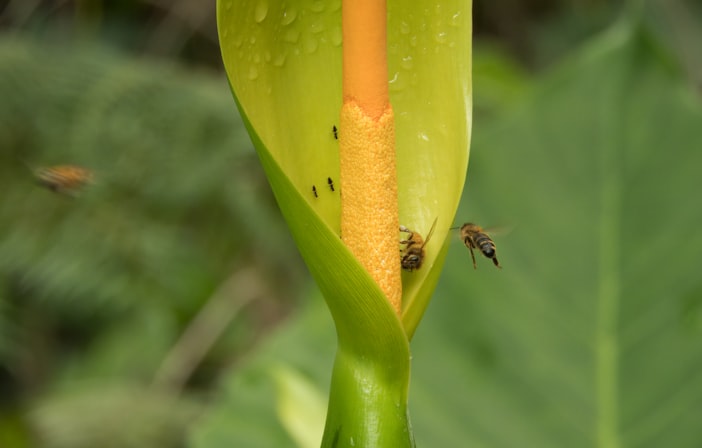
For roughly a century, the accepted explanation for how bees feed was capillary suction. The bee extends her proboscis into the flower's nectary. Capillary action draws nectar up the tube. A pharyngeal pump in the head creates suction. Nectar flows into the honey crop. Simple, plausible, tidy.
In 2026, researchers at Tsinghua University filmed bee feeding at 1,000 frames per second. The footage showed that the accepted model was wrong.
The tongue moves. Not slightly - it moves 13 times per second, driving in and out of the nectar in a rapid lapping motion, the hairs on its surface erecting on the withdrawal stroke to trap fluid through surface tension and viscous adhesion. The bee doesn't hold her tongue still and let capillary physics do the work. She laps. The mechanism is closer to a cat drinking water than to anyone drinking through a straw, and it wasn't correctly described until someone watched it fast enough to see it.
The Hairy Tongue
The glossa - the central tongue structure - is a long, slender, flexible organ covered in rings of fine branching hairs called filopodial papillae. These hairs are hydraulically controlled. When the glossa extends into the nectar, the hairs lie flat against the surface, streamlining it for penetration. When the glossa retracts, hemolymph pressure inside the glossa changes, causing the hairs to erect - standing out from the tongue like bristles on a bottlebrush. The erected hairs trap nectar through surface tension and viscous adhesion. The retraction pulls this nectar into the tube formed by the surrounding mouthparts.
The volume captured per lap depends on the nectar's viscosity, and the relationship is counterintuitive. Thin nectar (low sugar concentration, low viscosity) is captured in smaller volumes per lap because it drains off the hairs faster during retraction. Thick nectar (high sugar concentration, high viscosity) is captured in larger volumes per lap - it clings to the hairs more tenaciously. But thick nectar also slows the lapping rate, because the tongue moves more slowly through viscous fluid.
These two competing effects produce a trade-off curve. Maximum energy intake rate - the amount of sugar captured per second of feeding - peaks at a nectar concentration of roughly 50 to 60 percent sugar by weight. Below that concentration, the nectar flows easily but contains less sugar per unit volume. Above it, each lap captures more sugar but fewer laps per second reduces the rate.
That optimum - 50 to 60 percent sugar - is remarkably close to the nectar concentration produced by the majority of flowers that bees pollinate. The alignment isn't coincidental. The tongue shaped the flower. The flower shaped the tongue. Eighty million years of coevolution: flowers that produced nectar at the concentration bees fed on most efficiently attracted more bee visits, received more pollination, and produced more seeds. Bees whose tongues worked best at the concentration most flowers produced gathered more nectar and had more reproductive success. The system tuned itself to itself.
The Apiary Project tracks honey bee health data so you don't have to.
Explore the Data Hub →The Full Assembly
The glossa is one part of a multi-piece apparatus that unfolds from beneath the bee's head in fractions of a second.
The mandibles - the outer jaws - are used for chewing wax, building comb, biting during combat, and manipulating propolis. They don't participate in nectar feeding at all. The two galeae (from the maxillae) are blade-shaped structures that fold along either side of the glossa; when the proboscis is extended, the galeae interlock with the labial palps to form the food canal - a tube surrounding the tongue through which nectar travels toward the head. The pharyngeal pump, a muscular chamber inside the head, creates suction that draws nectar from the food canal into the esophagus and then into the honey crop.
The entire assembly extends during the final milliseconds before the bee touches the flower - triggered by the detection of floral scent or visual cues. The tongue is already out before landing. The folded-under design of the mouthparts, which makes them invisible when the bee is flying, allows them to deploy in a fraction of a second when they're needed.
Into the Crop
Nectar collected through the proboscis goes into the honey crop - an expandable storage organ in the abdomen that holds roughly 40 milligrams of nectar. The crop is separated from the true stomach by a muscular valve called the proventriculus, which allows the bee to carry nectar for transport without digesting it.
When a forager returns to the hive, she regurgitates the nectar from her crop into the mouth of a house bee, who processes it further - adding enzymes, evaporating water, and eventually depositing the concentrated solution into a comb cell for ripening into honey.
A typical foraging trip: 50 to 1,000 flower visits, 1 to 3 seconds each, gradually filling the 40-milligram crop. The trip takes 30 to 60 minutes total. A full crop adds roughly 40 percent to the bee's body weight, changing her flight dynamics significantly on the return. She flies heavier and slower, burning more fuel, which reduces the net delivery to the hive. At extreme foraging distances beyond about five kilometers, the fuel burned during the return flight approaches the energy content of the nectar carried, making the trip economically marginal.
Proboscis Length and Flower Access
The length of a bee's proboscis determines which flowers are accessible to her. A honey bee's proboscis runs about 6.5 millimeters - long enough to reach nectaries up to roughly 6 millimeters deep. Flowers with deeper nectaries (certain clovers, some salvias, many orchids) are inaccessible to short-tongued bees.
Bumblebees, with proboscis lengths of 8 to 20 millimeters depending on species, access deeper flowers that honey bees can't reach. Honey bees dominate on shallow-nectaried flowers through sheer colonial efficiency - thousands of foragers from one colony, directed by the waggle dance, overwhelming the competition.
Within honey bee subspecies, proboscis length varies enough to matter. The Caucasian bee (Apis mellifera caucasica) has a proboscis roughly 0.5 to 1 millimeter longer than the Italian bee (Apis mellifera ligustica). This gives the Caucasian access to red clover, whose nectary is too deep for most Italian bees. In regions where red clover is a major honey source, Caucasian genetics have been favored for this specific mechanical advantage.
The Taste System
The proboscis is also a sensory organ. The tip of the glossa contains taste receptors that allow the bee to assess sugar concentration and composition of nectar before committing to feed. Additional taste receptors sit on the tarsi - a bee that steps on a sugar solution extends her proboscis reflexively, a response called the proboscis extension reflex (PER).
The PER has been one of the most studied behaviors in insect neuroscience, because it provides a simple, reliable assay for associative learning. A bee is presented with an odor, followed by a sugar reward to the antenna or foot. After one or a few pairings, the bee extends her proboscis in response to the odor alone - she's learned that the odor predicts food. Researchers have used this to study learning, memory, olfactory processing, the effects of pesticides on cognition, and the neural basis of decision-making in insects.
The taste system distinguishes not just sugar concentrations but sugar types. Bees prefer sucrose over glucose and glucose over fructose at equal concentrations. Natural nectars contain varying ratios of these sugars, and bees discriminate between them in real time during feeding, making flower-by-flower decisions about whether the nectar quality justifies the visit.
13 Laps Per Second
The glossa of a honey bee extends and retracts 13 times per second during active feeding. At each cycle, roughly 0.5 to 1 microliter of nectar is trapped by 300 hairs on a tongue 3 millimeters long. The nectar travels up a tube 6.5 millimeters long, driven by the lapping motion and the pharyngeal pump, into a crop that holds 40 microliters. The crop fills in 1 to 3 minutes of active feeding, spread across 50 to 1,000 individual flower visits.
The total nectar volume a single bee collects in her two-to-three-week foraging career - roughly 10 trips per day for 15 days at 40 microliters per trip - is about 6 milliliters. About a teaspoon. Collected one tongue-lap at a time, 13 times per second, from flowers that evolved to match the tongue that evolved to match the flowers.
A teaspoon of nectar becomes about half a teaspoon of honey after water evaporation. One bee, one career, half a teaspoon. A colony produces 60 pounds of honey in a good year because 20,000 foragers are each contributing their half-teaspoon, tongue-lap by tongue-lap, 13 cycles per second, for as long as the flowers bloom and the wings hold together.
The proboscis folds back under the head. The bee flies. She finds another flower. The tongue comes out. Thirteen laps. Retract. Fly. Repeat. Until the forager doesn't come home - and another bee, 21 days old, takes her first orientation flight, learns the landscape, finds a flower, and extends her tongue for the first time.
Same mechanism. Same 13 laps per second. Same hairy straw that isn't a straw, feeding on flowers that were expecting her.