Africanized Bees (What 70 Years of Spread Actually Looks Like)
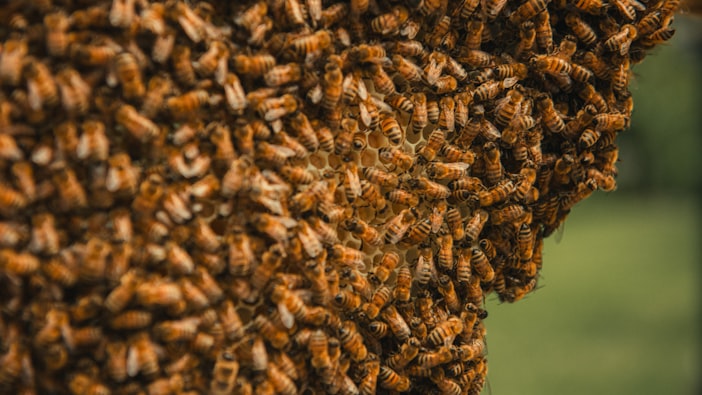
The story of Africanized honey bees begins with a man who wanted to help Brazilian beekeepers and ends with a town in Texas spending $20,000 on a giant bee statue. Everything in between involves a military dictatorship, a tortured nun, Saturday Night Live, a movie so bad it killed a genre, and approximately 1,000 human deaths across two continents. The bees didn't ask to be part of any of this.
The Beekeeper Who Ruined Everything
Warwick Estevam Kerr - born 1922 in Santana do Parnaiba, Brazil, trained under legendary geneticist Theodosius Dobzhansky at Columbia University - had a straightforward plan. European honey bees, the standard managed bee across the Americas, performed poorly in Brazil's tropical climate. They produced less honey, struggled with the heat, and generally failed to thrive in an environment they hadn't evolved for. African bees - specifically Apis mellifera scutellata from sub-Saharan Africa - were excellent tropical honey producers. Kerr's idea: bring African queens to Brazil, crossbreed them with the existing European stock, and produce a hybrid that combined African productivity with European gentleness.
In 1956, Kerr traveled to South Africa and acquired 63 live queen bees. He brought them to a quarantine area at an agricultural research station near Rio Claro, Brazil. Forty-eight queens survived the trip. Through natural attrition, the stock was reduced to 29 colonies maintained in hive boxes fitted with queen excluders - wire mesh devices that let workers pass but keep the larger queen confined, preventing swarming.
In October 1957, a local beekeeper visited the research station. He saw the queen excluders on the hives. He apparently interpreted them as accidental obstructions - something that didn't belong. He removed them.
Twenty-six Africanized queen swarms flew into the Brazilian forest.
Kerr hoped the escaped bees would die or mate with European drones and lose their African characteristics. They did not die. They did not lose their characteristics. Within a few years, reports of extraordinarily aggressive wild bees attacking livestock and people began arriving from an expanding radius around Rio Claro. The bees were breeding. They were spreading. And they were doing it at a rate that nobody had predicted.
The Apiary Project tracks honey bee health data so you don't have to.
Explore the Data Hub →The Scientist and the Dictatorship
The story of Warwick Kerr after the release is the part that rarely gets told, and it matters for understanding why the "killer bee" narrative took the shape it did.
Kerr was a self-declared socialist in a country that was, in 1964, seized by a military dictatorship. He was imprisoned that year for his political activities. In 1969, he was imprisoned again - this time for publicly protesting that soldiers who had raped and tortured Sister Maurina Borges, a nun who ran the Ribeirao Preto Orphanage, had gone unpunished. Kerr was, at that point, the president of the Brazilian Society for the Advancement of Science.
The military couldn't kill him. His international reputation as the first Brazilian scientist elected to the US National Academy of Sciences (1990) made him too visible. So they set about destroying his reputation instead. The narrative that Kerr had recklessly "created assassin bees" served the dictatorship's purposes perfectly: it discredited a political dissident while deflecting attention from the government's own failures.
The irony is this: after the African bees spread across Brazil, the country rose from 43rd to 7th largest honey producer in the world, producing 110 million pounds of honey. Kerr's experiment succeeded at its stated goal. Brazil's beekeeping industry transformed. The bees were excellent honey producers in the tropics. They were just also, as it turned out, extraordinarily defensive.
200 Miles Per Year
The spread was relentless.
Africanized bees expanded through South and Central America at 200-300 miles per year. At peak expansion, the front moved nearly a mile per day. The mechanisms driving the spread weren't just swarming - they were a suite of reproductive advantages that compounded with each generation.
African colonies swarm 10-16 times per year, compared to 1-6 times for European colonies. Each swarm is smaller, but the volume of propagation overwhelms the per-swarm difference. They abscond more readily - abandoning hives entirely during food shortages or disturbances, something European bees almost never do. Their drones outcompete European drones for virgin queens during mating flights: African colonies produce more drones, produce them year-round, and replace older drones with younger ones continuously. Queens and workers develop faster, so African-genotype queens emerge from their cells before European-genotype queens in the same colony.
The result is a genetic ratchet. With each queen replacement cycle, virgin queens disproportionately mate with African drones. African nuclear DNA introgression into European colonies compounds generation after generation. The bees don't invade like an army. They infiltrate like a gene pool.
The timeline reads like a dispatch from an advancing front:
- 1957: 26 swarms escape in Rio Claro, Brazil
- 1960s: Rapid expansion through Brazil. Between 1975 and 1988, 350 human deaths in Venezuela alone
- 1986: Arrived in Mexico
- October 15, 1990: First Africanized swarm detected in the United States - Hidalgo, Texas
- 1993: Arizona
- 1994: Puerto Rico (first oceanic island)
- 1995: California
- 2005: Confirmed east of the Mississippi, established in Florida
The town of Hidalgo, Texas responded to its status as ground zero for the American arrival by spending $20,000 on a giant killer bee statue and declaring itself the "Killer Bee Capital of the World." This is, to date, the single most economically rational response any municipality has had to an invasive species.
The Numbers That Matter
The behavioral differences between Africanized and European honey bees are not subtle. They are measurably, dramatically different by every metric researchers have devised.
Guard bee deployment: European colonies send 10-20 guard bees to investigate a disturbance. Africanized colonies send hundreds. Africanized guards are seven times more likely to leave the hive and sting.
Sting frequency: Africanized bees sting 4-10 times more frequently than European bees given identical stimuli. Brazilian studies measured scutellata-hybrid colonies delivering up to 8.5 times more stings than European colonies within the first 90 seconds of disturbance.
Pursuit distance: European bees defend a roughly 50-meter perimeter around the hive. Africanized bees pursue threats for 500 meters or more. In maximum defensive responses, soldiers attack intruders 100-plus meters from the nest and pursue for several kilometers.
Colony mobilization: approximately 10% of workers in a European colony participate in a maximum defensive event. Up to 50% of Africanized workers may pursue and sting. In a colony of 40,000 bees, that's the difference between 4,000 angry bees and 20,000 angry bees.
Recovery time: European bees calm down in 20-60 minutes after a disturbance. Africanized bees may remain agitated for up to 24 hours. A beekeeper who disturbs an Africanized colony in the afternoon may find it still aggressive the following morning.
The venom itself is identical between the two. Drop for drop, an Africanized sting delivers the same toxin as a European sting. Both bees lose their stinger and die after stinging. The danger is exclusively volume. One sting from an Africanized bee is medically indistinguishable from one sting from a European bee. The difference is that the Africanized colony sends 20,000 stinging bees instead of 4,000, pursues you for half a kilometer instead of 50 meters, and stays angry until tomorrow.
The Hollywood Version
The 1970s media response to Africanized bees was, to use a clinical term, hysterical.
Irwin Allen - the disaster film producer behind The Poseidon Adventure and The Towering Inferno - produced The Swarm in 1978, a big-budget thriller about killer bees attacking America. The film starred Michael Caine. It had a massive budget. It grossed $11.5 million. It currently holds a 9% rating on Rotten Tomatoes. It has been named one of the "100 Most Enjoyably Bad Movies Ever Made." Its failure effectively killed the 1970s disaster film genre and contributed to ending Allen's career.
The best part: Saturday Night Live's recurring "killer bee" sketches - featuring cast members in bee costumes performing increasingly absurd scenarios - had so effectively deflated public panic about Africanized bees that by the time The Swarm reached theaters, audiences found the premise more funny than frightening. SNL parodied the killer bee hysteria into absurdity before the movie could capitalize on it.
Other entries in the cinematic killer bee genre include Killer Bees (1974), The Bees (1978), and Killer Bees (2002). None of them are good. None of them are scientifically accurate. All of them depict bees as coordinated attack organisms pursuing strategic military objectives, which is not how bees work but is apparently how screenwriters think bees work.
The Actual Death Toll
The real numbers are serious but different from what the movies implied.
In Latin America: approximately 1,000 human deaths since the 1956 introduction. Venezuela accounted for 350 of those between 1975 and 1988. Brazil's numbers have escalated: from 1,440 reported envenomation cases and 3 deaths in 2000 to 35,590 cases and 268 fatalities in 2023 - a tenfold increase in cases and a dramatic increase in deaths over two decades.
In the United States: between 8 and 24 confirmed AHB-related fatalities since 1990, depending on the source and reporting period. Notable incidents include a farmer in Waco, Texas killed in 2013 after being stung an estimated 1,000 times by a colony of approximately 40,000 Africanized bees.
For context: the CDC documented 1,109 total deaths from hornet, wasp, and bee stings in the US between 2000 and 2017 - an average of roughly 62-72 per year. Africanized bee deaths represent a small fraction of that total. Lightning kills more Americans annually than Africanized bees have killed in 30 years.
The danger is real but localized. A person who stumbles into an Africanized colony faces a genuine medical emergency - hundreds or thousands of stings can cause massive envenomation, kidney failure, and death even in individuals without bee allergies. But the probability of encountering an aggressive Africanized colony is low, the geographic range in the US is limited to southern states, and the vast majority of bee stings in America still come from European honey bees and yellowjackets.
The Puerto Rico Experiment
And then there's the part of the story that nobody expected.
Africanized bees arrived in Puerto Rico in 1994. Within roughly a decade, they evolved to be as gentle as European bees. This has happened nowhere else on Earth.
Tugrul Giray at the University of Puerto Rico documented it in Evolutionary Applications in 2012. In two separate behavioral assays evaluating defensive response, Puerto Rican Africanized bees showed low defensiveness similar to European bees. They retained other Africanized traits - wing size, varroa mite resistance - but the aggression was gone.
The explanation is natural selection operating on a crowded island. Puerto Rico is densely populated. There is nowhere for bees to exist without encountering humans. The most aggressive colonies were almost certainly destroyed by people who didn't tolerate being attacked. Gentle colonies survived. Over a few generations, the selection pressure for docility was intense enough to shift the entire population's behavior.
A 2017 genomic study from the University of Illinois confirmed it at the DNA level: specific genomic regions had shifted toward European heritage, and those regions showed signs of positive selection. Evolution had edited the aggression out of the genome, on an island, in under a decade.
Puerto Rico's Africanized bees are the one place where the "killer bee" narrative inverted. The same genetics that produce 24-hour defensive fury on the South American mainland produce gentle, manageable colonies on a Caribbean island - because on the island, being aggressive was a death sentence administered by the dominant predator: humans.
The Varroa Silver Lining
Africanized bees maintain varroa mite infestation levels below 5% on adult bees without any chemical treatment. European bees, without treatment, face colony collapse from varroa within 1-2 years.
The resistance mechanisms are multiple and impressive. Puerto Rican Africanized bees remove 100% of attached varroa mites through grooming behavior - compared to slightly less than half for European bees. Resistant Africanized colonies remove 38% of mite-infested brood, versus 22% in susceptible European colonies. And the mites themselves fare worse: only 40% of mother mites produce viable offspring in Africanized colonies, compared to 75% in European colonies.
In Brazil, the original Japan/Thailand varroa haplotype has been replaced by the more virulent Korean haplotype - which has higher mite fertility. Despite this escalation in the parasite's reproductive ability, Africanized bee infestation levels remain low. The resistance is robust enough to withstand a more aggressive mite.
This creates a genuine dilemma for beekeeping. The genetics that confer the best varroa resistance in the Western Hemisphere are the same genetics that confer extreme defensiveness. The traits beekeepers desperately want - mite resistance, tropical productivity, hardiness - come packaged with the traits they absolutely cannot manage in populated areas. Separating one from the other is the ongoing challenge of bee breeding programs, and Puerto Rico's natural experiment suggests it may be possible, but only under selection pressures that take a decade and a captive population to achieve.
The Current Map
Africanized bees are established in Texas, California, New Mexico, Arizona, Oklahoma, Louisiana, Arkansas, and Florida. In California, the northernmost detected African mitotypes sit approximately 40 km south of Sacramento. Climate appears to be the primary barrier to further northward expansion - the bees are adapted for tropical and subtropical conditions and don't survive prolonged cold well.
Climate change may be shifting that barrier. As average temperatures warm and frost-free seasons lengthen, the range of viable Africanized bee habitat expands northward. The interaction between a warming climate and an expanding invasive genotype is another variable in an already complicated beekeeping landscape.
Commercial beekeepers in Africanized zones have adapted primarily through annual requeening - replacing queens with purchased European-stock queens to maintain gentle genetics in managed colonies. It's an ongoing cost and an ongoing arms race: every time a colony requeens naturally (through swarming or supersedure), the new virgin queen mates with whatever drones are flying, and in Africanized zones, many of those drones carry African genetics.
The beekeeper replaces the queen. The colony requeens itself. The beekeeper replaces again. It's not a solution. It's a holding pattern, maintained with purchased queens and vigilance.
Twenty-six swarms escaped in 1957. A local beekeeper removed some wire mesh he didn't understand. The scientist who brought the bees was imprisoned for defending a nun. The bees crossed two continents. Saturday Night Live made the whole thing funny. A town in Texas built a statue. And on a crowded Caribbean island, the killer bees quietly became gentle - because evolution doesn't care about narratives, only about what survives.